
Difference Between Organizing and Staffing
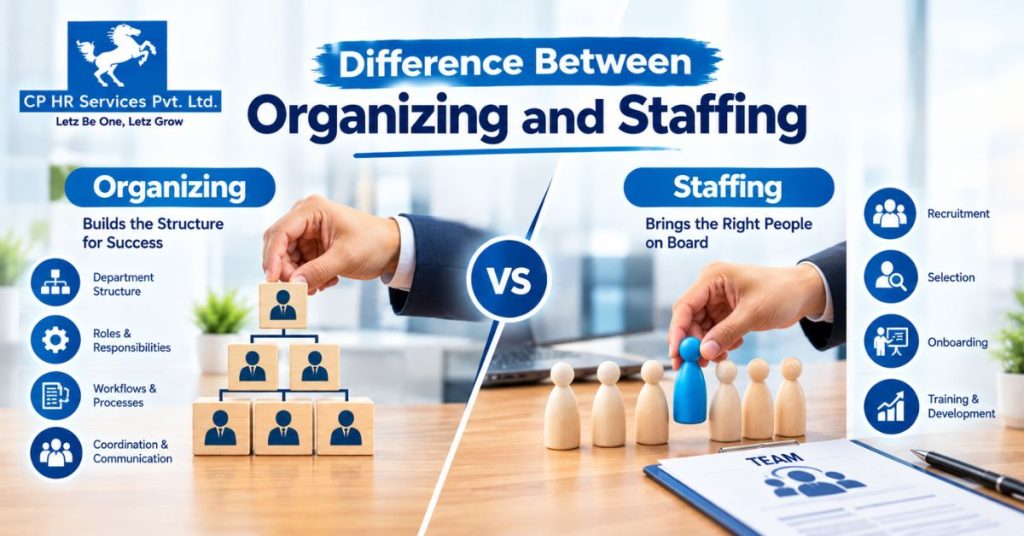
Sooner or later, every manager hits the same wall. The work grows, the team grows, and no one knows who owns what, and which seats are still empty. Two management functions handle those problems, and people always mix them up. This guide resolves organising vs. staffing in layman’s terms. You will see what each does, where it fits in the management cycle, and how to use both without tripping over either. The Short Answer: Difference Between Organising and Staffing An organisation designs the structure of a company. It establishes the tasks, who reports to whom, and where each role belongs. Staffing is the process of putting people into that structure. It finds, trains, selects, and keeps the employees who fill those positions. Here is the difference in one line: Where Organising and Staffing Fit in the Management Cycle Management textbooks break down the work of a manager into functions. According to OpenStax, the four main functions are planning, organising, leading, and controlling. In the same model, organising is the step that structures work and allocates resources. Where are the dudes? Some textbooks put it under organising or leading, because that four-function model doesn’t list it as a separate function. In many Indian business studies courses, it is treated as a separate function. “Staffing is the managerial function of filling and keeping filled the positions in an organisation structure,” reads a Class XII handout on the aees.gov.in website. That order remains in either case. You plan the work, you design the structure, you fill it in. What Is the Organising Function of Management? Organise goals into a working structure. Planning sets the targets, then a manager asks how to split the work up so people can hit them. The outcome is an organisational structure – a clear picture of roles, authority and reporting lines. What Organising Includes Common Organisational Structures Organising in Action Think about a logistics startup of 40 people. The founder divides the company into dispatch, warehouse, customer support and finance. She writes a short description of what each lead does and makes decisions about reporting lines. She hasn’t hired a single new person yet. That’s organizing. This case is an example, not a real company.” What Is the Staffing Function of Management? Staffing is putting the right people into the positions that the organisation created. It also keeps them filled over time because people leave, grow, and change jobs. We can take it one step at a time. The Staffing Process Who Handles Staffing Line managers know the requirements of a role. The process is normally run by HR teams. And some companies also work with outside partners. CP HR Services, a Pune-based HR firm operational since 2006, offers distinct hiring solutions covering recruitment, background verification, and hiring assessments on its website. Those three steps are a good fit for the recruit and select stages above. Organising vs Staffing: Side-by-Side Comparison Factor Organising Staffing Main focus Roles, authority, and reporting lines People who fill those roles Core question What work exists, and how does it connect? Who is right for each seat? Output Structure chart, role descriptions Hired, trained, and placed employees Timing Comes right after planning Comes after the structure is set Who leads it? Top and middle managers Line managers with HR support Time horizon Reviewed when strategy or size changes Runs all year, since people come and go Tools Org charts, job descriptions, workflows Job ads, tests, interviews, training plans Sign of failure Confusion over who decides what Empty seats or poor fit in the seats How Organising and Staffing Work Together Imagine organising as the blueprint and staffing as the construction crew. A strong blueprint without a crew is an empty building. A planless crew leaves you with a mess. Look out for these warning signs: Staffing choices also affect how long your structure remains stable. An ATD article in TD Magazine notes that employees in organisations with high internal mobility stay about 5.5 years, while employees in organisations with low mobility stay just under three years. The longer your structure sits, the fewer vacancies you will have. Hiring externally is also expensive. Wharton’s study of an investment banking environment found that outsiders need about two years to get up to speed. That is one industry, so take it as a warning and not a rule. It still demonstrates that staffing decisions deserve as much thought as the structure. Common Mistakes to Avoid And here’s why so many companies fail: Steps to Apply for Organising and Staffing in a Growing Business Next time you grow your team, use this order: Smaller firms that don’t have a full HR team need ready-made documents for steps four and seven. CP HR Services offers HR consulting services including formats, handbooks and SOPs with on-demand HR support. Next Steps Staffing and organising work in pairs. One draws the structure, one fills it in. First, build the structure, then hire against it, and as your business evolves, review both. See also the CP HR Services blog for related reading, such as how to help new employees settle in on day one. FAQs on Organising vs Staffing What is the difference between organising and staffing? Organising is the process of building the structure of a business, defining roles, authority, and reporting lines. Staffing is the process of filling the structure with the right people through recruitment, selection, training, and appraisal. Organising decides what seats there are. Staffing decides who sits in them. Which comes first, organising or staffing? First comes organising. You can’t tell who fits until you have a clear structure and defined roles. Then staffing fills those roles and keeps them filled as people leave, grow or move to new positions. Is staffing part of human resource management? “Yes.” Staffing is a part of human resource management. The staffing function is concerned with recruitment, selection, training, appraisal, and development of people. Line managers are still involved because they know what each role requires and who does it
Internal and External Sources of Recruitment: Know the Difference
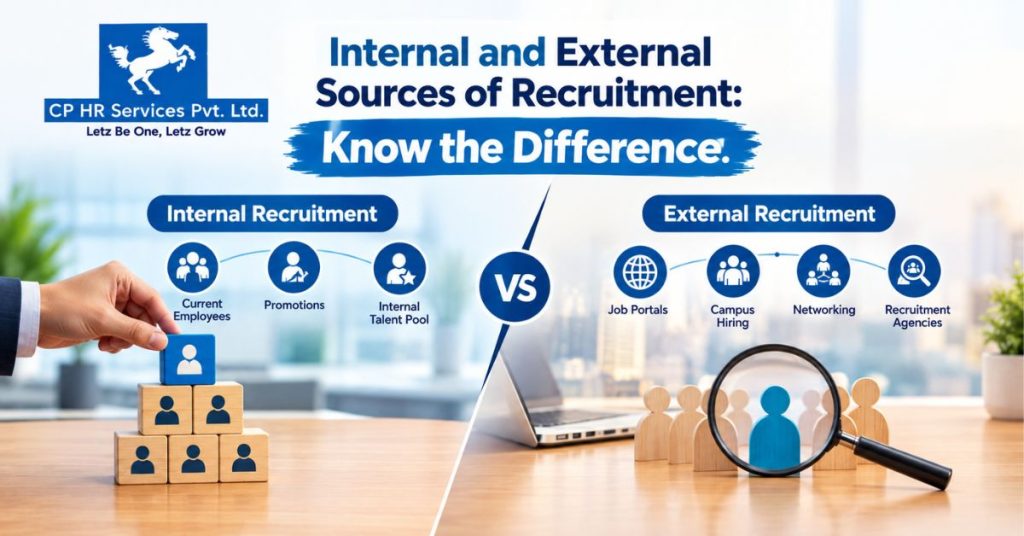
You have an open slot and a quick turnaround. Do you look inside your own team? Or do you just post the job and see who shows up? This choice is central to internal versus external sources of recruitment. Both paths work, and both have trade-offs in cost, speed, and risk. Let’s break it down so you can pick the right path for your next vacancy. The Short Answer Internal sources fill a vacancy with people already working for your company. It is filled with candidates from outside the company by external sources. Internal hiring is typically cheaper and quicker. External hiring brings in new skills and a wider talent pool. Most growing companies use both, varying by role. What Are Sources of Recruitment in HR? A source of recruitment is any location or channel from which you find candidates for a job. HR teams then tag these sources into two buckets based on one question – is the candidate already working for you? That answer will inform your budget, timeline, and even how your current team feels about the opening. So it pays to know both groups before you write the job post. Internal Sources of Recruitment Internal sources of recruitment are the talent you already have on board. They know you, and you know them. They know your products, your managers, and your habits. That’s what it looks like in real hiring. Common Internal Hiring Methods Advantages of Internal Hiring The retention point is supported by research. According to an ATD article in TD Magazine, employees at organisations with high internal mobility stay about 5.5 years, versus slightly under three years at organisations with low internal mobility. According to SHRM, LinkedIn data shows that employees who move around within a company are also more likely to stick around. Disadvantages of Internal Hiring External Sources of Recruitment External sources of recruitment are those that reach out to people outside your company. This group reaches more channels than the internal group and is still growing as hiring goes online. Common External Hiring Channels Advantages of External Hiring Disadvantages of External Hiring Internal vs External Sources of Recruitment: Side-by-Side Comparison Factor Internal sources External sources Candidate pool Current employees only Anyone in the job market Cost Usually lower Usually higher Speed Faster Slower Ramp-up time Short Longer Fresh ideas Fewer More Risk of a bad hire Lower, since you know the person Higher, since you know less Effect on morale Boosts it Can bruise it if staff feel ignored Best for Next-step and leadership roles New skills, fast growth, entry-level volume What the Research Says About Internal and External Hires Here’s why this decision should be revisited. Matthew Bidwell, a Wharton professor, looked at the question in an investment banking context. He found that outside hires received much lower performance ratings in the first two years than employees who were promoted or transferred into similar roles and said it takes about two years for outsiders to catch up. New hires from outside also earned much more than staff members promoted from within for similar jobs. That’s a straightforward tradeoff. You pay more for an outsider and wait longer for the complete results. Cost works the same way. According to LinkedIn’s talent development team, hiring a new employee costs about 2.5 times more than reskilling an existing one. Be careful. That’s one industry the Wharton study looked at, so consider it a cautionary tale, not a rule. The figures are also based on large company data sets, and your own figures may differ. Leverage the research to ask better questions, then look at your own hiring data. A Quick Scenario Take the example of a midsize manufacturer looking for a new production supervisor. A senior machine operator has 3 years with the firm and knows every line and has trained 2 juniors. Bringing that person in from within costs next to nothing, and the trust of the team is already there. Then the company needs a new operator, a position that is easier to fill from outside. Now reverse the roles. The same manufacturer wants a quality systems lead to bring in a certification that no one on the staff has ever worked with. There is no internal candidate. This time around, the smart move is to go outside. This is a simple illustration of the pattern. But the role determines the source. How to Choose Between Internal and External Hiring This is what you need to do for each new opening: When Internal Hiring Wins When External Hiring Wins Vet Every Hire, Whatever the Source “Because there are more unknowns with outside candidates, checking is even more important.” CP HR Services, a Pune-based HR company that has been in business since 2006, lists recruitment, background verification, and hiring assessments as separate hiring solutions on its website. This division makes sense. Hiring a candidate and confirming a candidate are two different jobs. Care must be taken with internal moves too. A long-time employee who moves to a finance or security position still needs a reasonable assessment of the requirements of the new role. Tips to Make Either Route Work Next Steps No path wins all the time. Internal hiring saves your budget and retains good people. External hiring brings in skills you don’t have. Pair the source to the role, track what each costs you, and look over the numbers after each hire. To learn more, visit the CP HR Services blog for topics such as helping new employees get settled on their first day. FAQs on Internal vs External Sources of Recruitment What is the main difference between internal and external sources of recruitment? Internal sources fill a vacancy by using your current employees through transfers, promotions, and internal postings. It is filled from outside the company through external sources like job portals, agencies, campus drives, and social media. Internal hiring is usually cheaper. External hiring gives you more choice. Are employee referrals an internal or external source of recruitment?
What Is External Sources of Recruitment in HRM

All hiring plans start with one question: where do the candidates come from? Sometimes the answer is inside your company. And often it doesn’t. Recruitment in HRM: External Sources – An Overview of the Main Sources, Pros and Cons, and Matching a Source to a Role. It also offers insights into how Indian employers can use public tools and screen outside hires. Let’s break it down. Just a quick note on sources. I used open university textbooks, Government of India records, recruiting blogs, and public pages of an HR firm. I obtained them on October 9, 2026. The textbooks use different terms. I note the differences below. What Are External Sources of Recruitment in HRM? External recruitment is the filling of a vacancy from outside your organisation. An open textbook on recruitment defines it as ‘searching outside the organisation for candidates’ and ‘enlarging the size of the talent pool’. External sources are the channels through which you get those outside candidates. Here are the most popular: One recruiting blog puts the idea succinctly: External recruiting draws on talent outside your organisation through job postings, agencies, campus hiring, social media and direct outreach to passive candidates. Passive candidates are people who are employed and not actively seeking employment. Internal vs. External Recruitment Employers rarely take one road for good. One chapter in a textbook said that a recruiting plan must specify whether candidates will come from inside, outside, or both. It also says the right choice depends on the labour market, the availability of internal talent, the budget and the company’s goals. Internal recruitment External recruitment Candidate pool Current employees People outside the company Typical sources Internal job postings, promotions, transfers Job portals, agencies, campuses, social media Cost and speed Usually lower and faster Usually higher and slower New skills and ideas Limited to what you already have Wider pool, new viewpoints Risk Smaller pool, possible gaps Unknown candidate, longer settling in Some organisations have already taken the decision. The same textbook notes that some organisations have no real choice, such as the military, which goes internal, or a small business, which goes external. Types of External Sources of Recruitment Now, to the channels themselves. They fit different roles and budgets. Job Portals and Company Career Pages Job boards cast the widest net. One recruiting blog reports that job boards generate about 90 per cent of applicants, and employee referrals generate 38 per cent of hires. “Those numbers are indicative, based on vendor analysis,” he said. The pattern, however, is plain. “Portals bring volume, and you’ve got to screen it yet.” Recruitment Agencies and Executive Search Many employers will outsource the search to an outside firm. Outside firms that do the searching are, in textbook language, external recruiters. Executive recruiters specialise in senior roles, and staffing companies provide temporary jobs. For a top-level position, a textbook suggests that the best way to find the right person might be to use an outside head-hunting firm. Campus Recruitment Campus drives are good for entry-level jobs. The textbook says that while campus recruiting can be effective for entry-level positions, it takes real effort to build relationships with colleges. Schedule visits early, as placement calendars fill quickly. Social Media Recruiting Social platforms position your vacancy in front of people where they’re already hanging out. “Social media is a popular recruiting method,” a textbook states. “Advertising on social networking websites may be the best strategy for an entry-level position. It also allows you to contact passive candidates directly. Job Fairs and Events Job fairs gather a lot of candidates in one room. Some companies have their own job fairs, while others go to industry or job-specific fairs to find specific people, says the textbook. Fairs allow for quick screening, but staff time adds up. Government Employment Services The public option is in India. The Ministry of Labour and Employment converted the 978 employment exchanges into career centres and launched the National Career Service (NCS) portal on 20 July 2015. Employers sign up with a Labour Identification Number and post vacancies on the portal. As of 15 November 2024, more than 3.53 crore vacancies have been posted, and more than 36.23 lakh employers have registered, the ministry informed Parliament. The legal context matters too. The NCS is supported by the Employment Exchanges (Compulsory Notification of Vacancies) Act, 1959, to the extent applicable. Is your establishment covered by the Act? Check with your legal adviser. Employee Referrals Referrals are in a grey area. Some sources classify them as internal recruitment, as a current employee makes the introduction. Others classify them as external recruitment because the candidate is from outside. Referrals are a great way to drum up interest in a posted role, and employers will typically give the referring employee an incentive, a textbook says. Regardless of the label you use, referred candidates still need the same screening as everyone else. How to Choose the Right External Source Match source to position. This fit guide uses points from the above textbooks: Role Source that often fits Why? Senior or executive role Executive search or head-hunting Outside firms can recruit for high-level positions. Entry-level role Campus drives, social media Campus recruiting can be effective for entry-level jobs. Temporary role Staffing firm Temporary positions may use a staffing firm. Hard-to-find skill Agency, direct outreach Reaches passive candidates Large volume Job portals, NCS, job fairs Wide reach at a lower cost per applicant Do some labour market research before you sign up. The textbook warns that recruiting from outside necessitates understanding the labour market and that talent availability varies widely by field. A source that works in one sector can fail in another sector. Advantages of External Recruitment A SAGE textbook summarises these benefits of external hiring: Disadvantages of External Recruitment The same summary lists the costs: That’s the last reason why screening is so important for external hires. How to Measure Which Source Works Don’t guess which channel is the best. Results to follow. One textbook suggests comparing the
What Is Security Background Check for Federal Employees

Getting selected for a government job in India is not the final step. Before an appointment letter becomes official, most candidates go through a security background check, formally known as Character and Antecedent Verification (CAV). This process exists to confirm that the person joining government service is who they claim to be, and that nothing in their history raises concern for a role that carries public trust. This guide explains what a security background check for government employees actually involves, who needs one, how the process works, and what happens if something does not check out. What Is Character and Antecedent Verification? Character and Antecedent Verification is the official process the Indian government uses to confirm a candidate’s identity, conduct, and background before appointment to a government post. It applies to officials recommended through recruiting bodies like the Union Public Service Commission (UPSC) and the Staff Selection Commission (SSC), as well as appointments across ministries, departments, and public sector organizations. According to a 2016 Office Memorandum from the Department of Personnel and Training (DoPT), the process requires selected candidates to complete an attestation form, which is then sent to the police stations covering the addresses the candidate has lived at, so authorities can verify the details before a final appointment order is issued. In short, it is India’s version of a security clearance check, built around police verification and a formal attestation process rather than the centralized federal systems used in some other countries. Who Needs This Verification? Security background checks apply broadly across government roles, though the depth of scrutiny varies by position. Categories typically covered include: Roles involving access to sensitive information, financial systems, law enforcement, or national security generally face a more detailed verification process than administrative or clerical positions. How the Security Background Check Process Works Step 1: The Candidate Submits an Attestation Form Once a candidate is recommended for appointment, they fill out a detailed attestation form. This form asks for personal details, addresses over a defined period (typically the last five years), educational background, and a self-declaration about any criminal cases, arrests, or convictions. Step 2: The Appointing Authority Forwards the Form to Police Verification The appointing department sends the completed form to the police stations associated with the candidate’s listed addresses. Local police then verify the candidate’s identity, conduct, and any record of criminal involvement. Step 3: Police Conduct Local Inquiries Verification officers may check local records, speak with neighbors or community contacts, and confirm the candidate’s residential history. This step is meant to catch anything a document search alone might miss. Step 4: The Report Is Sent Back to the Appointing Authority Once police verification is complete, the report goes back to the department that requested it. Under standard guidelines, this process is expected to be completed within a set period, though in practice, timelines can extend depending on the state and workload of the local police department. Step 5: Final Appointment Confirmation If the verification comes back clear, the appointment is confirmed. Many candidates already join on a provisional basis while verification is pending, with final confirmation dependent on a satisfactory report. Some departments allow up to six months for this process to complete, with escalation procedures if it runs longer. What Information Does the Attestation Form Cover? A typical attestation form used in this process asks for: Candidates are legally required to disclose this information accurately. Providing false information on the attestation form is itself treated as a serious issue and can lead to termination even after an appointment has been confirmed. Additional Checks for Sensitive and Defense-Related Roles For positions involving national security, law enforcement, or classified information, verification goes beyond a standard police check. This can include more detailed background inquiries, closer scrutiny of family and associate connections, and additional clearances specific to the department involved. Ex-servicemen re-employed within a year of discharge often go through a simplified process, relying on their service discharge records and prior military verification instead of starting the process from scratch. What Happens If Discrepancies Are Found? If a security background check reveals inaccurate information, an undisclosed criminal case, or other significant concerns, the outcome depends on the nature of the discrepancy and the department’s policy. Possible outcomes include: Departments generally treat non-disclosure of a criminal case more seriously than the case itself, since it points to a failure of honesty on the attestation form. How This Differs from Private Sector Background Checks Security background checks for government roles differ from the background verification most private employers use. Government verification is built specifically around police records, addresses, and formal attestation, with legal weight behind any false declaration. Private sector background checks, by comparison, typically focus on education verification, employment history, identity documents, and sometimes criminal record checks through licensed verification agencies, without the same centralized police involvement. Both processes share the same underlying goal: confirming that what a candidate claims about themselves holds up before they are trusted with a role, whether that role involves public service or private employment. Why Government Roles Require This Extra Layer of Scrutiny It helps to understand why this process exists at all, beyond simply being a bureaucratic formality. Government employees, even in administrative roles, often handle public funds, citizen data, or decisions that affect people’s lives directly. A police clerk, a revenue officer, or a customs official all hold a level of public trust that a private sector role does not always carry in the same way. This is also why the process leans so heavily on police verification rather than a private database search. Police stations have local knowledge, criminal records, and community context that a centralized database search alone cannot replicate. It is a slower process by design, built for thoroughness rather than speed. Tips for Candidates Going Through This Process If you have been selected for a government role and are waiting on your security background check, a few things can help the process move smoothly: How This Process Has Evolved The
10 Non-Monetary Incentives to Boost Employee Satisfaction in 2027

According to Gallup’s State of the Global Workplace 2026 report, global employee engagement fell to its lowest point since 2020 at 20% in 2025. South Asia experienced the steepest regional decline of any region, falling five percentage points in one year. Gallup estimates that this disengagement costs about $10 trillion in lost productivity globally. Pay rises alone will not fix this problem. Money matters, but it’s not the lever most companies can pull enough, and it’s rarely the reason people are quietly quitting at work. Non-monetary incentives—the things that make people feel recognised, trusted, and invested in—will tend to move engagement faster than another round of raises ever could. Here are 10 non-monetary incentives that you should consider adding to your 2027 people strategy (and why they work). What Are Non-Monetary Incentives? Non-monetary incentives are recognition and reward efforts that, while not directly adding to an employee’s pay cheque, still motivate and engage them. This includes things like public recognition, flexible schedules, learning opportunities, and meaningful autonomy in how work gets done. They work differently than raises or bonuses. The lure of monetary rewards usually creates a brief surge of motivation that soon dissipates. Non-monetary incentives, when done well, create a more resilient sense of being valued that lasts longer and costs a lot less to maintain. 1. Public Recognition and Appreciation A simple, specific acknowledgement, in a team meeting, company newsletter, or a direct message from leadership, costs almost nothing and has an outsized impact on morale. The keyword is precision. “Great work this quarter” doesn’t ring quite the same as identifying the specific project, decision, or effort that mattered. More formal recognition programmes where peers can nominate each other for specific contributions tend to be more effective than programmes that rely only on recognition handed down from managers. 2. Flexible Work Arrangements Flexible hours, hybrid schedules, or the ability to work remotely on some days consistently top the lists of most requested non-monetary benefits in recent workplace surveys. This is not just a pandemic-era preference that has faded away. “It is a true reflection of how employees want to organise their time between work and personal responsibilities. Flexibility doesn’t always mean working remotely 100% of the time. Small measures of control—such as selecting start times, shortening a workweek, or working from home one day a week—significantly enhance how supported employees perceive themselves to be. 3. Career Development and Upskilling Opportunities When a company offers training, certifications, or stretch projects, it signals to employees that they are a long-term investment, not a replaceable resource. This is even more crucial when skill demands shift quickly across industries, as employees who feel stuck often start looking elsewhere before they even think to ask for a raise. Development doesn’t have to be high budget. Internal mentorship, project rotations across teams, and coaching from managers are all meaningful development, even if there is no formal training budget attached. 4. Meaningful Autonomy Over Work Micromanagement kills engagement faster than almost anything else. By giving employees real ownership over how they approach a task, not just what the result should be, you develop a sense of trust and competence that no perk can replicate. This is especially true for veteran employees who check out the quickest when they don’t feel their judgement is trusted despite a history of good work. 5. Stronger, More Present Management Gallup research indicates that management, rather than pay or technology, is the key factor in the recent drop in engagement. Manager engagement fell off a cliff from 2024 to 2025, and in organisations that Gallup defines as best practice, manager engagement is nearly four times higher than the global average. In effect, investing in manager training, regular one-on-ones, and clear feedback loops is a non-monetary incentive in itself. People don’t leave good managers, even if the rest of the job is not perfect. 6. Mentorship Programmes Mentoring employees with someone inside the organisation, particularly for those starting or who have just been promoted, builds connection and a stronger sense of career direction. Mentorship is also good for the mentor, as it often increases their own engagement by providing a visible role in someone else’s growth. Formal programmes work, but informal mentorship, encouraged and supported by leadership rather than forced, often feels more real to both parties. 7. Mental Health and Wellness Support Counselling, wellness days, or a real culture of not overworking has gone from a nice-to-have to almost a baseline expectation. This is even more important, given how closely burnout correlates with disengagement. Gallup’s data indicates that engaged employees are significantly less likely to experience burnout than disengaged employees, suggesting that wellness support and engagement efforts are complementary rather than competing for the same budget. 8. Additional Time Off and Flexible Leave Extra personal days, a flexible leave policy, or the chance to take a short sabbatical after a period of intense work all show that a company values rest as part of sustainable performance, not simply a break from productivity. What counts is not the leave that is written down, but the leave that employees feel safe to take. 9. Purpose-Driven Work and Community Involvement Employees are increasingly looking for their work to connect to something larger than quarterly goals. That sense of purpose can be elevated at no direct cost through volunteering opportunities, company-supported community projects, or just more transparent communication about how someone’s role directly contributes to the bigger picture. This incentive works best when it is voluntary and genuine, not when it becomes a mandatory activity that seems like more work in disguise as a benefit. 10. Personalised and Experiential Rewards Generic company-branded merchandise rarely moves the needle the way a personalised reward does – an extra day off timed around something that matters to the employee, a curated learning subscription, or recognition tailored to what that specific person values. Personalisation requires more effort than a one-size-fits-all reward, but it lands with much more impact. Why Non-Monetary Incentives Matter More in 2027 Several forces
What Is Employment Status and Why It Is Important.
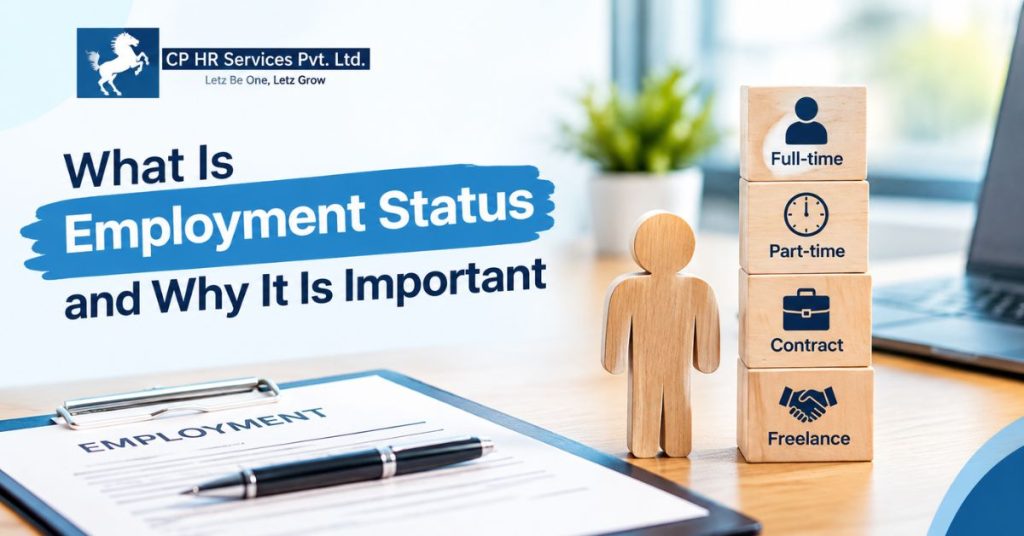
Two people can work for the same company, sitting at desks next to each other, and have totally different rights, benefits, and tax treatment. The biggest difference is one thing: employment status. Employment status is far more important than it seems on the surface. It determines whether a person receives provident fund contributions, paid leave, gratuity, or job security. For employers, an error can mean compliance penalties, back-pay claims, or disputes that can drag on for months. This guide gives you an understanding of what employment status means in India, the major classifications you’ll come across, and why it deserves more attention than most companies give it. What Does Employment Status Mean? Employment status refers to the legal status of a person’s relationship with work, based on the way they are engaged, paid, and managed. It determines which labour laws apply to them, what benefits they are entitled to, and how their income is taxed. Indian labour law does not rely on job titles alone to make that determination. Courts and regulators look at the actual nature of the relationship, including who controls the work, whether the person uses company equipment, how they are paid, and whether they work for only one employer. If the actual working relationship resembles that of an employee, the person classified as a “consultant” on paper may still be treated as an employee in practice. Main Types of Employment Status in India 1. Permanent Employees This is the usual ongoing employment relationship without a specified end date. Permanent employees generally enjoy the full range of statutory benefits, including provident fund contributions, gratuity after a qualifying period, paid leave, and protection against arbitrary termination. The vast majority of full-time office and factory jobs are of this type. 2. Fixed-Term Employees Fixed-term employment has a specified start and end date, often linked to a specific project or seasonal requirement. In India’s Labour Codes, this category was formally recognised, with a requirement that fixed-term employees receive the same wages and benefits as permanent employees doing similar work and a pro-rata gratuity entitlement even if the contract is for less than five years. 3. Probationary Employees Probationers are new employees in the first period of assessment, usually three to six months, but often longer for senior positions. Employers assess fit and performance during this period before offering the person a permanent role. Notice periods and termination rules in probation are generally less stringent than for confirmed employees. 4. Temporary and Casual Workers These are short-term or seasonal roles, often used to help manage peak demand or cover for absent staff. Casual workers are typically not as protected as regular employees, and they are paid for days or hours worked, not on a monthly salary basis. 5. Contract Labour Contract labour is the term used to describe employees that are supplied by a third-party contractor to work on a company’s premises, rather than being hired directly. This is a common arrangement in manufacturing, facilities management and logistics, and carries with it legal obligations for both the contractor and the company hiring the labour. 6. Consultants and Independent Contractors Consultants are generally hired to do professional work that is not part of the normal duties of the employee. They usually work on their own terms, invoice for their services, and do not enjoy the benefits of an employee. The main risk here is misclassification – if a “consultant” is actually working full-time, under the supervision of the company, with no independence, they could legally be an employee regardless of what the contract says. 7. Interns and Apprentices Interns and apprentices are generally early in their careers and looking for hands-on experience. They are often there for a set period of time, and sometimes they are given a formal stipend instead of a full salary. India has specific rules to govern apprenticeships, including a minimum stipend structure and training obligations. 8. Gig and Platform Workers India has seen a rapid growth in gig work, including delivery, ride-hailing and freelance digital work organised through platforms. Some states, like Rajasthan, Karnataka and Jharkhand, have enacted specific laws to extend registration and welfare benefits to this segment. They suggest a shift toward a recognition of gig work as a separate category of employment and not as a subset of casual labour. Why Employment Status Matters For Employees For Employers Employment Status and India’s Labour Codes India has been merging decades of individual labour laws into four labour codes: the Code on Wages, the Industrial Relations Code, the Code on Social Security and the Occupational Safety, Health and Working Conditions Code. They also formally define categories such as fixed-term employees and provide some protections for gig and platform workers, which older laws did not clearly cover. For employers, this means employment status classifications are becoming more consistent across states, although the implementation timelines and specific rules are still different. As the details are still evolving as states finalise their own rules under the central framework, it’s worth checking with an HR or legal advisor to keep up to date on how these codes apply to your workforce. How to Determine the Right Employment Status When you’re an employer creating a new role, before you decide how to classify it, ask yourself these questions: If you get the classification right at the time of hire, it saves a lot of trouble down the road as far as compliance and setting clear expectations with the person you’re bringing on board. How CP HR Services Can Help It is not always straightforward to correctly classify roles and build compliant employment relationships – this is particularly the case for companies that are scaling quickly or hiring across multiple categories simultaneously. CP HR Services has recruitment and HR consulting teams that work directly with businesses to get the hiring right from the get-go, whether it’s permanent, fixed-term for projects, or contract labour. We also offer monthly retainer and on-demand HR consulting for companies that require ongoing guidance on employment classification,
Importance of Career Guidance for Working Professionals

Career guidance is treated as something you need once in your life, somewhere around age 18, when you are picking a stream or a degree. Once you have a job, it’s assumed you’re good to go. If you have been working 10 or more years, you know that’s not the case. Roles evolve, and industries change. The skills that got you hired 10 years ago don’t always keep you relevant today. Career guidance for working professionals is exactly what it sounds like. It’s structured support for those already in work but needing clarity on where to go next. Whether that’s a promotion, a move into a new function or a full career change. In this article, we’ll explore why this type of guidance is more important now than ever before, what it actually entails, and how you can tell when it’s worth seeking out. What Is Career Guidance for Working Professionals? Career guidance for working professionals is a structured process that usually involves one-on-one sessions with a trained counsellor or coach. Career guidance helps a person assess their current career state and make informed decisions about the future. It is different in some important respects from career guidance for students. Fundamentally, the goal is the same as career advice for people of any age. It provides an individual with an opportunity to relate their talents and interests to realistic opportunities in the job market. Why Career Guidance for Working Professionals Matters Right Now There are some forces that are making this kind of support more relevant than it was a decade ago. The skills gap is growing fast. “The World Economic Forum’s Future of Jobs Report 2025 says that almost 59 out of every 100 workers globally will need to reskill or upskill by 2030, and skill gaps are cited by employers as the single biggest barrier to adapting their business” (World Economic Forum, “Future of Jobs Report 2025″, January 2025, https://www.weforum.org/publications/the-future-of-jobs-report-2025/digest/). During this period, nearly 40% of the core skills used by workers today are expected to change or become obsolete. Every year it becomes more difficult for you to determine what skills to focus on, alone, without any outside perspective. Employers are already responding, and workers need to catch up. In the same WEF report, 85% of employers say workforce upskilling is a priority, and about half of workers around the world have already been retrained in some way, up from 41% two years ago (World Economic Forum, “Future of Jobs Report 2025″, January 2025, https://www.weforum.org/publications/the-future-of-jobs-report-2025/digest/). Those professionals who wait for their employer to provide them a plan may fall behind those who take the initiative themselves. Career plateaus are common and rarely discussed. One of the most common reasons professionals seek guidance is due to feeling stuck in a role with no clear way forward. This kind of plateau, if not addressed, tends to lead to disengagement rather than a natural resolution. Sometimes job changes don’t go as people expect. Research on job changes post-pandemic found that many who changed jobs are now generally less satisfied than pre-pandemic, especially with the quality of leadership and communication in their new position (GoodTherapy, “Career Counselling: Professional Support for Work and Life Transitions,” https://www.goodtherapy.org/learn-about-therapy/issues/career-counseling). A poorly thought-out action without proper guidance might create a new problem instead of solving the old one. Key Benefits of Career Guidance for Working Professionals 1. Clarity on your actual options Many skilled workers can only see the road immediately in front of them: a promotion or nothing. A structured conversation with a career counsellor often surfaces options that weren’t visible from within the day-to-day grind of a current role, including adjacent industries or functions that leverage the same core skills. 2. A realistic, personalised plan instead of generic advice Career counsellors help create a development plan based on a person’s actual skills, interests, values, and constraints, instead of a generic checklist from a generic article (Therapy Group of DC, “Essential Guide to Career Counselling,” 2025, https://therapygroupdc.com/therapist-dc-blog/essential-guide-to-career ne is in their career, the more important this becomes, because experience brings more variables into play. 3. Better decision-making during transitions Career transitions come with a lot of uncertainty, whether it’s a layoff, a company restructuring, or a voluntary move. The guidance helps professionals evaluate offers, negotiate terms, and avoid decisions driven by anxiety or a sense of urgency. 4. Stronger long-term earning potential Career counselling has been linked to better economic outcomes over time, including less time spent unemployed and a stronger position in job searches (BetterHelp, “What Is Career Counselling?”, https://www.betterhelp.com/advice/careers/how-can-career-counseling-help-me/). Professionals who use platforms and support specifically designed for job matching also report significantly better hiring outcomes. One widely cited example found that job seekers using a structured career-scouting tool were 38% more likely to get hired (Indeed, “Career Counselling: What It Is and How Job Counsellors Help”, 2026, https://www.indeed.com/career-advice/finding-a-job/what-is-career-counseling). 5. Reduced stress around career uncertainty It’s really stressful not knowing what to do next, and even more stressful when you’ve been carrying it alone for months or years. It provides a way for people to work through that uncertainty rather than just sitting in it alone. 6. Support for lifelong learning, not just one decision Career development is a process, not a one-time decision. It’s an ongoing process, and guidance helps professionals develop habits around continuous skill building, instead of thinking of learning as something that ends after their first few years in the workforce. Who Benefits Most From Career Guidance as a Working Professional? This kind of support isn’t just for people in crisis. It is useful in a variety of situations. High performers who have hit a ceiling in their current organisation and don’t see a next step Signs You Might Need Career Guidance Sometimes it’s not clear that this sort of support will help. Some common symptoms are: If two or three of these sound familiar, a structured conversation with a career counsellor will probably save you more time than trying to figure it out on your own. How
10 Best AI Tools for Career Guidance and Growth

The job search and career planning process is not like it used to be five years ago. Resumes are screened by software before a human ever sees them. Now, instead of a friend going down a list of questions, you can do interview prep with an AI simulator. And figuring out what career path truly aligns with your skills is no longer a guessing game that you have to play alone. Job-searching, resume-building, and interview-prepping AI tools are now a standard way people look for jobs. In this guide, we’ll look at ten of the most useful, what they’re really good at, and where they fall short so you can build a toolkit that works for your particular situation rather than a collection of apps you’ll never open again. Why AI Tools for Career Growth Matter Now The rapid growth of this category can be attributed to a few shifts. 10 Best AI Tools for Career Guidance and Growth 1. LinkedIn LinkedIn is still the most powerful platform for personal branding, networking, and getting discovered by recruiters. AI-assisted features now help you write profile summaries, suggest skills to add, and surface job matches based on your activity (Cake, “The Ultimate Guide to AI Job Search Tools,” 2026, https://www.cake.me/resources/career-tool/ai-job-search-tools). It’s less effective as an independent resume builder and works best when combined with a dedicated resume tool. 2. ChatGPT ChatGPT is one of the most flexible tools in the arsenal of the job seeker. People use it to write resume bullet points, write cover letters, generate likely interview questions, and even conduct mock interview role play. It has a free tier, with paid plans beginning at approximately $20/month (Seekario, “Best AI Job Search Tools in 2026: A Complete Comparison,” https://seekario.ai/bpost/best-ai-job-search-tools-in-2026-a-complete-comparison). The downside is that it’s not a dedicated job search site. There’s no built-in ATS scoring or application tracking, so the quality of what you get is largely dependent on how well you prompt it. 3. Kickresume Kickresume is an AI-powered resume and cover letter maker, with templates that take you from a blank page to a finished document in no time. This is a good base resume for anyone looking to build a solid foundation before customising for an individual application. 4. Jobscan Jobscan is considered the standard for ATS optimisation. It compares your resume to a specific job description and gives you a match score as well as suggestions for keywords you may be missing (Cake, “The Ultimate Guide to AI Job Search Tools”, 2026, https://www.cake.me/resources/career-tool/ai-job-search-tools). This is one of the more helpful tools for someone who thinks their resume isn’t even getting to a human reviewer. 5. Teal Teal is a complete dashboard for the entire job search process, allowing users to track applications, save postings, and build resumes all in one place. If you’re applying to multiple jobs at once, this kind of structure matters more than any single AI feature. 6. Rezi Rezi is designed to be ATS-friendly and uses a 23-point evaluation system to score resumes based on keyword usage, formatting, and overall effectiveness (Denken Solutions, “Best AI Tools for Job Search & Applications 2026″, 2026, https://denkensolutions.com/blog/careers/ai-tools-for-job-seekers/). Its AI bullet writer feature helps to turn a plain job description into achievement-focused language, which tends to read better for both software and human reviewers. 7. Final Round AI Final Round AI is focused on interview prep and uses AI-powered mock interviews to help candidates practise their answers and how they deliver them before a real interview (Cake, “The Ultimate Guide to AI Job Search Tools,” 2026, https://www.cake.me/resources/career-tool/ai-job-search-tools). It’s a good option if you find interview anxiety harder to deal with than the resume stage. 8. Jobright Jobright is an AI-driven job matching platform that suggests openings based on your resume, experience, and stated goals. It also provides company research and niche filters, like visa-related filters for international candidates (Monster, “15 Best AI Job Search Tools to Help You Get Hired in 2026,” 2026, https://www.monster.com/career-advice/job-search/ai-job-search-tools). It’s best for those who want curated recommendations instead of scrolling through generic job boards. 9. Grammarly Grammarly is not a job search tool, per se, but it’s a supporting actor that’s more important than you think. A clean, error-free resume, cover letter, or LinkedIn message makes a huge difference in how a candidate comes across. Its AI suggestions spot things that are easy to miss when reviewing your own writing. 10. Coursera Coursera isn’t a job search engine in the traditional sense, but it’s an essential part of career growth. It provides AI-recommended learning paths and certifications for particular career goals, making it useful for anyone looking to close a skills gap before applying for jobs in a new field or at a higher level. How to Build an AI Tool Stack for Your Career Search You don’t have to run all ten tools simultaneously. Here’s a practical way to combine a few of them, depending on where you’re actually stuck. What AI Tools for Career Growth Can’t Do It’s fair to be up front about the limitations here. AI tools can help with repetitive tasks, but they can’t create a real professional relationship, tell your personal story in an interview, or tell you which job is right for you in terms of values, schedule, and long-term aspirations. Recruiters can often spot generic AI-written content quickly, so the human touch you add on top of these tools still matters more than the tools themselves (Apollo Technical, “Best AI Job Search Tools: What Actually Works in 2026,” 2026, https://www.apollotechnical.com/best-ai-job-search-tools-what-actually-works/). This is where structured career guidance still has a role that artificial intelligence cannot fully replace. Usually, understanding your strengths, weighing tradeoffs between different career paths, and getting honest feedback on how you’re actually coming across in an interview benefits from a real conversation with someone who’s done this work for years. Where CP HR Services Fits Into Career Planning CP HR Services, an HR consulting firm based in Pune, has been in operation since 2006. Apart from its recruitment and HR
What Is HR Transformation Consulting Services?

If you’ve spent any time reading about modern people management, you’ve probably heard the phrase “HR transformation”. That sounds big. That sounds expensive. And to many small and mid-sized business owners, it sounds like something only big corporations with full-time HR departments need to worry about. Not quite. At its heart, HR transformation is about making sure your people management practices match how your business actually works today – not how it worked five or ten years ago. And HR transformation consulting services are the outside expertise companies utilize to help them make that transition without the guesswork. Here is why this issue is more important now than before. Hybrid work, tighter budgets, new compliance rules, and rising employee expectations have all changed the face of “good HR”. According to Gartner, HR transformation is about changing how HR delivers services, manages talent, and uses technology so the function delivers real business value rather than just functioning in the background (Gartner, “Road Map to HR Transformation”). That’s a fancy way of saying: HR needs to stop being a paper pusher and start being an active partner in growing the business. So let’s walk through it, starting with what it actually means to a business like yours. What Does HR Transformation Actually Mean? HR transformation is not a one-off project with a start date and an end date. It’s an evolution of how a company thinks about hiring, policies, employee experience and compliance so that HR actually supports business goals instead of just keeping the lights on administratively. Successful transformations generally affect four areas: leadership, the HR operating model, HR team skills and HR technology (Gartner, “What Is HR Transformation and What Does It Achieve?”). In layman’s terms, this means: The good news is Gartner also says it doesn’t have to be a total overhaul. It could be an incremental shift that gradually aligns people, strategy, processes and technology with business goals, rather than a full rebuild done all at once (Gartner, “What Is HR Transformation and What Does It Achieve?”). That’s a relief for a growing SME. You don’t have to rebuild everything overnight. You need a plan and usually a partner who has done it before. Why Companies Turn to HR Transformation Consulting Services Most companies don’t wake up one day and say, “We want HR transformation.” Typically, they hit one particular problem first. Some common triggers: Any of these on its own is enough to call in outside HR expertise. Trying to do all of it internally, plus the day-to-day operations, usually means something gets dropped. Why do businesses hire HR consultants? Not because it sounds impressive, but because it’s faster and more reliable than working it out alone. That’s the practical reason. Core Components of an HR Transformation Engagement Every consulting assignment is a little different depending on the business, but most projects contain a common set of building blocks: Remember, none of this means that you need to have a full internal HR department on day one. This is precisely why consulting services exist, to give a business access to HR expertise on a flexible basis. How the HR Transformation Consulting Process Usually Works Whether the consultant is working with a 15-person startup or a 500-person company, a typical engagement proceeds in a fairly predictable way: Budget and urgency usually dictate what happens next. Some companies want a one-off project. Some people want ongoing support to deal with HR issues as they come up rather than letting them build up. Common Signs Your Business Needs HR Transformation Support You don’t need an audit to know something is wrong. Usually a few signs are enough: If two or more of these sound familiar, it may be time to consider bringing in some outside HR help before small gaps turn into bigger, more costly problems. How CP HR Services Supports Growing Businesses This is the kind of work a company like CP HR Services undertakes. CP HR Services, based in Pune, has been working since 2006 with start-ups, SMEs and larger organisations who want practical HR support and don’t want to build a large internal department. CP HR Services doesn’t believe in a one-size-fits-all package, so we offer monthly retainer HR consulting for businesses that want ongoing support with policies, hiring, attendance and compliance questions, and HR on-demand services for companies that need help with a specific, time-bound issue. The team also offers corporate training programmes and helps with recruitment and background verification, so businesses receive consistent support throughout the entire hiring and people-management lifecycle and not just parts of it. For a business that is somewhere between “we need real HR structure” and “we are not ready to hire a full HR team”, this flexible, retainer-based model is usually a practical, pragmatic starting point. CP HR Services offers a variety of services and industries which can be viewed directly on the CPHR Services website. Choosing the Right HR Transformation Consulting Partner Not every consultant is a good fit for every business. Here are some things to check before you sign with anyone: A good HR consulting partner should not seem like a vendor but an extension of your own team that understands your business well enough to give advice that fits, not cookie-cutter templates lifted from somewhere else. Final Thoughts HR consulting for business transformation addresses a real, common problem: businesses outpace their HR systems. You don’t need a big internal HR department to solve that. You’ll need clear policies, a repeatable hiring process, reliable compliance support, and someone experienced to help with the setup. It could be a monthly retainer, a short-term project, or a mix of both. Whatever the arrangement, the goal is the same: build HR that helps your business, not hinders it. Frequently Asked Questions 1. What is HR transformation consulting services in simple terms? It’s external expertise that changes the way a company does HR — policies, hiring, compliance, technology — so that people’s practices actually support business goals instead of just
How is ERP Consulting Career Growth?

ERP consulting is frequently recommended, but seldom well explained. It pays well; companies are always hiring. They will tell you this. But they won’t walk you through what the actual career progression looks like, or if the growth holds up once you are a few years in. So let us answer the real question: What is the actual ERP consulting career growth in India, stage-wise, supported by real salary and market data, not just general hype? What Does an ERP Consultant Do, Exactly? ERP stands for Enterprise Resource Planning. It is software that enables a company to run its finance, supply chain, HR, and operations on a single integrated system. SAP, Oracle, Microsoft Dynamics 365, and Odoo are all platforms, and they all have their own consulting specialists. An ERP (Enterprise Resource Planning) consultant takes this software and tailors it to the way a particular business actually operates and then provides support for the system after it is installed and operating. The work typically consists of the following. Consultants usually specialise in a functional area (finance, supply chain, or HR) or in a technical track (customisation, integration, or system administration), and the best performers eventually develop depth in both. Why the Market Backdrop Supports Long-Term Growth The growth of a career in any consulting field is very much dependent on the market on which it is based, whether it is growing or shrinking. The data is pointing very strongly in one direction for ERP. By 2031, India’s enterprise resource planning market is expected to reach USD 2.62 billion, with Mordor Intelligence’s industry report predicting a compound annual growth rate of 16.08 per cent between 2026 and 2031. The same report states that in that market, small and medium enterprises are adopting ERP at an even higher rate than large companies, with a CAGR of 19.2 per cent compared to 17.83 per cent for large enterprises over the same period. A lot of this is driven by regulatory pressure. According to Mordor Intelligence’s analysis, mandatory e-invoicing rules above a certain turnover threshold, together with stricter audit-trail requirements from the Ministry of Corporate Affairs, have pushed millions of businesses to adopt compliant ERP systems rather than manage this manually. Indian companies are fast shifting away from legacy on-premise systems, with cloud-native ERP suites commanding close to 54 per cent market share as of 2025. If you’re looking to build a consulting career, this combination is important. Regulatory demands create demand that doesn’t go away when budgets get tight, and SME adoption is growing faster than large enterprise adoption, so the client base continues to grow beyond the traditional large corporate accounts. ERP Consulting Career Growth by Stage Here is what the average salary-responsibility curve looks like: It’s the same pattern at every stage. Growth accelerates when a consultant transitions from generalist configuration work to a recognised specialisation (be that a specific ERP platform, an industry vertical or a newer capability like AI-assisted implementation). What Actually Drives Faster Growth in This Field Not all ERP consultants grow at the same pace. Those who get up the ladder faster tend to develop these advantages: Skills that are near the edge, like data migration or basic automation. ERP systems are increasingly integrated with AI tools and analytics dashboards, and the consultants who can bridge that gap are seeing the steepest pay bumps. The Honest Downsides of This Career Path To get a fair assessment of ERP consulting career growth, one must weigh the trade-offs: This career is a good fit if you like the idea of steady, compounding growth over a number of years rather than a quick jump out of the gate. You are paid well from day one, but the early stages may seem slower than expected. Making an Informed Decision Before You Specialise Picking an ERP platform, a functional vs. technical track, and a training path is a lot to sort out right after graduation or mid-career. A structured career counselling conversation can help match your background, be it finance, supply chain, or software, with the ERP specialisation that is most likely to pay off for you specifically. CPHR Services conducts career guidance programs for students and working professionals that specifically address this type of decision, comparing ERP consulting with other technology and business career options based on your actual strengths instead of general market hype. Since 2006, CPHR Services has been working in this area along with recruitment and HR consulting for organisations across India, which means the guidance comes from people who also see what specialisations companies are actively hiring for. No matter what platform or track you choose, the market data above indicates that the ERP consulting career growth in India has some real room to run over the next several years, especially if you build one clear specialisation early on and couple it with real project experience. Frequently Asked Questions How is ERP consulting career growth compared to general IT roles? ERP consulting rewards specialisation in a particular platform and is usually associated with steeper long-term salary growth than generalist IT roles. Starting salaries are on par with other IT jobs, but after 3-5 years, the gap widens considerably. Which ERP platform offers the best career growth in India? SAP remains the most sought-after platform, especially S/4HANA specialists, but there is also high demand for Oracle, Microsoft Dynamics 365, and Odoo consultants, particularly as SMEs adopt cloud-based ERP systems. Do I need a technical background to grow in ERP consulting? No. Coding skills are not required for functional consulting roles in finance, supply chain, or HR modules. Customisation or integration technical tracks require programming knowledge, but both have good growth potential. How long does it take to become a senior ERP consultant? Most consultants reach senior-level responsibility and compensation of about ₹15 lakh or more within five to eight years, provided they develop a clear specialisation and lead at least a few full implementation projects. Is ERP consulting a stable career in the long run? Yes, mainly