
Difference Between Staffing and Consulting

You have a hole in your business. Perhaps the team is short-handed. Maybe a process keeps crashing, and no one knows how to fix it. Both problems sound like “we need outside help”, but they call for different types of help. This guide breaks down staffing vs. consulting in plain terms so you can match the right partner to the right problem. A brief note on the terms used: by “staffing” I mean companies that provide people, and by “consulting” I mean companies that provide advice, e.g., HR consulting or management consulting. The Short Answer: Difference Between Staffing and Consulting Staffing firms supply people to do work that you have already defined.” Consulting firms provide advice, plans, and methods to solve a problem you may still be trying to figure out. Staffing fills a chair. Consulting repairs a system. Here is the difference in 3 lines: Some projects require both, and that will be covered later. What Is a Staffing Firm? A staffing agency recruits, screens, and places workers with client businesses. The agency is the employer of record for the workers for the duration of the assignment. You tell the firm what role you require. The firm finds the person, does the paperwork, and sends the person to your site. The American Staffing Association says staffing firms care for the people they send to work, so they pay wages, employment taxes, workers’ compensation insurance, and benefits. This is consistent with practice in the US, so check your own contract to see how these duties are divided. Common Staffing Models CP HR Services, based out of Pune, has been in business since 2006 and lists recruitment, background verification, and hiring assessments as independent hiring solutions on its website. That three-some really shows the people’s side of the work: find ‘em, check ‘em, and assess ‘em. When Staffing Works Well Drawbacks of Staffing What Is a Consulting Firm? The Institute of Management Consultants Australia defines management consulting as a strategic advisory service that provides an organisation with independent and objective advice on management issues, challenges and opportunities. The key word is independence. A consultant is not involved in your daily politics and can say what insiders dare not. Some problems are so deep that a company needs the objective view and expert advice of an outside party, according to EBSCO’s research overview. What HR Consultants Typically Do CP HR Services offers HR consulting services on a monthly retainer basis and on-demand HR support, including formats, handbooks, and SOPs. Corporate training is also provided. This is what consulting is, on a smaller scale: ongoing advice or off-the-shelf documents, not extra headcount. When Consulting Works Well Drawbacks of Consulting Staffing vs Consulting: Side-by-Side Comparison Factor Staffing Consulting What you buy People to do defined work Advice, plans, and methods Main question Who can do this job? What is wrong, and how do we fix it? Who employs the workers? Usually the staffing firm for temp work, you for direct hires The consulting firm’s own staff Who directs daily work? Usually you Usually the consultant Time frame Weeks to months, or permanent for direct hire Project-based or ongoing retainer How do you pay? Hourly markup, or a share of first-year salary Project fee, retainer, or day rate Best for Filling seats fast Solving problems and building systems Main risk Poor fit or short tenure Advice that never gets used Success looks like Roles filled, work done A working process your team can run alone How Labour Law Shapes the Choice in India Here is the law, so let us break it down. The Government of India has rationalised 29 earlier Labour Laws and made four Labour Codes effective from 21 November 2025. The main employer will provide the contract workers with health and social security benefits, the government announcement said. Simply put, when you utilize contract staffing, you are responsible for those workers regardless of whether a staffing agency hires them. Ask any agency for their licence, their statutory payments and how they deal with benefits. Include the answers in your contract. Consultants who advise but do not supply workers are usually outside these contract-labour rules, but the wording of each contract is important. This is general information and not legal advice. Consult with a labour law professional about your setup. A Quick Scenario Imagine a distribution company of 80 people, based in Pune. 3 needs land on the owner’s desk in 1 month. First, it’s festival season, and the warehouse needs twelve pickers for six weeks. The owner knows the job and the timeframe. That’s a staffing problem. Secondly, in the past year, a third of the warehouse team has gone. No one knows why, and the company doesn’t have a pay structure written down. The owner does not know the cure. That’s a consulting matter. Third, the company needs to fill five permanent roles against that plan after a consultant has built the pay grades and a hiring plan. Now, steered by the consulting work, is staffing again. This is a sample scenario, not an actual company. It shows the pattern: consulting often comes first when the problem is undefined, and staffing comes second when the plan is defined. How to Choose Between Staffing and Consulting Here’s how to do it: Quick Decision Rules Questions to Ask Any Provider Next Steps Staffing: it gives you people. Consulting provides you answers. What is the gap you are facing? What does success look like? Ask providers for clear scope and terms. If the problem is murky, begin with advice. If you have a plan, get other people involved. Related reading: The CP HR Services blog offers posts on subjects like helping new hires get settled on day one. FAQs on Staffing vs Consulting What is the main difference between staffing and consulting? Staffing provides people to fill positions you have defined. Consulting gives independent advice and problem-solving approaches. The staffing agency provides hands for your team. A consulting firm helps you to decide
Difference Between Organizing and Staffing
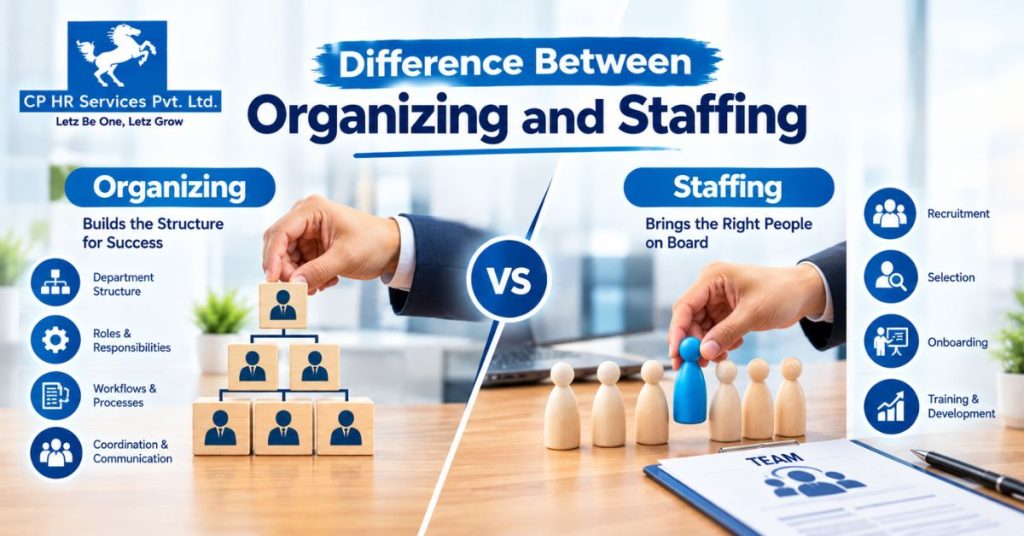
Sooner or later, every manager hits the same wall. The work grows, the team grows, and no one knows who owns what, and which seats are still empty. Two management functions handle those problems, and people always mix them up. This guide resolves organising vs. staffing in layman’s terms. You will see what each does, where it fits in the management cycle, and how to use both without tripping over either. The Short Answer: Difference Between Organising and Staffing An organisation designs the structure of a company. It establishes the tasks, who reports to whom, and where each role belongs. Staffing is the process of putting people into that structure. It finds, trains, selects, and keeps the employees who fill those positions. Here is the difference in one line: Where Organising and Staffing Fit in the Management Cycle Management textbooks break down the work of a manager into functions. According to OpenStax, the four main functions are planning, organising, leading, and controlling. In the same model, organising is the step that structures work and allocates resources. Where are the dudes? Some textbooks put it under organising or leading, because that four-function model doesn’t list it as a separate function. In many Indian business studies courses, it is treated as a separate function. “Staffing is the managerial function of filling and keeping filled the positions in an organisation structure,” reads a Class XII handout on the aees.gov.in website. That order remains in either case. You plan the work, you design the structure, you fill it in. What Is the Organising Function of Management? Organise goals into a working structure. Planning sets the targets, then a manager asks how to split the work up so people can hit them. The outcome is an organisational structure – a clear picture of roles, authority and reporting lines. What Organising Includes Common Organisational Structures Organising in Action Think about a logistics startup of 40 people. The founder divides the company into dispatch, warehouse, customer support and finance. She writes a short description of what each lead does and makes decisions about reporting lines. She hasn’t hired a single new person yet. That’s organizing. This case is an example, not a real company.” What Is the Staffing Function of Management? Staffing is putting the right people into the positions that the organisation created. It also keeps them filled over time because people leave, grow, and change jobs. We can take it one step at a time. The Staffing Process Who Handles Staffing Line managers know the requirements of a role. The process is normally run by HR teams. And some companies also work with outside partners. CP HR Services, a Pune-based HR firm operational since 2006, offers distinct hiring solutions covering recruitment, background verification, and hiring assessments on its website. Those three steps are a good fit for the recruit and select stages above. Organising vs Staffing: Side-by-Side Comparison Factor Organising Staffing Main focus Roles, authority, and reporting lines People who fill those roles Core question What work exists, and how does it connect? Who is right for each seat? Output Structure chart, role descriptions Hired, trained, and placed employees Timing Comes right after planning Comes after the structure is set Who leads it? Top and middle managers Line managers with HR support Time horizon Reviewed when strategy or size changes Runs all year, since people come and go Tools Org charts, job descriptions, workflows Job ads, tests, interviews, training plans Sign of failure Confusion over who decides what Empty seats or poor fit in the seats How Organising and Staffing Work Together Imagine organising as the blueprint and staffing as the construction crew. A strong blueprint without a crew is an empty building. A planless crew leaves you with a mess. Look out for these warning signs: Staffing choices also affect how long your structure remains stable. An ATD article in TD Magazine notes that employees in organisations with high internal mobility stay about 5.5 years, while employees in organisations with low mobility stay just under three years. The longer your structure sits, the fewer vacancies you will have. Hiring externally is also expensive. Wharton’s study of an investment banking environment found that outsiders need about two years to get up to speed. That is one industry, so take it as a warning and not a rule. It still demonstrates that staffing decisions deserve as much thought as the structure. Common Mistakes to Avoid And here’s why so many companies fail: Steps to Apply for Organising and Staffing in a Growing Business Next time you grow your team, use this order: Smaller firms that don’t have a full HR team need ready-made documents for steps four and seven. CP HR Services offers HR consulting services including formats, handbooks and SOPs with on-demand HR support. Next Steps Staffing and organising work in pairs. One draws the structure, one fills it in. First, build the structure, then hire against it, and as your business evolves, review both. See also the CP HR Services blog for related reading, such as how to help new employees settle in on day one. FAQs on Organising vs Staffing What is the difference between organising and staffing? Organising is the process of building the structure of a business, defining roles, authority, and reporting lines. Staffing is the process of filling the structure with the right people through recruitment, selection, training, and appraisal. Organising decides what seats there are. Staffing decides who sits in them. Which comes first, organising or staffing? First comes organising. You can’t tell who fits until you have a clear structure and defined roles. Then staffing fills those roles and keeps them filled as people leave, grow or move to new positions. Is staffing part of human resource management? “Yes.” Staffing is a part of human resource management. The staffing function is concerned with recruitment, selection, training, appraisal, and development of people. Line managers are still involved because they know what each role requires and who does it
Internal and External Sources of Recruitment: Know the Difference
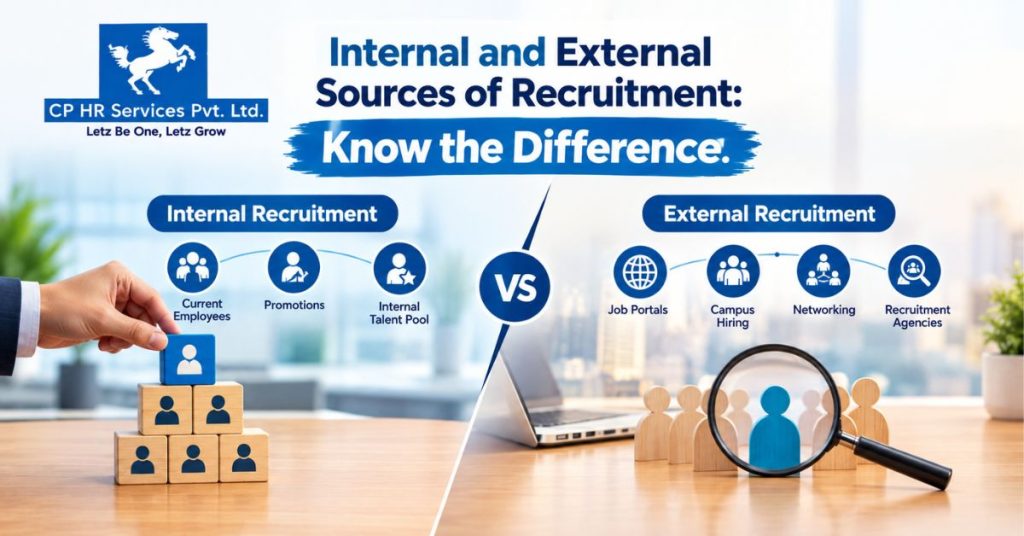
You have an open slot and a quick turnaround. Do you look inside your own team? Or do you just post the job and see who shows up? This choice is central to internal versus external sources of recruitment. Both paths work, and both have trade-offs in cost, speed, and risk. Let’s break it down so you can pick the right path for your next vacancy. The Short Answer Internal sources fill a vacancy with people already working for your company. It is filled with candidates from outside the company by external sources. Internal hiring is typically cheaper and quicker. External hiring brings in new skills and a wider talent pool. Most growing companies use both, varying by role. What Are Sources of Recruitment in HR? A source of recruitment is any location or channel from which you find candidates for a job. HR teams then tag these sources into two buckets based on one question – is the candidate already working for you? That answer will inform your budget, timeline, and even how your current team feels about the opening. So it pays to know both groups before you write the job post. Internal Sources of Recruitment Internal sources of recruitment are the talent you already have on board. They know you, and you know them. They know your products, your managers, and your habits. That’s what it looks like in real hiring. Common Internal Hiring Methods Advantages of Internal Hiring The retention point is supported by research. According to an ATD article in TD Magazine, employees at organisations with high internal mobility stay about 5.5 years, versus slightly under three years at organisations with low internal mobility. According to SHRM, LinkedIn data shows that employees who move around within a company are also more likely to stick around. Disadvantages of Internal Hiring External Sources of Recruitment External sources of recruitment are those that reach out to people outside your company. This group reaches more channels than the internal group and is still growing as hiring goes online. Common External Hiring Channels Advantages of External Hiring Disadvantages of External Hiring Internal vs External Sources of Recruitment: Side-by-Side Comparison Factor Internal sources External sources Candidate pool Current employees only Anyone in the job market Cost Usually lower Usually higher Speed Faster Slower Ramp-up time Short Longer Fresh ideas Fewer More Risk of a bad hire Lower, since you know the person Higher, since you know less Effect on morale Boosts it Can bruise it if staff feel ignored Best for Next-step and leadership roles New skills, fast growth, entry-level volume What the Research Says About Internal and External Hires Here’s why this decision should be revisited. Matthew Bidwell, a Wharton professor, looked at the question in an investment banking context. He found that outside hires received much lower performance ratings in the first two years than employees who were promoted or transferred into similar roles and said it takes about two years for outsiders to catch up. New hires from outside also earned much more than staff members promoted from within for similar jobs. That’s a straightforward tradeoff. You pay more for an outsider and wait longer for the complete results. Cost works the same way. According to LinkedIn’s talent development team, hiring a new employee costs about 2.5 times more than reskilling an existing one. Be careful. That’s one industry the Wharton study looked at, so consider it a cautionary tale, not a rule. The figures are also based on large company data sets, and your own figures may differ. Leverage the research to ask better questions, then look at your own hiring data. A Quick Scenario Take the example of a midsize manufacturer looking for a new production supervisor. A senior machine operator has 3 years with the firm and knows every line and has trained 2 juniors. Bringing that person in from within costs next to nothing, and the trust of the team is already there. Then the company needs a new operator, a position that is easier to fill from outside. Now reverse the roles. The same manufacturer wants a quality systems lead to bring in a certification that no one on the staff has ever worked with. There is no internal candidate. This time around, the smart move is to go outside. This is a simple illustration of the pattern. But the role determines the source. How to Choose Between Internal and External Hiring This is what you need to do for each new opening: When Internal Hiring Wins When External Hiring Wins Vet Every Hire, Whatever the Source “Because there are more unknowns with outside candidates, checking is even more important.” CP HR Services, a Pune-based HR company that has been in business since 2006, lists recruitment, background verification, and hiring assessments as separate hiring solutions on its website. This division makes sense. Hiring a candidate and confirming a candidate are two different jobs. Care must be taken with internal moves too. A long-time employee who moves to a finance or security position still needs a reasonable assessment of the requirements of the new role. Tips to Make Either Route Work Next Steps No path wins all the time. Internal hiring saves your budget and retains good people. External hiring brings in skills you don’t have. Pair the source to the role, track what each costs you, and look over the numbers after each hire. To learn more, visit the CP HR Services blog for topics such as helping new employees get settled on their first day. FAQs on Internal vs External Sources of Recruitment What is the main difference between internal and external sources of recruitment? Internal sources fill a vacancy by using your current employees through transfers, promotions, and internal postings. It is filled from outside the company through external sources like job portals, agencies, campus drives, and social media. Internal hiring is usually cheaper. External hiring gives you more choice. Are employee referrals an internal or external source of recruitment?
How to Make New Hires Comfortable on Their First Day of Work

First impressions are hard to forget. Research on new hire experience from BambooHR finds that 62% of employees say their impressions of the first day are still accurate months later. But how someone feels walking out of the office on day one is probably how they will describe your company for a long time. That first day means more to most managers than they realise. According to research by Digitate, SHRM data indicates that up to 20% of employee turnover occurs in the first 45 days of a job, and a negative onboarding experience is twice as likely to drive employees to seek opportunities elsewhere. It’s not just good manners to make new hires feel comfortable on their first day at work. It’s one of the least expensive things a business can do to protect its hiring investment. Why the First Day Matters So Much The significance of the first day New workers come in with a mix of excitement and fear. They still don’t know where the bathroom is, who to turn to for help, or whether their new boss is approachable. Every little signal, whether it’s a warm welcome, clear instructions, or someone checking in on them, reduces that uncertainty or increases it. According to Brandon Hall Group, a strong onboarding process can increase employee retention by 82%. That’s a number you can’t ignore. A good first day – well-organised, comfortable – sets the tone for everything that comes next: how quickly somebody becomes productive and whether they stay past their first year. How to Make New Hires Comfortable: A Step-by-Step Approach 1. Start Before Day One The comfort starts even before the new hire walks in. Send them a welcome email a few days before, covering the practicalities – arrival time, what to bring, dress code, and who will be there to greet them. Give a quick overview of the team and what the first day will be like so that nothing is a shock. A simple gesture, like a welcome kit or note from their new manager, can go a long way to ease those first-day jitters before they even step foot in the office. 2. Prepare Their Workspace in Advance Few things shake a new hire’s confidence more than arriving at an empty desk, no laptop, or a login that is not yet working. Have their workstation, equipment, e-mail account, and any needed system access ready before they arrive. This one step eliminates one of the most common and most preventable first-day frustrations. 3. Assign a Warm, Personal Welcome When the new hire walks in, they should be immediately greeted, ideally by their manager or a designated buddy, not just by the front desk. Five minutes of personal welcome does more to calm nerves than any presentation slide deck. 4. Introduce Them to the Team Early If you make the new hire meet colleagues at the end of the day, they will be on their own during the hours when they most need to feel connected. Take them for a walk, introduce names and roles, and provide an opportunity for a quick hello to everyone. Even a brief team lunch or coffee break on day one can go a long way toward helping a new hire feel like they’re part of the group and not an outsider looking in from the sidelines. 5. Assign a Buddy or Mentor A new hire can be assigned a peer buddy, someone who is not in their direct reporting line, to provide a pressure-free person to ask questions they may feel uncomfortable asking their manager. This one relationship often makes the difference between a new hire who feels supported and one who feels lost. 6. Set Clear, Realistic Expectations Vague instructions are anxiety-provoking. Explain the general picture of what their first day, first week, and first month will look like. A simple 30-60-90 day outline gives them a sense of direction instead of them having to guess what success looks like. 7. Avoid Overloading Them with Information It’s tempting to try to stuff every policy, tool, and process into day one. Resist that impulse. Instead, spread orientation content out over the first week or two and focus on what the new hire really needs to be able to do on day one: where to sit, who to call, and what their first assignment will be. 8. Check In Throughout the Day A quick check-in at lunch and close to the end of the day is a way to see that a new hire is someone someone is paying attention to and how they are settling in. It doesn’t need to be formal. Sometimes, a simple “How’s it going so far? Anything you need?” is enough to catch small confusions before they become bigger frustrations. 9. Give Them an Early, Achievable Task On day one, assign a small, clear task to a new hire, something simple, so they have an early feeling of contribution rather than sitting through a full day of passive orientation. Even doing one little thing successfully builds confidence fast. 10. Follow Up at the End of the Day Before they leave, take a few minutes to ask how the day went and to answer any remaining questions. This last moment often sets the tone for how a new hire is feeling as they head home on their commute and how they feel about coming back the next day in turn. Common Mistakes That Undermine a New Hire’s Comfort A few patterns repeat themselves in bad first-day experiences: Onboard Day 1 as a one-day event. A good first day is important, but it needs to be reinforced over the first few weeks, not just the opening hours that count. Why This Effort Pays Off Some of this may look like a small, obvious courtesy. It is, and it works for that reason alone. New hires aren’t looking for a big gesture. They want the simple signals that they made the right choice: a prepared workspace, a
What Is a Reference Check and Why It Is Important?
A resume tells you who a candidate is. A reference check tells you what others say about them. Both are important, but only one provides an outside perspective before you make a hiring decision that might shape your team for years to come. This guide explains what a reference check really is, the reference check and why it is important for hiring in India today, and how to do one properly without wasting your time or the candidate’s. What Is a Reference Check? A reference check is a step in the hiring process when an employer contacts people who have worked with a candidate in the past, typically former managers, supervisors, or colleagues, to verify information about their work history and performance. Generally, this occurs after a successful interview and before the final offer is issued. A typical reference check will include: Some companies stop at checking basic facts. Others go further and ask specific, structured questions to build a more detailed picture of how someone actually performs on the job. Both are reference checks, but the second provides much more useful information. Reference Check vs. Background Verification These two terms are used interchangeably, but they are not the same. A reference check evaluates performance and character based on conversations with people who worked closely with the candidate. A background verification is something different, and it is based on facts and records, confirming educational qualifications, employment history, identity documents, addresses, and at times, even criminal records through official sources and databases. Essentially, a reference check tells you how someone operates. A background check verifies the truth of the information on their resume. Both are used in a strong hiring system. Why Reference Checks Matter More Than Ever The numbers bear that out. Resume exaggeration is pretty common. According to a background verification report titled ‘Workforce Fraud Files’ by AuthBridge on India’s workforce, the year 2025 witnessed 6% of white-collar hires being found to have discrepancies, with some of the highest rates seen in sectors such as pharma, BFSI, telecom, and IT or ITES. In pharma alone, the mismatches were around 16%, and in BFSI, it came close to 11.7%. These numbers only include factual mismatches found by formal verification. They don’t pick up softer issues, such as a candidate overstating his or her role, taking credit for work by a team, or leaving out why he or she actually left their last job. That’s exactly where a reference check can fill the gap. Here’s why you should add a reference check to your hiring process. 1. It Confirms What the Resume Cannot Interviews are a one-way performance. Candidates rehearse answers, practise stories, and put their best foot forward. This is fair and expected. A reference check is a second source: someone who saw the candidate work on a day-to-day basis, not talk about it in an interview. 2. It Reduces the Risk of a Bad Hire A bad hire costs more than just the pay cheque. This includes lost productivity, disruption to the team, training time, and the cost of having to start the search again. Reference checks catch red flags before an offer is extended, not after someone has joined and the damage is done. 3. It Reveals Work Style and Team Fit A former boss can tell you things that a resume will never reveal. How does this person perform under pressure? Are they directionally sound? Are they reliable with a tight deadline? These types of insights help you know whether someone will actually flourish on your team — not just whether they’re able to do the job on paper. 4. It Protects Your Company’s Reputation If you hire someone with a history of conduct problems and you’re unaware of it, it can lead to legal, safety, or reputational issues down the line. One of the easiest ways to catch this before it becomes your problem is a reference check. 5. It Builds Trust with Your Own Team When a new hire is all that was advertised – reliable, skilled, and easy to work with – it reflects well on the person who made the hiring decision. Consistent, thorough reference checks build a track record of good hires, which builds trust in your HR process over time. How to Conduct a Reference Check the Right Way Step 1: Ask for the Right References Request at least two references who have directly supervised or worked with the candidate in their most recent positions. A reference from five jobs ago doesn’t tell you much about how someone does now. Step 2: Prepare Specific Questions Don’t ask generic questions like “Was this person a good employee?” Instead, ask about particular situations: Step 3: Listen for What Is Not Said Hesitation, vague answers, or a reference to someone who ducks direct questions can tell you as much as a glowing recommendation. A former manager who says, “I can only confirm dates of employment,” because of company policy, is one thing, but one who simply will not answer a question about reliability is another. Step 4: Document Everything Write down notes on each reference request. It protects you in the event that a hiring decision is ever questioned later and keeps the process consistent from candidate to candidate. Step 5: Combine It with Formal Background Verification A phone reference check is a useful tool but should be used in conjunction with more formal verification of education, employment history, and identity documents. Together they paint a complete and defensible picture before you make an offer. Common Mistakes Employers Make with Reference Checks How CP HR Services Supports This Process As part of our core recruitment work, we at CP HR Services do background verification and hiring assessments; hence, we can see the impact that a proper reference check has on the quality of a hire. In addition to formal verification of facts, our team assists companies in developing structured reference and screening processes that are more than just a quick phone call and
India Salary Guide 2027 by Job Role and Industry
Whether you’re job-hunting, negotiating a rise, or planning pay bands for a growing team, you need numbers you can trust, not numbers you guess at. This India Salary Guide 2027 compiles the latest projections from HR research firms and government labour data to reveal where salaries are headed across industries, roles, and cities. Most of this information applies to FY 2026-27 (April 2026 to March 2027), the time frame that most staffing and rewards firms use when they release forward-looking salary reports. Here are the numbers and what they mean for you. How Salaries in India Are Expected to Grow in 2027 Two of India’s most cited compensation studies tell the same broad story: growth is continuing, but it is settling into a more steady, selective pattern than the last couple of years. Both studies agree on the same directionality. Pay rises are not across the board. They are concentrated in jobs and industries that require specialised, execution-heavy skills. India Salary Guide 2027 by Industry Based on the two reports above, here are the industries compared. Highest-Growth Industries Steady-Growth Industries Slower-Growth Industries Except for technology consulting. Core IT roles continue to be in high demand across other industries, but pure-play IT services companies are expected to hike salaries at a slower pace than almost every other vertical in this India Salary Guide 2027. India Salary Guide 2027 by Job Role Increment percentages tell you only part of the story. The TeamLease report also details the expected increase for certain roles, and a few of them are way above the average. Job Role Projected Increment (FY27) Electrical Engineers 11.2% Project Engineers 10.7% Quality Control Inspectors 10.9% IT Support Executives 10.1% to 10.3% Quality Assurance Engineers 10.2% Site Engineers 10.2% EHS Officers 10.1% Relationship Executives 10.1% See a pattern here. Most of the jobs that had the biggest gains are hands-on jobs like engineering, quality, safety, and field support. This is in line with what both reports say is a shift toward compensation that pays for applied skills, rather than just general experience. Salary Growth by City in 2027 Metro cities still lead in absolute pay, but the fastest growth is spreading out. TeamLease data shows: Non-metro centres like Visakhapatnam, Nagpur and Jaipur are also gaining ground, driven by expansion in manufacturing and fresh industrial investment outside the traditional metro belt. If you are hiring or looking for jobs outside Delhi, Mumbai or Bengaluru, this move is worth watching. What Is Driving These Salary Trends Both reports repeatedly generate a handful of forces: Freshers vs. Experienced Professionals: What Changes Salary guides are often read the same way, no matter what stage you are at in your career, but freshers and experienced professionals should be looking at this data differently. For freshers, industry-level increment numbers matter less than starting pay bands, because you’re negotiating a first offer, not a rise on an existing salary. What matters more is what sectors are actively hiring at an entry level now. If you’re early in your career, all of EV, fintech, healthcare, and GCCs are ramping up their entry-level intake in lockstep with their salary budgets, making them worth a closer look. The percentages of the increment are more directly applicable to experienced professionals, as they tend to be perched on top of an existing salary. A 10 per cent increase on a senior engineer’s package is a much bigger absolute number than the same percentage on an entry-level role. This is also a good place to change jobs for better pay than staying where you are. The pay jump on a change of job in India has historically been much higher than an annual pay hike at the same company, especially in high-demand functions such as engineering, quality, and specialised technical support. Skills Pushing Salaries Higher in 2027 Besides industry and role, some skill areas keep coming up as pay drivers in multiple reports: The Bigger Picture: Average Salary in India Numbers specific to the industry are important, but knowing where the overall baseline is also helps. In March 2026, India’s Ministry of Statistics and Program Implementation released the 2025 Annual Report of the Periodic Labour Force Survey (PLFS). It stated that the average monthly earnings of a regular wage or salaried worker were ₹24,217 for men and ₹18,353 for women. The national figure counts the entire workforce, not just the corporate and white-collar portion. For metro city professionals working in urban, formal-sector jobs, actual pay is a lot more than this baseline, especially in IT, finance, and engineering jobs. How to Use This Salary Guide If you are negotiating an offer or setting pay bands for your team, here are some things to remember: How CP HR Services Can Help One thing is to read a salary report. Applying it in a real hiring decision or a real career move is another. As CP HR Services supports companies in recruitment, hiring assessments, and background verification, we get to see how pay bands actually work in offer negotiations across different industries. We also offer HR consulting services, including monthly retainer HR and on-demand support, for businesses that need help setting fair, competitive compensation structures without guesswork. If you are a job seeker trying to find your niche, CP HR Services’ career counselling programmes can help you understand how your skills and experience translate into true market value. Learn more about these services on the CP HR Services website. Frequently Asked Questions 1. What is the expected salary increment in India for 2027? TeamLease and Aon have estimated average increments across the industry to be in the range of 8.6 to 10.2 per cent, while the overall number for corporate India is expected to be around 9.1 per cent. 2. Which industries pay the highest salary hikes in 2027? EV and EV infrastructure, real estate and infrastructure, and NBFCs are topping the list in the latest TeamLease and Aon reports, with all projected in the 10% to 10.2% range. 3. Which cities in India will
10 Best Career Guidance Consultancy in India 2026

Career decisions were made by talking to a schoolteacher or relative who “knew someone in that field.” Today, there’s a real industry in India around career guidance, from psychometric assessment platforms to boutique consultancies that work one-on-one with students and professionals. That’s a good thing, but it also means that choosing the right one takes more than a quick search. Here are ten career guidance consultancies worth knowing in India in 2026, what they are actually known for, and how to figure out which type of consultancy matches your specific situation. What Does a Career Guidance Consultancy Actually Do? Before you compare names, it helps to know what you’re comparing. Usually a career guidance consultancy will offer some combination of: Not every consultancy does all of this. Some focus almost entirely on students picking a stream, and others work specifically with working professionals changing careers midway. How We Evaluated These Consultancies The following list is based on a few reliable criteria: Top 10 Career Guidance Consultancies in India 1. CP HR Services CP HR Services is a Pune-based HR consulting firm in the career guidance space since 2006. Its Career & Education Excellence Vertical offers structured career guidance to students from Class 8 and also consultancy for online and distance learning for working professionals. The only difference is that the founder of the firm, Dr Mohammed Bawaji, is directly involved, and he is a well-known career coach who does a lot of the counselling sessions himself on topics like choosing a stream, shortlisting colleges, and planning a career transition. The company has a strong rating on Google, based on hundreds of reviews from clients, many of whom mention specifically the clarity they received from the one-to-one sessions. 2. Mindler Mindler is one of the most popular career guidance platforms in India, based on a five-dimensional psychometric assessment of style, interest, aptitude, personality, and emotional intelligence. It helps students in classes 8 to 12 in planning their careers and also allows them to connect with mentors and virtual internships. Thus, it is a good option for students who are still exploring options (Invest4Edu, “Top 10 Online Career Counselling Platforms in India,” 2026, https://www.invest4edu.com/blog/top-online-career-counselling-services-in-india). 3. iDreamCareer iDreamCareer works with a large network of schools and reaches out to millions of students annually, providing both Indian and international guidance on higher education, entrance exams, and course selection. It’s especially powerful for students considering study-abroad options and domestic paths (Career Plan B, “Top 7 Career Counselling Platforms in India,” 2025, https://www.careerplanb.co/best-career-counseling-platforms-india/). 4. CareerGuide.com CareerGuide.com offers live chat and scheduled counselling sessions for students and professionals. It has more than 30 career assessment tests in the streams of skill, personality, and domain (Career Plan B, “Top 7 Career Counselling Platforms in India,” 2025, https://www.careerplanb.co/best-career-counseling-platforms-india/). It’s a flexible option for those who want guidance but not a commitment to one long-term programme. 5. Edumilestones Edumilestones has a huge network of trained career counsellors at hundreds of locations across India and also offers assessments in various regional languages besides Hindi and English. It has also created a platform for the career counsellors themselves to run branded practices. This is different from the consultancies that only work directly with students (Career Plan B, “Top 7 Career Counselling Platforms in India,” 2025, https://www.careerplanb.co/best-career-counseling-platforms-india/). 6. Univariety Univariety – Direction to discover and admissions, blended online and offline career counselling, and access to a detailed career encyclopedia. It works directly with schools, positioning itself as a partner for institutions that wish to embed career guidance within their curriculum rather than being a direct-to-consumer service. 7. Careers360 Careers360 is a popular name among students preparing for competitive exams like NEET, JEE, and other entrance exams, providing college reviews, rankings, and detailed entrance guides along with its career guidance content. “It’s a good place to start for students looking for data-heavy comparisons of institutions before they narrow down a path.” 8. Reach Ivy ReachIvy is an international education counselling company that aids students in narrowing down universities abroad and preparing winning applications. This is one of the more established names in that niche, if families are focused on overseas education rather than on planning a career back home. 9. Dheya Career Mentors Dheya is one of the older names in this space, with roots tracing back to 1985. Families who want ongoing mentorship through the various phases of a student’s education are more attracted to its long-term career coaching model than a one-and-done assessment-and-report approach. 10. Career Futura Career Futura focuses on career changes and uses psychometric testing to help students and working professionals to make the transition rather than just to make first-time career decisions. That makes it a relevant option for the smaller but growing segment of folks who want guidance later in their careers, not just at the start. How to Choose the Right Career Guidance Consultancy A few practical checks can save you from a disappointing experience. Students vs. Working Professionals: Different Needs, Different Fit It’s worth calling out directly that not all consultancies on this list serve both audiences equally well. Platforms like Mindler, iDreamCareer, Careers360 and Univariety are primarily built to help students make choices, select streams and get admission into colleges. Consultancies like Career Futura and firms like CP HR Services extend their work into the working professional space, dealing with career transitions, promotion planning and returning to work after a break. If you are a working professional, it’s worth confirming a consultancy actually has experience with that specific stage before booking a session designed for a 16-year-old choosing a stream. Why CP HR Services Stands Out for a Broader Range of Clients Most of the career guidance platforms in India are aimed at students. One of the few names on this list that runs structured programmes for students (starting from Class 8) and working professionals looking to change careers or pursue further education is CP HR Services. The firm’s wider HR consulting background has provided this range, working in the recruitment and HR space
Is 40 Too Late for a Career Change?

If you’re reading this at midnight after another long day at a job that doesn’t feel right anymore, here’s the short answer: No, 40 is not too old to change careers. It could be one of the better times to make one. That’s not some feel-good thing; it makes you feel better about being stuck in a line. It’s evidence-based, and it’s a trend that career researchers are seeing over and over again in different countries and industries. In this article, we will cover why the fear of changing careers at 40 is worse than the reality, what the research actually says, and how to make a career change without risking your financial future. Why 40 Feels Like a Deadline There’s a story that a lot of people have in their heads. Something like this is the idea: your 20s are for exploring, your 30s are for building, and in your 40s you’re supposed to be settled. All the rest feels like falling behind. When you look at the data, that story doesn’t really add up. Research from the American Institute for Economic Research backs this up, finding that 40 is near the median age for a major career change based on survey data collected across working adults (American Institute for Economic Research, cited in Final Round AI, “Career Change at 40: What to Expect, Top Fields, and Salary Data,” 2025, https://www.finalroundai.com/blog/career-change-at-40). Therefore, switching careers at this age is not the exception. It is more than the average. What the Data Actually Says About Career Changes at 40 Here’s what research consistently shows about those who transition later in their working life. Why Your 40s Might Actually Be a Good Time to Switch There are genuine benefits to being older and having more experience, although it doesn’t always seem that way at the moment. The Honest Challenges, Because They’re Real Too “Talking about the upside alone wouldn’t be right. There are real difficulties of naming. There is age bias. “New Career at 40: It’s Not Too Late, Here’s What to Do,” Kelly Services, 2026, https://www.mykelly.com/career-advice/new-career-at-40, states that about 64% of workers aged 50 and older say they have seen or experienced age discrimination at work, and a considerable number of older job seekers worry that their age will put them at a disadvantage in terms of hiring. This is not a fear that is imagined. It’s a consideration to plan for, not ignore. 40, it’s a different sort of financial squeeze. “At this age, many are supporting a family, paying a mortgage or saving for a child’s education. When you change careers, you need a financial plan behind it, not just enthusiasm. It’s really hard to start from zero. This can be seen from the data on skill overlap. People who attempt to walk away from everything and start over in some unrelated field have far less luck than those who pivot into something related to what they already know. The good news is that there are practical answers to all three of these challenges. And that’s really what the rest of this guide is all about. How to Approach a Career Change at 40 the Right Way 1. Start with your transferable skills, not a blank slate. List honestly what you really are good at: the technical skills, the soft skills, and the industry knowledge. Most people don’t realise how much of that translates to a completely different field when you look closely.” 2. Target adjacent industries before unrelated ones. The marketing director in healthcare can often find it easier to move to technology marketing than to an entirely different field. A finance manager can move to operations in a new sector more quickly than starting in an unfamiliar function from scratch. First, check for overlap. 3. Fill specific gaps, not your entire resume. You probably don’t need another full degree. A third of successful career changers chose a targeted certificate or short course over years of additional education. (data in Prentus, “How to Change Careers at 40 in 2026″, 2026, https://prentus.com/blog/embrace-the-next-chapter-how-to-make-a-career-change-at-40). Identify the one or two specific skills your target role really requires and build those. 4. Give yourself a realistic timeline. Most successful transitions take somewhere between six and eighteen months from decision to new role, depending on reskilling requirements. This process is normally sped up at one’s peril. 5. Reposition yourself as experienced, not entry-level If you are new to the field, don’t apply for entry-level positions. Position your leadership, judgement, and project experience. Seek roles such as consultant, project lead, or specialist that emphasise depth over years spent in that one industry. 6. Get a second, informed opinion. You can talk yourself out of a move or into one without any input from the outside. Talking to someone who does career counselling regularly can really open your eyes to things you can’t see on your own, whether it’s an unrealistic timeline or an underused strength you haven’t thought about. Where CP HR Services Can Help Pune-based HR consulting firm CP HR Services has been in operation since 2006 and conducts career guidance and counselling programmes for students who are making their first career choice or are working professionals. If you’re at the point where you know something needs to change but don’t know how to make the move without risking your finances or your confidence, that’s exactly the kind of decision a structured career counselling conversation can help with. It all starts with understanding your real skills, limitations, and goals, not generic advice, and then mapping a realistic way forward. If you have been thinking of changing your career, before you make any big decisions on your own, it is worth checking out what CP HR Services can offer through its career guidance and counselling programmes. Final Thoughts Forty is not the end date. It’s nearer the middle of a working life that, statistically, has another two decades or more. Again and again the data confirms this: At this age, those who switch careers
Corporate Sustainability Training: a Complete Guide

Sustainability has moved from a side conversation in the boardroom to a line item that shows up in investor calls, client contracts, and now, in India, regulatory filings. But most companies still think of it as something that the compliance team handles by itself. That is space, and that is what corporate sustainability training is for. This guide describes what corporate sustainability training really is, why more Indian companies are now making it a priority, what a good corporate sustainability training programme looks like, and how you can get one up and running at your own organisation. What Is Corporate Sustainability Training? Corporate sustainability training is a formal learning programme that teaches employees, managers, and leadership about environmental, social, and governance (ESG) practices and how they apply to day-to-day work activities. Not a one-time lecture on recycling. A good programme builds regulatory context, data reporting, risk awareness, and behaviour change at all levels of the company. What comes under this umbrella includes: Why Corporate Sustainability Training Matters Right Now A few forces are pushing this topic up the priority list for Indian businesses. The pressure of regulation is here. The Securities and Exchange Board of India introduced the Business Responsibility and Sustainability Report (BRSR) in 2021, replacing the older format of the Business Responsibility Report, and made it mandatory for the top 1,000 listed companies by market capitalisation from FY 2022-23 (Securities and Exchange Board of India, BRSR framework circular, 2021, https://www.sebi.gov.in). The report suggests nearly 140 data points across nine principles based on National Guidelines on Responsible Business Conduct. In 2023, SEBI introduced BRSR Core, a more stringent set of 49 KPIs which now require third-party assurance for the largest 150 companies (with a plan to cover the full top 1,000 by FY 2026-27) (SEBI BRSR Core disclosure and assurance framework, July 2023, https://www.sebi.gov.in). Employees who are gathering and reporting this data need to understand what they are measuring and why. Talent requires it. Studies by staffing and research firms have shown multiple times that a significant portion of job seekers, particularly younger professionals, take a company’s environmental and social commitments into account when deciding where to work (Stepstone and Handelsblatt Research Institute study, quoted in Terra Institute, ESG Training for Companies, 2024, https://terra-institute.eu). Workforce research compiled by compliance training provider VinciWorks also shows that purpose-driven companies are much more likely to report higher retention than their peers. (VinciWorks, “Why is ESG Training Important for Employees?”, 2024, https://vinciworks.com). There is a real gap in knowledge. A Deloitte study cited by Forbes found that while most business leaders believe sustainability is a top priority, only about 60% of companies have a sustainability strategy, and only slightly more than half of companies offer their employees any climate-related training (Deloitte study cited in Westford For Business, “The Importance of ESG Training for Employees,” https://westfordforbusiness.com). Training is a straightforward way to bridge that gap. What Topics Should a Corporate Sustainability Training Program Cover? You see these building blocks in a program that actually changes behaviour, not just checks a box. Who Needs Sustainability Training in a Company? This is a question I often get asked, and the honest answer is that sustainability training is not just for a dedicated ESG team. How to Build a Corporate Sustainability Training Program This is a practical, step-by-step method for companies to use. Common Challenges Companies Face Even the best-intentioned programmes encounter some recurring problems. How CP HR Services Can Support Your Training Goals A slide deck alone will not create a training programme that addresses compliance requirements and real behaviour change. It takes people who know adult learning, workplace culture, and how to make technical material land with a general audience. CP HR Services is a Pune-based HR consulting firm, specialising in designing corporate training programmes in areas like leadership development, behavioural training, and organisational development for companies across industries since 2006. If your organisation is looking to develop a sustainability training track in conjunction with your existing HR and compliance programmes, partnering with a team that already knows how to structure and deliver corporate training can save you a fair amount of trial and error. You can learn more about what CP HR Services has to offer in this space on its corporate training page. The goal, whether you are starting from scratch or building on an existing programme, should be the same – employees who understand not just what sustainability means, but what it means for the work they do each day. Final Thoughts Corporate sustainability training is no longer a nice-to-have extra for those companies with extra budget to spend. This is becoming standard for companies in India with SEBI’s BRSR requirements, investors asking questions and a workforce that cares more and more about where it works. Those that do, with role-specific content, regular updates and leadership buy-in, tend to see the benefits show up in retention, compliance readiness and reputation. CP HR Services and the like can help build that structure, making training part of the way a company functions, not just a check-box item. Frequently Asked Questions What is the difference between sustainability training and ESG training? In practice, the terms mostly go together. ESG training explicitly incorporates governance topics like ethics, board accountability and transparency into the mix, while sustainability training often focuses on environmental and social practices. Is sustainability training mandatory for Indian companies? While no law directly mandates training per se, SEBI’s BRSR framework requires the top 1,000 listed companies to provide detailed ESG disclosures. Without trained staff to accurately collect and report that data, it’s going to be very hard to meet the requirement.” How long does a corporate sustainability training programme take? General awareness sessions typically last 2-4 hours. Training for reporting teams on the technical aspects, including frameworks such as BRSR, can be a day-long event or delivered over a number of sessions. Who should attend sustainability training in a company? Everyone, but ideally to varying depths. All employees get a baseline session, but
What Is Posh Training in Corporate?

If you walk into any HR department in India today, you will hear the term ‘POSH training’ come up in almost every compliance conversation. But many employees and even HR teams do not have a clear idea of what it means and why it is so important. Let’s break it down. POSH training in corporate environments refers to the formal training that companies provide to their employees, managers, and committee members on how to prevent, identify, and address sexual harassment in the workplace. This is not a formality for once. In accordance with Indian law, it is a legal requirement, and it has a direct impact on how safe and fair the workplace feels. This article discusses what POSH training is, who requires it, what the law says, and how a company can implement it correctly. What Does POSH Stand For? POSH is an acronym for Prevention of Sexual Harassment. In India, the term refers to the Sexual Harassment of Women at Workplace (Prevention, Prohibition and Redressal) Act, 2013, and the POSH Rules notified by the Ministry of Women and Child Development in the same year. This is often referred to as the POSH Act as a whole. The law was formulated following decades of advocacy after the Vishaka Guidelines laid down by the Supreme Court in 1997. Once passed, it became the first standalone Indian statute dealing specifically with sexual harassment at the workplace and applies to every workplace in the country, public or private, formal or informal. What Is POSH Training in Corporate Companies? Corporate POSH training is a structured learning programme that helps to educate employees, managers, and Internal Committee members about their rights and responsibilities as per the POSH Act. Here’s what a typical programme covers: Good training does not read the law verbatim. It uses discussion, case studies, and role play so people actually remember what to do when a situation comes up.” Who Needs to Attend POSH Training? One of the most searched questions on the subject. Here is a direct answer. If a company trains only its IC people and ignores the rest of the workforce, it’s missing the point. The policy needs to be known by everyone for it to actually work. What Does the POSH Act 2013 Require From Employers? The law requires specific duties of the employers, not a general “be aware”. The POSH Act, 2013 and the rules published by the Ministry of Women and Child Development require every organization with 10 or more employees to constitute an Internal Committee (also known as the Internal Complaints Committee (ICC)) to receive and inquire into complaints of sexual harassment (Ministry of Women and Child Development, Government of India, 2013, https://wcd.nic.in). This committee should have a chair, at least two internal members, and one external member with expertise in the subject. Besides setting up the committee, employers are expected to: The latest developments have added another dimension. On August 12, 2025, the Supreme Court ordered the state governments to carry out district-wise compliance surveys and register Internal Committees on the SHe-Box portal, a complaint platform set up by the central government under the Ministry of Women and Child Development (SHe-Box compliance directive, Ministry of Women and Child Development, August 2025, https://shebox.wcd.gov.in). For companies that have not yet registered their IC, this is NOT something to be left for later but an active task. Non-compliance is also not a trivial matter. Companies that fail to set up an Internal Committee may be penalized with a fine of up to ₹50,000 for the first offense and higher fines for subsequent offenses and, in some cases cancelation of business licenses (Sexual Harassment of Women at Workplace Act, 2013, Section 26, Ministry of Law and Justice, Government of India). Why Is POSH Training Important for Companies? That’s why this training is more than a checkbox for compliance. What Topics Should a Strong POSH Training Program Cover? Most programmes that are not purely legal text understanding include: How Often Should Companies Conduct POSH Training? The law does not specify an exact number of sessions per year, but the general practice recommended by HR consultants and legal advisors is: Companies that train only once at launch and never train again tend to see that awareness fade in a year or two. Steps to Roll Out POSH Training in Your Organisation How to Choose the Right Training Partner Not every company has the internal expertise to design and deliver this type of training. Many organisations bring in outside professionals who specialise in workplace policy, corporate training, and HR compliance to run these sessions and keep the material current. There are a few things you should be looking for when you select a training partner: experience running structured corporate training programmes, trainers who understand the legal side and the human side of these conversations, and a willingness to customize sessions to your industry and company size, instead of handing you a generic slide deck. CP HR Services is an HR consulting firm in Pune that provides recruitment and HR consulting services. We also provide corporate training programmes, including Behavioral Training, communication training, and workplace policy programmes. If you are building a training calendar for your organisation, consider talking with a firm that has real-world, hands-on experience designing programs around real situations that happen on the job, not just theory. You can check the website to see what CP HR behaviour offers in corporate training and if it fits your team’s needs. Whichever partner you select, ask to see sample modules, trainer credentials, and how they measure if the training actually changed behavior, not just if people sat through a session. Final Thoughts POSH training in a corporate environment is not about paperwork. That’s the difference between a workplace where people know what to do when something goes wrong and one where confusion and silence prevail. The law sets the minimum standard. An Internal Committee. A written policy. Annual training. Companies that go further and create true awareness at every