
Why HR Consulting Is Important for Your Business
Picture this: You’re running a growing business, juggling client demands, managing finances, and suddenly your top performer quits without warning. Your HR processes are scattered across Excel sheets, compliance issues are piling up, and you’re spending more time on paperwork than strategy. Sound familiar? HR consulting is important for your business because it transforms these everyday chaos moments into streamlined, strategic advantages. It’s like having a GPS for your human resources guiding you through complex employment landscapes while you focus on what you do best. What Exactly Is HR Consulting? Think of HR consulting as your business’s personal trainer for people management. Just as a fitness trainer spots your weak points and creates targeted solutions, HR consultants identify gaps in your human resource processes and build customised strategies. HR consulting involves external experts who dive deep into your organisation’s people challenges. They analyse everything from recruitment hiccups to employee engagement issues, then craft practical solutions that actually work in the real world. Unlike generic advice from Google searches, these consultants bring industry-specific insights and proven methodologies that have helped hundreds of businesses like yours. The Real Business Impact of Professional HR Consulting Transforming Recruitment from Guesswork to Science Remember the last time you hired someone who looked perfect on paper but turned out to be completely wrong for your team culture? Professional HR consultants use data-driven approaches to identify candidates who don’t just have the right skills they fit your company’s DNA. They understand that hiring the wrong person can cost up to three times their annual salary in replacement costs, training, and lost productivity. Here’s what strategic recruitment consulting delivers: Building Bulletproof Compliance Systems One labour law violation can cost your business lakhs in penalties, not to mention the reputation damage. India’s complex employment regulations change frequently, and staying updated isn’t just recommended it’s survival. HR consultants act as your compliance guardians, ensuring your policies align with: They create compliance calendars, audit existing processes, and build systems that prevent violations before they happen. Why HR Consulting Is Important for Your Business Growth Scalability Without Growing Pains Growing from 10 to 100 employees isn’t just about hiring more people it’s about fundamentally changing how your organisation operates. Without proper HR frameworks, rapid growth often leads to: Strategic HR consulting helps you build scalable people processes that grow with your business. Consultants design organisational structures, create standardised procedures, and implement systems that maintain your company culture even as you expand. Data-Driven Decision Making Modern HR isn’t about gut feelings anymore it’s about insights derived from employee data. Professional consultants bring analytics tools and expertise to help you understand: This data transforms HR from a cost centre into a strategic business function that directly impacts your bottom line. HR Consulting vs. In-House: Understand the key differences to choose the best model for your business growth and workforce management. Specific Areas Where HR Consulting Makes a Difference Employee Engagement and Retention Losing good employees is expensive and demoralising. HR consultants don’t just conduct generic employee satisfaction surveys they dig deeper to understand what actually motivates your specific workforce. They might discover that your tech team values flexible working hours more than salary increases, or that your sales team needs recognition programs rather than additional benefits. Customised engagement strategies can: Performance Management Systems Traditional annual appraisals are dead. Modern performance management requires ongoing feedback, clear goal alignment, and development-focused conversations. HR consultants help design performance systems that: Training and Development Programs Generic training programs waste time and money. Effective L&D requires understanding your specific skill gaps and business objectives. Consultants conduct thorough training needs analysis, then design programs that deliver measurable results. They might recommend technical certifications for your IT team while focusing on leadership development for your managers. How CP HR Services Revolutionises HR for Growing Businesses When businesses in Pune and across Maharashtra need comprehensive HR solutions, they turn to CP HR Services for good reason. As a top HR services consultancy in Pune, India, CP HR offers recruitment, HR training, career counseling, and tailored HR solutions for diverse industries. What sets CP HR Services apart is their holistic approach to human resource challenges. Their vision focuses on placing the Right Resource at the Right Place in the Right Time at the Right Price. CP HR’s comprehensive service portfolio includes: Their expertise spans recruitment, background verification, career counselling, and online courses, making them a one-stop solution for businesses looking to streamline their entire HR function. The real value lies in their understanding of local market dynamics combined with global best practices. They’ve helped hundreds of businesses transform their people processes, from startups scaling rapidly to established companies optimising their workforce strategies. The ROI of Investing in Professional HR Consulting Smart business owners think in terms of return on investment. Here’s how HR consulting pays for itself: Cost Savings: Revenue Impact: Risk Mitigation: Most businesses see measurable improvements within 3-6 months of implementing professional HR consulting recommendations. Common Myths About HR Consulting Debunked Myth 1: “HR consulting is only for large corporations” Reality: Small and medium businesses often benefit more because they lack dedicated HR resources. Myth 2: “It’s too expensive for growing businesses” Reality: The cost of not having proper HR processes far exceeds consulting fees. Myth 3: “External consultants don’t understand our business” Reality: Good consultants spend time understanding your unique challenges and industry dynamics. Myth 4: “We can handle HR internally” Reality: Most business owners underestimate the complexity and time requirements of modern HR. Making the Smart Choice for Your Business Future Every successful business reaches a point where amateur HR approaches start limiting growth. The question isn’t whether you need professional HR support it’s whether you’ll invest in it before problems become crises or after expensive mistakes. HR consulting is important for your business because it transforms people management from a necessary evil into a competitive advantage. It’s the difference between hoping your workforce will drive success and strategically ensuring they do. Ready to transform your HR challenges
HR Consulting vs. In-House: Which is Right Model
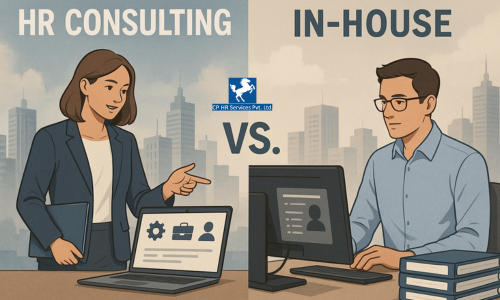
Picture this: It’s Monday morning, and your startup just landed its biggest client yet. Great news, right? Except now you need to hire 20 people in the next two months, set up payroll systems, draft employment contracts, and somehow ensure you’re compliant with labour laws. Your co-founder is frantically googling “how to write job descriptions” while you’re wondering if HR consulting vs. in-house is even a debate worth having at this stage. If this sounds familiar, you’re not alone. Every growing business in India faces this crossroads – should you build an internal HR team or partner with external HR consultants? The decision impacts everything from your budget to company culture, and frankly, there’s no one-size-fits-all answer. Let’s break down both models so you can make an informed choice that actually makes sense for your business. What is In-House HR vs. HR Consulting? In-house HR means having dedicated HR professionals as full-time employees within your organisation. They’re physically present, know your company inside out, and handle everything from recruitment to employee relations on-site. HR consulting, on the other hand, involves partnering with external specialists who provide HR services as needed. Think of them as your HR Consulting on-demand they bring expertise without the full-time commitment. The choice between these models isn’t just about cost (though that matters). It’s about finding the right fit for your business stage, industry, and growth plans. Benefits of In-House HR Teams Deep Company Knowledge and Culture Integration Your in-house HR team lives and breathes your company culture daily. They understand the quirks, the unspoken rules, and what makes your employees tick. When Rajesh from accounts has a conflict with Priya from marketing, your internal HR person knows the history, personalities, and the best approach to resolve it. This intimate knowledge becomes invaluable during: Immediate Availability and Dedicated Focus Need to discuss a sensitive issue? Your in-house HR is just a desk away. There’s no appointment booking, no waiting for callbacks, and certainly no worrying about whether they’ll be available during your crisis. Benefits include: Long-term Strategic Planning In-house teams are invested in your company’s future. They’re planning your workforce needs for the next quarter, next year, and beyond. They understand your business cycles, seasonal hiring patterns, and can anticipate HR needs before they become urgent. Advantages of HR Consulting Services Cost-Effective Expertise Access Here’s the reality check hiring a senior HR professional in Mumbai or Bangalore can cost you ₹8-15 lakhs annually, plus benefits. Add junior HR staff, training costs, and software subscriptions, and you’re looking at a significant investment. HR consulting vs. in-house cost comparison often favours consulting, especially for smaller businesses. You get access to senior-level expertise without the full-time price tag. Specialized Knowledge and Industry Best Practices HR consultants work with multiple companies across various industries. They’ve seen what works, what doesn’t, and what’s trending. When labour laws change (and they do frequently in India), your consultant is already updated and compliant. Key advantages: Scalability and Flexibility Your startup might need intensive recruitment support this month but only basic payroll management next month. HR consultants offer this flexibility without you having to hire and fire based on fluctuating needs. Objective, Unbiased Perspective Sometimes you need an outsider’s view. HR consultants can provide honest feedback about your company practices, identify blind spots, and suggest improvements without office politics getting in the way. Discover the Top 10 HR Consulting Firms in India that excel in recruitment, strategy, and workforce solutions for business growth. When to Choose In-House HR Company Size and Growth Stage Optimal for companies with 50+ employees Once you hit this threshold, the volume of HR activities typically justifies a full-time person. You’ll have enough recruitment, employee relations, and administrative work to keep someone busy. Stable, established businesses If your hiring patterns are predictable and your processes are established, an in-house team can manage day-to-day operations efficiently. Industry-Specific Requirements Some industries have unique compliance requirements, union relationships, or cultural considerations that benefit from dedicated, internal expertise. Examples include: Strong Company Culture Focus If your company culture is your competitive advantage, having someone internally dedicated to nurturing and protecting it becomes crucial. When HR Consulting Makes More Sense Startups and Small Businesses (Under 50 Employees) The HR consulting vs. in-house debate often leans towards consulting for smaller companies. You get professional expertise without the overhead of a full-time salary, benefits, and office space. Project-Based Needs Need to implement a new performance management system? Planning a major restructure? These intensive, short-term projects are perfect for consultants who can dedicate focused time without long-term commitment. Rapid Growth Phases When you’re scaling quickly, external support can help you build processes, hire rapidly, and maintain compliance without getting overwhelmed. Cost Constraints Let’s be honest cash flow matters. If budget is tight but you still need professional HR support, consulting offers a middle ground. Hybrid Approach: Best of Both Worlds Many smart companies don’t choose sides – they blend both models strategically. Common hybrid setups: This approach works particularly well for mid-sized companies (50-200 employees) who want dedicated support but also need access to specialized expertise. How CP HR Services Bridges the Gap When evaluating the HR consulting vs. in-house decision, partnering with an experienced consultancy can provide the best of both worlds. Since 2006, CP HR Services has been helping companies find the right talent and individuals find the right direction in their careers, offering a comprehensive suite of HR solutions that adapt to your business needs. What sets CP HR Services apart is their holistic approach. They support businesses with hiring, employee verification, and HR Consulting Services in Pune, while also providing career counselling and online education choices. This means whether you need immediate recruitment support, background verification for new hires, or strategic HR consultation, you get consistent service from a team that understands the Indian business landscape. Their model works particularly well for companies caught in the HR consulting vs. in-house dilemma. You can start with their consulting services to establish processes and handle
Top 10 Skills for Students Entering Before the Corporate World

Remember that sinking feeling when your senior asked, “So, what skills for corporate world students should you actually have beyond your degree?” You’re not alone if this question kept you up at night. Most Indian students spend years mastering textbooks but graduate feeling unprepared for actual workplace demands. The gap between college curriculum and corporate expectations has never been wider. Here’s the reality: Technical skills for entry-level jobs matter, but they’re just the foundation. Today’s employers want well-rounded professionals who can hit the ground running from day one. This comprehensive guide reveals the top 10 essential skills that will transform you from a nervous fresher into a confident corporate professional. The Corporate Skills Reality Check: What Employers Actually Want Let’s address the elephant in the room. Indian companies receive thousands of applications for every entry-level position. What separates hired candidates from rejected ones isn’t always the highest GPA. Leading HR consultancies report that businesses now prioritize hiring candidates with strong soft skills alongside technical competencies, focusing on long-term potential rather than just academic performance. With expert HR consulting services in Pune, organizations can refine their recruitment strategies to identify well-rounded talent that drives sustainable growth. Here’s what makes the difference: Must-Have Corporate Skills for Freshers: The Complete Top 10 List 1. Business Communication Essentials: Your Gateway to Professional Success Think communication means speaking good English? Think again. Corporate communication involves: Real-world example: Priya, a computer science graduate, landed her dream job at a Mumbai-based fintech not because of her coding skills, but because she could explain technical concepts to non-technical stakeholders during her interview. Pro tip: Practice explaining your engineering project to your grandmother. If she understands it, you’ve mastered business communication. 2. AI Literacy for Corporate Jobs: The New Must-Have Skill Artificial Intelligence isn’t replacing humans it’s amplifying human capabilities. Essential AI literacy includes: Industry reality: Companies now expect entry-level employees to leverage AI tools effectively, regardless of their department. 3. Data Fluency for Non-Tech Roles: Numbers Tell Stories You don’t need to be a data scientist to work with data. Basic data fluency means: Career impact: Marketing, HR, finance, and operations roles now require basic data interpretation skills for decision-making. 4. Digital Productivity Tools Mastery: Work Smarter, Not Harder The modern workplace runs on digital tools. Essential tool categories: Internship skills that impress employers: Knowing these tools before you start shows initiative and reduces onboarding time. 5. Remote Collaboration Skills: The Future of Work Hybrid and remote work aren’t temporary trends they’re permanent fixtures. Remote collaboration essentials: Professional development tip: Practice these skills through online group projects, virtual internships, or remote volunteer work. 6. Critical Thinking and Problem-Solving: Your Competitive Advantage Companies don’t want order-takers; they want problem-solvers. Critical thinking involves: Workplace scenario: When a client complaint arises, critical thinkers don’t just forward it to their manager—they analyze the root cause and propose solutions. 7. Adaptability and Learning Agility: Thriving in Constant Change The only constant in today’s corporate world is change. Adaptability skills include: Career growth insight: Professionals who adapt quickly often get promoted faster than those who resist change. 8. Emotional Intelligence and Workplace Relationships: The Human Factor Technical skills get you hired; people skills get you promoted. Emotional intelligence components: 9. Time Management and Prioritization: Mastering Professional Productivity College taught you to manage classes and assignments. Corporate life demands juggling multiple projects, deadlines, and stakeholder expectations. Effective time management strategies: 10. Industry-Specific Technical Proficiency: Your Foundation Skills While soft skills matter, technical competency remains crucial. Key areas to focus on: How to Develop Corporate Skills in College: Practical Action Steps Don’t wait until graduation to start building these skills. Immediate actions you can take: During coursework: Through internships: Additional skill-building opportunities: Certifications to Boost Employability: Strategic Credential Building While degrees establish your foundation, certifications demonstrate commitment to continuous learning. High-impact certification areas: Strategic approach: Choose certifications that complement your degree and target industry, not random popular courses. How CP HR Services Bridges the Campus-to-Corporate Gap Understanding these essential skills is just the beginning implementing them effectively requires expert guidance. CP HR Services specializes in bridging this exact gap through comprehensive career counseling, strategic recruitment support, and targeted skill development programs. As a trusted recruitment agency and placement consultancy in Pune, we help individuals and organizations align career goals with business growth. What makes CP HR Services uniquely positioned to help students transition successfully? Comprehensive career guidance approach: Real-world connection advantage: Their vision of “placing the Right Resource at the Right Place at the Right Time at the Right Price” comes from deep industry knowledge and extensive employer relationships. Practical support services: The difference? They don’t just help you find jobs they help you build careers. Many consultancies focus solely on placement, but CP HR Services invests in your long-term professional development through strategic skill building and market insight sharing. Final Thoughts: Your Corporate Success Blueprint The transition from campus to corporate doesn’t have to be overwhelming. Success comes from systematically building these essential skills while you’re still in college, not scrambling to learn them after graduation. Remember these key principles: The Indian job market is competitive, but well-prepared candidates with the right skills for corporate world students consistently stand out and succeed. Take action today. Your future corporate self will thank you. Ready to accelerate your corporate readiness? Connect with CP HR Services for personalized career guidance and strategic skill development support. Transform your potential into professional success with expert mentorship and industry insights. Frequently Asked Questions (FAQs) Q1: What are the most important soft skills for workplace success? Communication, emotional intelligence, adaptability, and critical thinking top the list. These skills help you collaborate effectively, handle workplace challenges, and build strong professional relationships that drive long-term career success. Q2: How can I develop technical skills for entry-level jobs without work experience? Focus on practical application through personal projects, internships, online courses, and freelance work. Build a portfolio showcasing real-world problem-solving using industry-relevant tools and technologies. Q3: When should I start preparing for the campus-to-corporate
How to Make Better Assessment Process for Hiring
Are you tired of making expensive hiring mistakes because your hiring assessment process feels like throwing darts in the dark? You’re not alone. Every HR manager in India has been there interviewing candidates who looked perfect on paper but turned out to be completely wrong for the role. The cost of a bad hire can be astronomical, sometimes reaching up to 3x their annual salary when you factor in recruitment costs, training time, lost productivity, and the eventual replacement process. But here’s the thing: most companies are still using outdated assessment methods from the 1990s. It’s time to revolutionize your approach with effective candidate assessment methods that actually predict job success. The Hidden Problems with Traditional Hiring Methods Let’s be honest about what’s broken. Most Indian companies still rely heavily on gut feelings and basic interviews that barely scratch the surface. By leveraging professional hiring assessments services in Pune, businesses can make data-driven decisions, reduce hiring errors, and find candidates who truly fit the role. Traditional interview red flags: Research shows that unstructured interviews predict job performance with only 14% accuracy. That’s basically a coin flip. Your hiring decisions deserve better than gambling. Why Structured Hiring Evaluation Techniques Change Everything Think of structured assessments like a GPS for recruitment. Instead of wandering around hoping to find the right destination, you have a clear roadmap to identify top talent. Structured hiring evaluation techniques follow a systematic approach: Companies using structured approaches see 25% better hiring outcomes and 40% less employee turnover. Those numbers speak for themselves. Building Bias-Free Recruitment Assessments That Work Unconscious bias is the silent killer of good hiring decisions. We all have them preferences based on background, appearance, communication style, or even which college someone attended. Here’s how to minimize bias in your assessment process: Before the assessment: During assessments: After assessments: Remember: the goal isn’t to eliminate human judgment, but to make it more accurate and fair. Making Data-Driven Hiring Decisions Like a Pro Numbers don’t lie, and they shouldn’t be ignored in hiring. Smart companies are moving beyond gut feelings to embrace analytics in their recruitment process. Key metrics to track: Tools that help: Start simple – pick 2-3 key metrics and track them consistently. You’ll be amazed at the patterns that emerge. Skills Testing Best Practices That Actually Predict Success Here’s a reality check: asking someone if they’re good at Excel isn’t the same as watching them build a complex spreadsheet. Skills testing should mirror real job challenges as closely as possible. Technical skills testing: Soft skills assessment: The key is authenticity the closer your test mirrors the actual job, the better it predicts performance. Advanced Assessment Methods: Cognitive Ability Tests for Hiring Intelligence matters in most jobs, but measuring it effectively requires the right approach. Cognitive ability tests for hiring can predict job performance better than interviews or experience alone. What to test: Popular cognitive assessment tools in India: Just remember: cognitive ability should be one piece of the puzzle, not the entire decision. Work Sample Tests for Recruitment: Show, Don’t Tell Nothing beats seeing someone actually do the job. Work sample tests for recruitment give candidates a chance to demonstrate their abilities in a controlled environment. Examples by role type: Best practices: The investment in work sample tests pays off tremendously in hiring accuracy. Embracing AI-Powered Hiring Assessments and Modern Technology Technology is revolutionizing how we assess talent, and Indian companies are catching up fast. AI-powered hiring assessments can analyze everything from video interviews to voice patterns to predict job fit. Current AI applications: Caution flags: The future is here, but use it wisely. Gamification in Candidate Evaluation: Making Assessments Engaging Who says hiring assessments have to be boring? Gamification in candidate evaluation can reveal insights while creating a positive candidate experience. Smart gamification examples: The key is ensuring the game mechanics actually relate to job requirements. Don’t gamify just for the sake of being trendy make it meaningful. Video Interview Assessment Tools: Expanding Your Talent Pool Post-pandemic, video interviews aren’t just convenient they’re essential for accessing talent beyond geographic boundaries. Video interview assessment tools can help you evaluate candidates more effectively than traditional phone screens. Platform features to look for: Video interview best practices: Remember: not everyone is comfortable on camera, so don’t let video skills overshadow job competencies. How CP HR Services Helps Companies Build Better Assessment Processes When it comes to implementing these advanced assessment strategies, partnering with experienced HR consultants can accelerate your success. CP HR Services stands out as one of India’s leading HR consulting firms in India, specializing in comprehensive recruitment solutions and talent management strategies. What makes them different from typical recruitment agencies? Their holistic approach includes: Their core philosophy of “placing the Right Resource at the Right Place at the Right Time at the Right Price” aligns perfectly with modern assessment methodologies. Instead of just filling positions quickly, they focus on long-term hiring success through structured evaluation processes. Why partner with specialists: The investment in professional assessment design pays for itself through better hiring outcomes and reduced turnover. Measuring Success: Key Metrics for Your Assessment Process You can’t improve what you don’t measure. Track these metrics to continuously refine your hiring assessment process: Quality metrics: Efficiency metrics: Predictive accuracy: Set up dashboards to track these metrics monthly and review trends quarterly. Common Mistakes to Avoid in Assessment Design Learn from others’ mistakes instead of making them yourself: Over-engineering the process: Ignoring candidate experience: Lack of validation: Legal compliance oversights: Prevention is always better than expensive lawsuits. The Future of Hiring Assessments The assessment landscape will continue evolving rapidly. Emerging trends to watch: Stay curious about new methods, but always validate them against actual job performance before full implementation. The goal isn’t to be cutting-edge it’s to be effective. Conclusion: Your Next Steps to Assessment Excellence Building a better hiring assessment process doesn’t happen overnight, but every improvement compounds over time. Start with one or two changes that address your biggest pain points. Maybe it’s
Hiring Challenges in BFSI Sector and How to Overcome Them
Ever stared at a stack of resumes for a banking position, only to realize none of them tick all your boxes? BFSI sector hiring challenges have become the elephant in the room that most HR leaders whisper about but rarely address head-on. You’re not alone in this struggle. The Banking, Financial Services, and Insurance (BFSI) sector in India is booming with a projected growth rate that makes other industries jealous. But here’s the catch: finding the right talent feels like searching for a needle in a haystack, blindfolded, during a thunderstorm. Partnering with the top recruitment consultancy in Pune can simplify the process, ensuring BFSI companies connect with the right talent efficiently. Let’s dive into why hiring in BFSI feels so challenging and, more importantly, how you can actually solve these problems without losing your sanity. The Reality of Talent Shortage in Banking Sector Picture this: You post a job for a risk analyst position on Monday. By Friday, you have 200+ applications. Sounds good, right? Wrong. Out of those 200 applications, maybe 15 candidates actually understand what risk analysis means in a banking context. The rest are just playing the application lottery, hoping something sticks. The BFSI sector saw a 28% growth in hiring demands for 2024, with a 24% increase in demand for entry-level positions compared to the previous year. But this growth comes with its own set of headaches. Here’s what’s really happening: Compliance Skill Gaps in BFSI Are Widening Banking regulations change faster than social media trends. One day it’s Basel III, the next it’s some new RBI guideline that makes everyone scramble. Most candidates know the basics, but compliance expertise? That’s rare gold. The problem isn’t just knowledge it’s staying updated. Financial institutions face regulatory burdens alongside cybersecurity threats and competition from FinTechs. High Attrition in Insurance Industry Creates a Vicious Cycle Insurance companies are stuck in a revolving door situation. They hire, train, and just when employees become valuable, they leave. The sector faces challenges related to high attrition rates, creating a constant need for fresh recruitment while losing institutional knowledge. Why does this happen? Fintech Recruitment Difficulties: The New Kid on the Block Traditional banks thought they had problems? Fintech companies are playing in an entirely different league. They need candidates who understand both finance AND technology. That’s like asking for someone who speaks Mandarin and can also perform brain surgery. India’s fintech sector was valued at around $100-110 billion in 2024, and is projected to reach $150–200 billion by 2025. The challenge? Traditional banking professionals often lack tech skills, while tech professionals don’t understand financial nuances. Challenges Recruiting Loan Officers Loan officers aren’t just number crunchers anymore. They’re relationship managers, risk assessors, compliance experts, and customer service representatives rolled into one. Finding someone who can: That’s asking for a unicorn. How to Attract BFSI Talent: Strategies That Actually Work Stop doing what everyone else is doing. Generic job descriptions and standard interview processes won’t cut it anymore. 1. Employer Branding for BFSI Companies Your company culture is your biggest selling point. Don’t just say: “We offer competitive salaries.” Instead, show: “Here’s how our employees grew from analysts to VPs in 3 years.” Real example: Instead of posting “Looking for dedicated banking professionals,” try “Join our team that helped digitize rural banking for 2 million customers.” 2. Create Clear Career Progression Maps Banking professionals want to see their future. Not just the next promotion, but the entire journey. Show them: 3. Hiring Risk Analysts in BFSI: The Smart Way Risk analysis candidates are analytical by nature. They want data, not fluff. When recruiting risk analysts: Upskilling Strategies for Financial Hires Here’s a secret: You don’t always need to find perfect candidates. Sometimes, creating them works better. AI in Banking Recruitment: Leverage Technology Use AI tools for: Initial Screening: Skill Assessment: Predictive Analytics: Build Internal Training Programs For Compliance Roles: For Customer-Facing Positions: Cross-Training Opportunities Don’t put people in boxes. A loan officer who understands insurance products becomes more valuable. An insurance agent who knows banking services can serve customers better. Sales Hiring in Insurance Sector: Breaking the Stereotype Insurance sales isn’t just about pushy salespeople anymore. Modern insurance professionals are consultants, advisors, and problem solvers. Look for These Qualities: Instead of: “Aggressive sales targets achiever” Look for: “Customer problem solver with consultative approach” Instead of: “High-pressure sales experience” Look for: “Relationship building and trust development skills” Create Realistic Job Previews Show candidates what they’ll actually do: How CP HR Services Transforms BFSI Recruitment While most recruitment agencies treat BFSI hiring like any other sector, CP HR Services understands the unique challenges financial institutions face. They support businesses with hiring, employee verification, and HR consulting while guiding professionals through career counseling a comprehensive approach that addresses both employer and candidate needs. What sets them apart in BFSI recruitment? Deep Sector Understanding: CP HR Services doesn’t just match keywords on resumes. They understand that a compliance officer needs more than regulatory knowledge they need practical experience with audit processes, stakeholder management, and change implementation skills. Comprehensive Candidate Verification: In BFSI, character matters as much as competence. Their employee verification services ensure you’re not just hiring skilled candidates, but trustworthy ones who can handle sensitive financial information. Strategic HR Consulting: Beyond filling positions, they help BFSI companies build sustainable hiring strategies. This includes developing role-specific competency frameworks, creating retention-focused onboarding programs, and establishing internal mobility pathways. Career Counseling Integration: By providing career counseling to candidates, they ensure better job-fit matching. A candidate who understands their career trajectory in BFSI is more likely to stay and grow with your organization. Their “Right Resource at the Right Place at the Right Time at the Right Price” philosophy isn’t just a tagline it’s particularly crucial in BFSI where wrong hires can have compliance, operational, and financial implications. Discover how to reduce employee turnover with smarter recruitment by hiring the right talent and building long-term organizational success. Building a Sustainable BFSI Hiring Strategy Focus on Cultural Fit Technical skills
How to Reduce Employee Turnover with Smarter Recruitment
Ever wondered why some companies seem to have a revolving door while others retain top talent for years? The secret isn’t just about fancy perks or higher salaries. It’s about getting your recruitment strategy right from day one to reduce employee turnover effectively. Think about it. Every time someone leaves, you’re not just losing an employee you’re losing institutional knowledge, team dynamics, and a significant chunk of money. Studies show that replacing an employee can cost anywhere from 50% to 200% of their annual salary. For a company paying ₹10 lakhs annually, that’s ₹5-20 lakhs down the drain for every wrong hire. But here’s the thing most turnover starts during recruitment. When you hire the wrong person for the wrong role, you’re setting everyone up for failure. Partnering with a trusted recruitment agency in Pune can help ensure the right talent is matched to the right role, reducing turnover and driving long-term success. Let’s explore how smarter recruitment can transform your retention game. The Hidden Connection: Recruitment and Retention Most HR leaders treat recruitment and retention as separate departments. Big mistake. Hiring for retention strategies should be your north star from the moment you post a job ad. Every interview question, every assessment, every reference check should ask one fundamental question: “Will this person thrive here long-term?” Consider Ravi, who joined a Mumbai startup as a marketing manager. Great resume, impressive interview performance, solid references. But within six months, he was out the door. The reason? The company culture valued quick decision-making and startup hustle, while Ravi thrived in structured, process-driven environments. Nobody asked the right cultural fit questions during hiring. This is where predictive hiring to reduce turnover comes in. Instead of just looking at what someone can do, you need to understand how they work, what motivates them, and whether they’ll genuinely enjoy your workplace. Behavioral Interviewing: Your Secret Weapon for Culture Fit Behavioral interviewing for culture fit isn’t just about asking “Tell me about a time when…” questions. It’s about understanding patterns of behavior that predict long-term success. Here are three game-changing behavioral interview techniques: 1. The Values Alignment Test Instead of asking generic questions, probe specific scenarios that reflect your company values. If innovation is key, ask: “Describe a time you challenged the status quo and how you handled pushback.” 2. The Stress Response Indicator Every job has stressful moments. Ask candidates about their worst workday and how they recovered. Their response reveals resilience patterns and coping mechanisms. 3. The Growth Mindset Detector Ask about their biggest professional failure and what they learned. Top performers own their mistakes and extract actionable insights. The magic happens when you compare their responses with your high-performing employees’ stories. Patterns emerge that help you spot future rockstars. Skills-Based Hiring: Beyond the Resume Traditional hiring focuses too heavily on degrees and previous job titles.Skills-based hiring impact on retention is massive because you’re selecting people who can actually do the job well. When someone excels at their core responsibilities, they’re more likely to: Create practical assessments that mirror real work situations. For a content writer, don’t just review their portfolio give them a brief and see how they approach research, ideation, and execution under mild time pressure. For a sales role, simulate a challenging client conversation. Watch how they listen, adapt their approach, and handle objections. The candidates who excel in these realistic scenarios are the ones who’ll thrive in the actual role. Onboarding Programs That Set the Stage for Retention Your recruitment process doesn’t end when someone signs the offer letter. Onboarding programs that improve retention start before day one. Pre-boarding Excellence: First Week Fundamentals: 30-Day Integration: Companies with strong onboarding programs retain 82% more new hires. That’s not a coincidence it’s a strategy. Building Company Culture from the Recruitment Stage Company culture and employee turnover are intimately connected. But culture isn’t something that happens to new employees it’s something they should experience during the recruitment process itself. Show, don’t just tell: When Priya interviewed at a Bangalore tech company, she noticed how every interviewer mentioned work-life balance without being prompted. They shared specific examples: flexible hours during festival seasons, mental health days, team members taking sabbaticals. This consistency across interviews signaled a genuine cultural commitment, not just HR talking points. She joined and stayed for four years, eventually becoming a team lead. Employee Engagement from Day One Employee engagement from day one requires intentional design. Engaged employees are 87% less likely to leave their companies. Create engagement through: Meaningful Work Assignment: Don’t start new hires with busy work. Give them a small but impactful project that connects to company goals. Clear Progression Pathways: During recruitment, outline specific skills they’ll develop and potential career moves within 1-2 years. Recognition Systems: Establish how achievements are celebrated, from peer recognition to formal awards. Autonomy Building: Gradually increase decision-making authority as they demonstrate competence. Mentorship Programs: Your Retention Insurance Policy Mentorship programs for new hires create emotional anchors that go beyond job satisfaction. When someone has a mentor, they have an advocate, a guide, and a reason to stay during challenging times. Effective mentorship matching considers: Set clear expectations: Leveraging Turnover Analytics for Smarter Hiring Turnover analytics for HR transforms gut feelings into data-driven decisions. Track these key patterns: Exit Interview Insights: High-Performer Analysis: Predictive Indicators: This data helps refine your recruitment criteria and processes continuously. Stay ahead with the recruitment trends MNCs must watch in 2025, shaping the future of global hiring and talent management. Understanding the True Cost of Bad Hiring Decisions The cost of bad hiring decisions extends far beyond replacement expenses: Direct Costs: Hidden Costs: Opportunity Costs: For a mid-level position, these combined costs often exceed ₹15-25 lakhs. Getting recruitment right isn’t just nice-to-have it’s financially critical. Essential Retention Metrics for Talent Acquisition Retention metrics for talent acquisition should guide every hiring decision: Quality of Hire Metrics: Predictive Indicators: Process Effectiveness: Track these monthly and adjust recruitment strategies based on patterns. How CP HR Services Transforms Your Recruitment-Retention Strategy
Top Recruitment Trends Mncs Must Watch in 2025
Ever wondered why your best candidates are slipping through your fingers faster than sand? Recruitment trends 2025 are reshaping how multinational companies compete for top talent, and the playbook you used even last year might already be outdated. The global hiring landscape is evolving at breakneck speed. Companies that don’t adapt their strategies risk losing their competitive edge in an increasingly talent-scarce market. Leveraging internal sources of recruitment can help organizations retain top talent, reduce hiring costs, and build stronger, more loyal teams. This isn’t just about posting jobs and hoping for the best anymore. Today’s MNCs need sophisticated approaches that blend technology, human insight, and cultural awareness to attract the right people. Let’s dive into the trends that are defining recruitment success in 2025. The AI Revolution in MNC Recruitment AI-Powered Candidate Screening Takes Center Stage Artificial Intelligence will handle 95% of initial candidate screening in 2025. This statistic isn’t just impressive it’s revolutionary for how MNCs manage high-volume hiring across multiple countries. AI in MNC recruitment is solving three major pain points: Think of AI as your digital hiring assistant that never sleeps. It’s working around the clock, screening candidates in Mumbai while you’re asleep in New York. Companies like Unilever have already implemented AI screening for their graduate programs. They reduced their hiring timeline from 4 months to just 4 weeks while improving candidate quality. Chatbots Transform High-Volume Hiring Chatbots for high-volume hiring are becoming indispensable for MNCs dealing with thousands of applications. Gen AI recruitment chatbots use conversational AI to intelligently automate candidate engagement at practically every stage of the hiring process. Here’s how smart MNCs are using chatbots: Initial Engagement: Instant responses to candidate queries Pre-screening: Basic qualification checks before human review Interview Scheduling: Automatic coordination across time zones Status Updates: Real-time application progress tracking The beauty of chatbots? They speak multiple languages and work 24/7. Perfect for global talent acquisition trends where candidates might apply from anywhere in the world. Skills-Based Hiring Revolution Moving Beyond Degrees to Real Capabilities Skills-based hiring increased to 81% in 2024. Skills-based hiring MNCs are discovering something powerful: a computer science degree from a prestigious university doesn’t guarantee coding excellence. The shift is dramatic: This trend is particularly impactful for MNCs operating in emerging markets. Talent in countries like India, Philippines, and Eastern Europe often have exceptional skills but may lack traditional credentials. Consider how Google dropped degree requirements for many roles. They found that 15% of their new hires don’t have college degrees, yet they perform just as well as their degree-holding peers. Predictive Analytics for Smarter Decisions Predictive analytics for hiring is helping MNCs make data-driven decisions about candidate success. Instead of relying on gut feelings, companies now use: Imagine having a crystal ball that tells you which candidates will thrive in your organization. That’s essentially what predictive analytics delivers. Gen Z and the Changing Candidate Landscape Understanding Gen Z Recruitment Strategies Nearly 60% of fresh-faced Gen Z grads today can’t land a job. This creates both a challenge and an opportunity for MNCs. Gen Z recruitment strategies need to be completely different from what worked for millennials: What Gen Z Values: What Doesn’t Work with Gen Z: Smart MNCs are adapting by creating mobile-first application experiences and using video interviews for initial screening. The Campus Recruitment Evolution For Gen Z, who are often still exploring their career paths, campus recruitment remains one of the most effective strategies. But campus recruitment in 2025 looks nothing like it did five years ago. Modern Campus Recruitment: Remote and Hybrid Work Revolution Remote Hiring for Multinational Companies The pandemic didn’t just change where we work it revolutionized who we can hire. Remote hiring for multinational companies has opened up talent pools that were previously inaccessible. A company in Singapore can now easily hire a software developer from Bangalore, a marketing expert from São Paulo, and a designer from Berlin all for the same project. Benefits of Global Remote Hiring: Cross-Border Hiring Best Practices Cross-border hiring best practices are becoming essential knowledge for HR teams. Legal Considerations: Cultural Considerations: Technology Infrastructure: Companies like GitLab and Buffer have perfected remote-first cultures, with employees spread across 65+ countries. Diversity, Equity, and Inclusion at Scale DEI Initiatives for Global Teams DEI initiatives for global teams are no longer nice-to-have they’re business imperatives. MNCs are realizing that diverse teams consistently outperform homogeneous ones. But implementing DEI at global scale requires sophisticated approaches. Effective Global DEI Strategies: Measurement Matters: Hybrid Work Policies and Talent Retention Hybrid Work Policies in MNCs Candidates in 2025 prioritize authentic employer brands that reflect company values, culture, and purpose. Hybrid work policies in MNCs are becoming key differentiators in talent attraction and retention. Successful Hybrid Models: The companies getting this right offer genuine flexibility, not just lip service to work-life balance. Automation in Talent Acquisition Automation in talent acquisition is streamlining processes that used to consume weeks of HR time. Smart Automation Applications: But here’s the key: automation handles the administrative stuff, freeing up humans for relationship building and strategic decisions. How CP HR Services Supports Your Global Recruitment Strategy Navigating these complex recruitment trends 2025 can feel overwhelming for even the most experienced HR teams. That’s where specialized recruitment partners become invaluable. CP HR Services understands the unique challenges MNCs face when scaling their talent acquisition efforts. As one of India’s leading recruitment agencies, they bring deep expertise in both local market knowledge and global hiring best practices. What Sets CP HR Services Apart: Their philosophy of placing “the Right Resource at the Right Place at the Right Time at the Right Price” aligns perfectly with modern MNC needs. Local Market Expertise: Deep understanding of India’s talent landscape, which is crucial for companies looking to tap into one of the world’s largest skilled workforces. Technology Integration: They leverage modern recruitment tools while maintaining the human touch that’s essential for cultural fit assessment. Scalability: Whether you’re hiring 10 people or 1000, they have the infrastructure to support high-volume recruitment without
How Do I Know If a Recruitment Agency Is Legal

Legal recruitment agency verification starts with understanding the basic question every job seeker faces: “Is this agency legitimate or just another scam waiting to happen?” Picture this: You’re desperately job hunting after months of unemployment. A recruitment agency calls promising your dream job for just ₹5,000 upfront. Your gut says something’s off, but desperation whispers “maybe this time it’s real.” This exact scenario traps thousands of Indians every year into fake recruitment schemes. The good news? Learning how to verify a recruitment agency takes just a few simple steps that can save you from financial fraud and career disasters. Understanding Legal Recruitment Agencies in India What Makes a Recruitment Agency Legal? A legitimate recruitment agency operates under specific legal frameworks in India. Government license for recruiters isn’t just a fancy certificate. it’s your first line of defense against scams and highlights the benefits of using a recruitment agency for your job search, ensuring safety, trust, and genuine opportunities. Legal agencies must: The Reality of Illegal Recruitment Practices Illegal recruitment practices cost Indians over ₹200 crores annually through various scams. From fake overseas job promises to upfront fee frauds, unregistered agencies exploit job seekers’ desperation. The most common illegal tactics include: Red Flags: How to Spot Fake Recruitment Agency Signs Immediate Warning Signals Fake recruitment agency red flags are often visible from your first interaction: Money Demands: Communication Red Flags: Scam Job Consultancy Signs You Cannot Ignore Unrealistic Promises: Pressure Tactics: Step-by-Step Guide: How to Verify a Recruitment Agency 1. Check if Job Consultancy is Genuine Through Official Verification Ministry of Labour Verification: DGE Registration Check: 2. Digital Verification Methods Online Presence Audit: Document Verification: 3. Physical Verification Steps Office Visit Checklist: 4. Background Research Techniques Industry Network Verification: Understanding Recruitment Agency Laws in India Legal Framework Overview Recruitment agency laws in India are governed by multiple regulations: Primary Legislation: Compliance Requirements Mandatory Registrations: Legal agencies must also maintain: Ministry of Labour Approved Recruiters: What This Means Understanding Official Approval Ministry of Labour approved recruiters undergo rigorous verification processes. This approval indicates: Benefits of Choosing Approved Agencies Working with officially approved agencies provides: Advanced Verification Techniques Financial Health Assessment Key Indicators to Check: Technology and Process Evaluation Modern Agency Markers: Regional Considerations: Registered Recruitment Agencies List State-Specific Requirements Different Indian states maintain their own registered recruitment agencies list: Maharashtra: Industrial, Energy and Labour Department database Delhi: Labour Department’s official portal Karnataka: Department of Labour registration system Tamil Nadu: Employment and Training Department records Local Verification Methods Regional Checks: How CP HR Services Stands Out in Legal Recruitment As one of India’s established HR consulting firms in India, CP HR Services operates as a legitimate recruitment agency in Pune, offering comprehensive HR solutions including recruitment, HR training, and career counseling across diverse industries. What sets CP HR Services apart in the legal recruitment landscape: Transparency and Compliance: Professional Approach: Verification Confidence: When you work with established firms like CP HR Services, you benefit from their legal compliance, professional expertise, and commitment to ethical recruitment practices—exactly what you should expect from any legitimate recruitment agency. How to Report Fake Recruiters Immediate Action Steps If you encounter fraudulent agencies: Online Reporting Platforms Government Portals: Protecting Yourself: Best Practices Smart Job Seeking Strategies Before Engaging Any Agency: During Interactions: Building Your Verification Checklist Essential Verification Points: Conclusion Navigating India’s recruitment landscape requires vigilance, but it’s not rocket science. The key lies in asking the right questions, verifying official registrations, and trusting your instincts when something feels off. Remember: legitimate agencies earn money by successfully placing candidates, not by collecting upfront fees. They invest time in understanding your skills and matching you with appropriate opportunities. Your career deserves better than falling victim to recruitment scams. Take these verification steps seriously, and you’ll confidently identify agencies that truly serve your professional interests. Ready to work with verified recruitment professionals? Connect with CP HR Services, an established agency that prioritizes legal recruitment agency verification and transparent practices. Ready to find legitimate job opportunities? Connect with verified recruitment agencies that prioritize transparency and legal compliance in their placement processes. Your dream job awaits with the right professional guidance. Frequently Asked Questions 1. What documents should a legal recruitment agency provide? A legitimate agency should provide their business registration certificate, DGE registration, GST certificate, and office lease agreement. They should also offer written job placement agreements without demanding upfront fees. 2. How can I verify if a recruitment agency is registered with the government? Visit the Ministry of Labour and Employment website or your state’s labour department portal. Search their official database using the agency’s name and registration number to confirm their legal status and validity period. 3. Are recruitment agencies allowed to charge fees from job seekers in India? Generally, legitimate recruitment agencies charge fees from employers, not job seekers. Any agency demanding upfront registration or processing fees from candidates should be treated with extreme caution as this often indicates fraudulent practices. 4. What should I do if I’ve been cheated by a fake recruitment agency? Immediately file a complaint with your local police station, report to the Ministry of Labour’s grievance portal, and contact the cybercrime helpline at 1930. Document all communications and payment receipts as evidence. 5. How long does it take to verify a recruitment agency’s authenticity? Basic verification through government databases takes 10-15 minutes online. Complete verification including office visits, reference checks, and document verification may require 2-3 days but ensures your safety from recruitment scams.
Top 10 HR Consulting Firms in India
Finding the right HR consulting firms in India can feel like searching for a needle in a haystack when your business is growing fast and HR challenges keep piling up. You know that feeling, right? Your startup is scaling rapidly, but your HR processes are still stuck in the stone age. Or maybe you’re a mid-sized company drowning in compliance requirements and talent acquisition headaches. Here’s the thing – India’s HR consulting landscape has evolved dramatically over the past decade. What used to be just basic recruitment services has transformed into comprehensive human capital management solutions that can make or break your business success. This guide breaks down the top 10 HR consulting firms in India that are actually worth your time and investment in 2024. Why Your Business Needs Professional HR Consulting Services Before diving into our rankings, let’s talk about why best HR consulting companies Pune, India have become essential partners rather than optional add-ons. Think about it – while you’re focused on your core business, HR regulations change monthly. Employee expectations evolve daily. Talent wars intensify annually. The real cost of DIY HR management: Smart businesses realize that leading HR advisory firms India bring specialized expertise that would cost 3x more to build in-house. Top 10 HR Consulting Firms in India: The Complete Rankings 1. CP HR Services – Right Resource at the Right Place, Right Time, Right Price CP HR Services stands out as one of the best recruitment agencies in India, serving as a comprehensive platform for all Human Resource needs with their unique philosophy of strategic talent placement. What makes them exceptional: Best for: Growing companies, startups, and mid-sized businesses seeking personalized HR partnerships 2. ABC Consultants – The Pioneer of Organized Recruitment ABC Consultants was the first company in India to offer organized recruitment services and has operated as preferred talent acquisition partners to multinationals and prominent Indian organizations over the past five decades. What makes them special: Best for: Large enterprises needing executive search and senior-level hiring 3. Randstad India – Global Expertise, Local Execution Randstad India is a leading global HR services provider with a presence spanning over 20 cities across the country, establishing itself as a trusted partner for organizations seeking comprehensive HR solutions. Key strengths: Best for: Companies requiring large-scale workforce solutions and temporary staffing 4. ManpowerGroup India – Full-Spectrum HR Solutions Manpower India is a full-fledged HR consulting firm that specializes in delivering the right talent to its clients, enhancing human capital management and administration through high-quality workforce solutions. Service highlights: Best for: Mid-to-large companies needing end-to-end HR outsourcing 5. TeamLease Services – India’s Largest Staffing Company TeamLease has revolutionized HR outsourcing companies India with their innovative approach to workforce management. What sets them apart: Best for: Companies in manufacturing, IT, and retail sectors 6. Adecco India – Swiss Precision in HR Consulting Adecco’s unique value proposition: Best for: IT companies and engineering firms needing specialized talent 7. Kelly Services India – Specialized Industry Focus Why Kelly Services stands out: Best for: Companies in healthcare, education, and technical services 8. Quess Corp – Technology-Driven HR Solutions Quess Corp’s competitive advantages: Best for: HR firms for startups India and tech-forward companies 9. Ma Foi Strategic Consultants – Strategic HR Partnership Ma Foi’s core strengths: Best for: Companies undergoing organizational restructuring 10. IKYA Human Capital Solutions – Comprehensive Workforce Partner What makes IKYA unique: Best for: Growing companies needing scalable HR solutions How to Choose the Right HR Consulting Partner for Your Business Selecting from the recruitment consulting firms India landscape requires more than just comparing price lists. Key evaluation criteria: Industry Expertise: Does the firm understand your sector’s unique challenges? Service Range: Can they grow with your business needs? Technology Capability: Do they offer modern, efficient HR tech solutions? Compliance Knowledge: Are they updated with latest labor law changes? Cultural Fit: Will they understand and preserve your company culture? Track Record: Do they have success stories similar to your business size? Current Trends Shaping HR Consulting in India The talent acquisition firms India are adapting to several game-changing trends: AI-Powered Recruitment: Most top firms now use AI for resume screening and candidate matching. Remote Work Solutions: Post-pandemic, HR consulting now includes distributed team management. Compliance Automation: Given India’s complex labor laws, automated compliance is becoming standard. Employee Experience Focus: Beyond hiring, firms now offer comprehensive employee engagement solutions. Gig Economy Integration: Leading consultants help companies build hybrid workforces combining full-time and freelance talent. Making HR Consulting Work: Implementation Best Practices Once you’ve selected your HR consulting partner, success depends on proper implementation. Set clear expectations upfront: Define deliverables, timelines, and success metrics. Maintain regular communication: Weekly check-ins prevent misalignment. Integrate with your team: Don’t treat consultants as outsiders – make them part of your process. Track ROI religiously: Measure time-to-hire, cost-per-hire, and employee satisfaction improvements. How CPHR Services Transforms Your HR Challenges While the big names dominate headlines, specialized firms like CPHR Services bring focused expertise that often delivers better results for growing businesses. CPHR Services positions itself as a comprehensive platform for all Human Resource needs, believing in the vision of placing the Right Resource at the Right Place at the Right Time at the Right Price. What makes CPHR Services different: Right-sized solutions: Unlike large consultancies with one-size-fits-all approaches, CPHR Services customizes solutions for your specific business size and industry. Cost-effective expertise: You get senior consultant attention without paying for layers of bureaucracy common in large firms. Quick implementation: Smaller teams mean faster decision-making and implementation timelines. Personal relationships: Direct access to decision-makers ensures your concerns are heard and addressed promptly. Local market knowledge: Deep understanding of regional talent pools and local compliance requirements. For businesses seeking personalized attention and tailored HR solutions, specialized firms often deliver superior value compared to large corporate consultancies. Conclusion: Your Next Steps in HR Excellence Choosing the right HR consulting partner isn’t just about today’s needs it’s about building a foundation for tomorrow’s growth. The best HR consulting companies India
What Happens If Background Verification Fails

Did you know that nearly 58% of Indian employers have caught candidates lying on their resumes? In today’s competitive job market, background verification has become more than just a procedural step it’s a crucial shield protecting organisations from potential fraud, security breaches, and costly hiring mistakes. As businesses across India continue to grow and expand their workforce, understanding the background verification process in HR has become essential for maintaining workplace integrity and compliance. Understanding Background Verification in the Indian Context Background verification is a systematic process where employers verify the authenticity of information provided by job candidates during the hiring process. This comprehensive screening ensures that the person you’re bringing into your organisation is exactly who they claim to be, with legitimate qualifications, experience, and a clean track record. In India, where the job market is highly competitive and resume inflation is common, background verification serves as a critical quality control mechanism. It helps employers make informed decisions whilst protecting their organisation’s reputation, security, and legal compliance. Key Components of the Background Verification Process in HR Identity Verification The foundation of any background check begins with confirming the candidate’s identity. This involves verifying government-issued documents such as: Indian HR departments must ensure these documents are authentic and match the candidate’s claimed identity. Professional verification services use advanced technology to detect forged documents and cross-reference information across multiple databases. Educational Qualification Verification Educational fraud is unfortunately common in India, making this verification crucial. The process includes: Many Indian companies have discovered candidates with fake degrees from non-existent universities, making this step absolutely essential. Employment History Verification Previous employment verification helps confirm: This process typically involves contacting previous employers’ HR departments, though some companies in India may be reluctant to share detailed information about former employees. Address Verification Physical address verification ensures the candidate’s residential stability and genuineness. This includes: Criminal Background Checks Although challenging in India due to decentralised police records, criminal background checks are increasingly important. These may include: The Step-by-Step Background Verification Process Phase 1: Documentation Collection The process begins immediately after the job offer is extended. Candidates are required to submit: Phase 2: Initial Screening HR teams or verification agencies conduct preliminary checks to ensure all documents are complete and appear authentic. This stage helps identify obvious discrepancies or missing information. Phase 3: Detailed Verification This comprehensive phase involves: Phase 4: Report Generation All findings are compiled into a detailed report that includes: Phase 5: Decision Making Based on the verification report, HR teams make informed decisions about: Challenges in Background Verification in India Document Authenticity Issues India’s diverse educational landscape and varying documentation standards can make verification challenging. Some institutions may have closed down, changed names, or have poor record-keeping systems making it even more important to partner with an Employee Background Verification Company for Screening to ensure accurate and reliable checks. Ask ChatGPT Privacy and Data Protection With the implementation of India’s Personal Data Protection Bill, organisations must balance thorough verification with candidates’ privacy rights. Obtaining proper consent and handling sensitive information responsibly is crucial. Regional Variations Different states in India may have varying procedures for document verification, criminal checks, and address verification. This complexity requires specialised knowledge and local expertise. Technology Limitations While urban areas have digitalised records, rural areas may still rely on manual processes, making verification time-consuming and sometimes unreliable. Best Practices for HR Professionals Establish Clear Policies Develop comprehensive background verification policies that outline: Use Professional Services Partnering with experienced verification agencies can provide: Maintain Transparency Keep candidates informed about: Ensure Legal Compliance Stay updated with Indian labour laws, privacy regulations, and industry-specific requirements. Ensure all verification processes comply with: Technology’s Role in Modern Background Verification Digital transformation has revolutionised background verification in India. Modern verification platforms offer: These technological advances have significantly reduced verification timelines from weeks to days whilst improving accuracy and transparency. Industry-Specific Considerations Banking and Financial Services BFSI companies require enhanced verification including: IT and Technology Sector Tech companies focus on: Healthcare and Pharmaceuticals Healthcare organisations prioritise: Cost Considerations and ROI While background verification involves costs, the return on investment is substantial: The average cost of a bad hire in India can range from 3-10 times the annual salary, making background verification a cost-effective investment. The Future of Background Verification in India As India continues its digital transformation, background verification is evolving with: Conclusion The background verification process in HR has become an indispensable component of modern recruitment in India. As organisations strive to build trustworthy teams whilst mitigating risks, comprehensive background verification ensures that hiring decisions are based on accurate, verified information rather than blind trust. For Indian employers, investing in robust background verification processes isn’t just about compliance it’s about building a foundation of integrity that supports long-term organisational success. Whether you’re a startup or an established enterprise, partnering with experienced verification professionals can help you navigate the complexities of Indian background verification whilst ensuring your hiring process remains efficient and effective. Companies like CP HR Services, with their expertise in employee background verification across major Indian cities, demonstrate how professional verification services can streamline this crucial process whilst maintaining the highest standards of accuracy and compliance. Remember, in today’s competitive business environment, the cost of thorough background verification is always less than the cost of a bad hire. Make background verification a priority in your HR processes, and build a workforce you can trust. Frequently Asked Questions Q: How long does the background verification process typically take in India? The standard background verification process in India usually takes 7-15 working days, depending on the complexity of checks required and the responsiveness of verification sources. Q: Is background verification mandatory for all employees in India? While not legally mandatory for all positions, background verification is highly recommended and required for sensitive roles in banking, finance, and security sectors. Q: Can an employer withdraw a job offer based on background verification results? Yes, employers can withdraw job offers if background verification reveals material discrepancies or false