
Difference Between Staffing and Consulting

You have a hole in your business. Perhaps the team is short-handed. Maybe a process keeps crashing, and no one knows how to fix it. Both problems sound like “we need outside help”, but they call for different types of help. This guide breaks down staffing vs. consulting in plain terms so you can match the right partner to the right problem. A brief note on the terms used: by “staffing” I mean companies that provide people, and by “consulting” I mean companies that provide advice, e.g., HR consulting or management consulting. The Short Answer: Difference Between Staffing and Consulting Staffing firms supply people to do work that you have already defined.” Consulting firms provide advice, plans, and methods to solve a problem you may still be trying to figure out. Staffing fills a chair. Consulting repairs a system. Here is the difference in 3 lines: Some projects require both, and that will be covered later. What Is a Staffing Firm? A staffing agency recruits, screens, and places workers with client businesses. The agency is the employer of record for the workers for the duration of the assignment. You tell the firm what role you require. The firm finds the person, does the paperwork, and sends the person to your site. The American Staffing Association says staffing firms care for the people they send to work, so they pay wages, employment taxes, workers’ compensation insurance, and benefits. This is consistent with practice in the US, so check your own contract to see how these duties are divided. Common Staffing Models CP HR Services, based out of Pune, has been in business since 2006 and lists recruitment, background verification, and hiring assessments as independent hiring solutions on its website. That three-some really shows the people’s side of the work: find ‘em, check ‘em, and assess ‘em. When Staffing Works Well Drawbacks of Staffing What Is a Consulting Firm? The Institute of Management Consultants Australia defines management consulting as a strategic advisory service that provides an organisation with independent and objective advice on management issues, challenges and opportunities. The key word is independence. A consultant is not involved in your daily politics and can say what insiders dare not. Some problems are so deep that a company needs the objective view and expert advice of an outside party, according to EBSCO’s research overview. What HR Consultants Typically Do CP HR Services offers HR consulting services on a monthly retainer basis and on-demand HR support, including formats, handbooks, and SOPs. Corporate training is also provided. This is what consulting is, on a smaller scale: ongoing advice or off-the-shelf documents, not extra headcount. When Consulting Works Well Drawbacks of Consulting Staffing vs Consulting: Side-by-Side Comparison Factor Staffing Consulting What you buy People to do defined work Advice, plans, and methods Main question Who can do this job? What is wrong, and how do we fix it? Who employs the workers? Usually the staffing firm for temp work, you for direct hires The consulting firm’s own staff Who directs daily work? Usually you Usually the consultant Time frame Weeks to months, or permanent for direct hire Project-based or ongoing retainer How do you pay? Hourly markup, or a share of first-year salary Project fee, retainer, or day rate Best for Filling seats fast Solving problems and building systems Main risk Poor fit or short tenure Advice that never gets used Success looks like Roles filled, work done A working process your team can run alone How Labour Law Shapes the Choice in India Here is the law, so let us break it down. The Government of India has rationalised 29 earlier Labour Laws and made four Labour Codes effective from 21 November 2025. The main employer will provide the contract workers with health and social security benefits, the government announcement said. Simply put, when you utilize contract staffing, you are responsible for those workers regardless of whether a staffing agency hires them. Ask any agency for their licence, their statutory payments and how they deal with benefits. Include the answers in your contract. Consultants who advise but do not supply workers are usually outside these contract-labour rules, but the wording of each contract is important. This is general information and not legal advice. Consult with a labour law professional about your setup. A Quick Scenario Imagine a distribution company of 80 people, based in Pune. 3 needs land on the owner’s desk in 1 month. First, it’s festival season, and the warehouse needs twelve pickers for six weeks. The owner knows the job and the timeframe. That’s a staffing problem. Secondly, in the past year, a third of the warehouse team has gone. No one knows why, and the company doesn’t have a pay structure written down. The owner does not know the cure. That’s a consulting matter. Third, the company needs to fill five permanent roles against that plan after a consultant has built the pay grades and a hiring plan. Now, steered by the consulting work, is staffing again. This is a sample scenario, not an actual company. It shows the pattern: consulting often comes first when the problem is undefined, and staffing comes second when the plan is defined. How to Choose Between Staffing and Consulting Here’s how to do it: Quick Decision Rules Questions to Ask Any Provider Next Steps Staffing: it gives you people. Consulting provides you answers. What is the gap you are facing? What does success look like? Ask providers for clear scope and terms. If the problem is murky, begin with advice. If you have a plan, get other people involved. Related reading: The CP HR Services blog offers posts on subjects like helping new hires get settled on day one. FAQs on Staffing vs Consulting What is the main difference between staffing and consulting? Staffing provides people to fill positions you have defined. Consulting gives independent advice and problem-solving approaches. The staffing agency provides hands for your team. A consulting firm helps you to decide
Difference Between Staffing and Human Resource Management
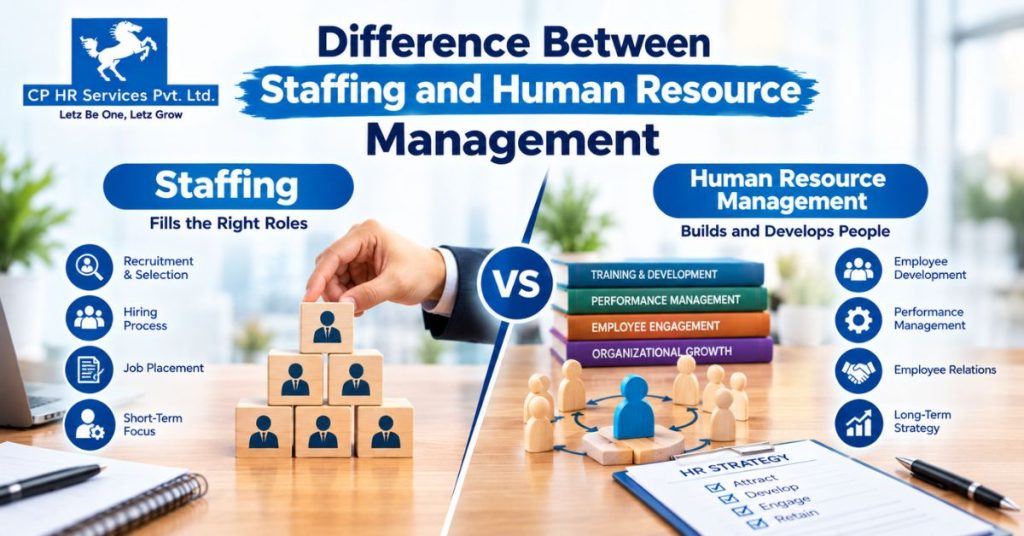
People use “staffing” and “human resource management” as if they are synonymous. They don’t. One on top of the other, you wrap a job. When they get mixed up, you end up with muddled job roles, thin HR plans, and wrong exam answers. This guide simplifies staffing versus human resource management: you will see what each of the terms covers, where they overlap, and how to make use of both in a real business. The Short Answer: Difference Between Staffing and Human Resource Management Staffing is about filling roles with the right people and keeping those roles filled. Human resource management (HRM) is the larger task of managing all that affects people at work. That includes hiring, but also pay, policies, discipline, welfare, and more. Lesson 2 National Institute of Open Schooling 2.1 HRM is a wider concept, and staffing is one part of it. Here is the difference in 3 lines: What Is Staffing? Staffing is one of the functions of management. In a Class XII handout on the aees.gov.in website, it is described as “filling and keeping filled the positions in an organisation structure”. As the NIOS lesson states, it is “the managerial function of using and developing human resources”. Notice the two pieces. You fill the seats, and you keep filling the seats. “If you hire well and lose people in six months, you’ve only done half the job. The Staffing Process The handout lists the following steps: identifying workforce requirements, recruitment, selection, placement, advancement, appraisal, and development. Here’s the breakdown: Who Handles Staffing All managers do some staffing. Managers want capable people on their teams. Much of the process is delegated to an HR team or an outside partner for larger companies. CP HR Services, a Pune-based HR firm in business since 2006, lists recruitment, background verification, and hiring assessments as separate hiring solutions on its website. These three services correspond to the recruit and select stages described above. What Is Human Resource Management? HRM manages people throughout their entire period with a company. The IEEE Technology Navigator states that HR encompasses the entire employee lifecycle—from attracting and hiring talent to developing employees, managing compensation/benefits, labour relations, and separation from employment. This list shows why HRM is the wider term. Staffing is in the early half of the life cycle. HRM addresses all of this. What HRM Covers Why HRM Decisions Shape Staffing Results Other choices affect the effectiveness of staffing. For one thing, career paths influence how long people stay. TD Magazine’s ATD article notes that employees at organisations with high internal mobility are staying for approximately 5.5 years, compared to slightly under three years at organisations with low mobility. No matter how good a company’s hiring is, a company with weak career paths is going to fill the same seats over and over again. Staffing vs Human Resource Management: Side-by-Side Comparison Factor Staffing Human resource management Scope Narrow: filling and keeping roles filled Wide: the whole employee lifecycle Main goal Right people in the right jobs Capable, motivated, well-managed workforce Typical activities Planning headcount, recruiting, selecting, placing, training Everything in staffing, plus pay, policy, relations, welfare Time horizon Tied to vacancies and role changes Continuous, every day of employment Who owns it? Line managers, often with HR support HR department with line manager input Where it lives One function within management A broad discipline of its own Sample question Do we have enough trained machine operators? Is our pay fair, and are our policies clear? Sign of failure Empty seats or poor fits High turnover, unrest, weak morale How Staffing Fits Inside HRM Think of HRM like an umbrella. One of the biggest ribs holding it up is staffing, but it is not the whole umbrella. Work that belongs mainly to staffing: Work that belongs to HRM beyond staffing: Some activities belong to both camps. Many Indian textbooks place training, appraisal, and pay design under staffing and others under HRM. That should not trouble you. The edges are fuzzy, but the big picture is there. Staffing is about getting and developing the right people. HRM is about managing the entire relationship. A Quick Scenario Take a manufacturing company that has 60 people. The plant superintendent needs three new machine operators for a second shift. She counts the jobs, puts them up, interviews six possibilities, chooses three, and arranges their first week’s training. That’s personnel. Meanwhile, the HR manager is setting overtime rules for the new shift, changing pay bands, updating the leave policy, handling a scheduling complaint, and investigating why two supervisors quit last quarter. That’s HRM. Both jobs are important and feed into each other. This is a sample case, not a real-world company. Common Mistakes to Avoid Here’s how teams get stuck: Which Does Your Business Need First? Most businesses need both from the start, but small teams can start light. Go through these steps: For smaller companies without an HR team, steps two through four will require ready-made documents. CP HR Services lists HR consulting on a monthly retainer and on-demand HR support, including formats, handbooks, and SOPs, as part of its HR consulting services. Next Steps Remember the simple rule: staffing is a part, and HRM is the whole. Fill your seats by getting your staffing right. And then construct the wider HRM layer of pay, policy, and employee care so people want to stay in them. Related reading: The CP HR Services blog explores topics such as how to help new hires get settled in on the first day. FAQs on Staffing vs Human Resource Management What is the main difference between staffing and human resource management? Staffing includes planning, recruiting, selecting, training, and appraising to fill and keep positions. HRM is wider. This includes staffing and pay, policies, employee relations, welfare, and legal records. Staffing is one facet of HRM, not a stand-alone or equal area. Is staffing a part of human resource management? Yes. Indian business studies materials, including a National Institute of Open Schooling lesson,
Difference Between Organizing and Staffing
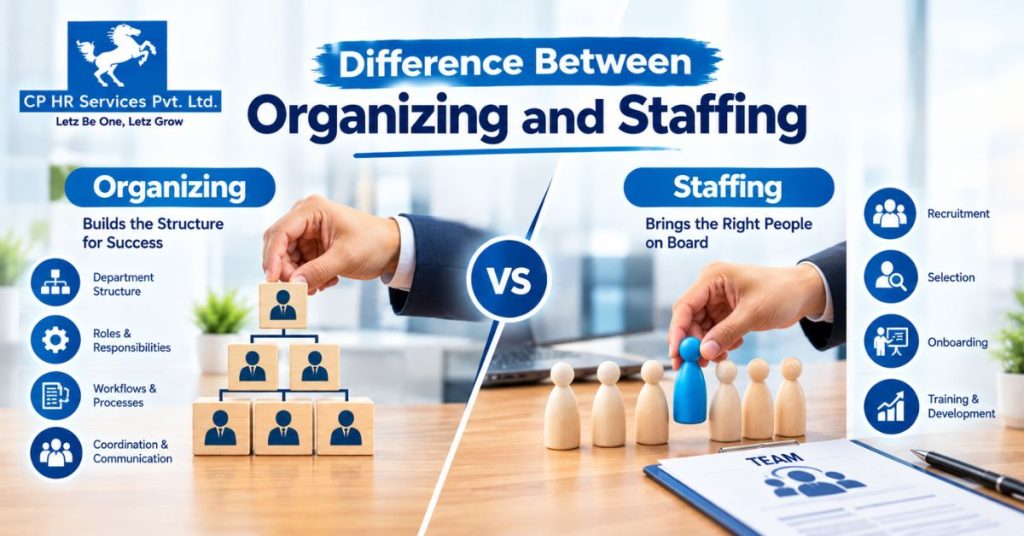
Sooner or later, every manager hits the same wall. The work grows, the team grows, and no one knows who owns what, and which seats are still empty. Two management functions handle those problems, and people always mix them up. This guide resolves organising vs. staffing in layman’s terms. You will see what each does, where it fits in the management cycle, and how to use both without tripping over either. The Short Answer: Difference Between Organising and Staffing An organisation designs the structure of a company. It establishes the tasks, who reports to whom, and where each role belongs. Staffing is the process of putting people into that structure. It finds, trains, selects, and keeps the employees who fill those positions. Here is the difference in one line: Where Organising and Staffing Fit in the Management Cycle Management textbooks break down the work of a manager into functions. According to OpenStax, the four main functions are planning, organising, leading, and controlling. In the same model, organising is the step that structures work and allocates resources. Where are the dudes? Some textbooks put it under organising or leading, because that four-function model doesn’t list it as a separate function. In many Indian business studies courses, it is treated as a separate function. “Staffing is the managerial function of filling and keeping filled the positions in an organisation structure,” reads a Class XII handout on the aees.gov.in website. That order remains in either case. You plan the work, you design the structure, you fill it in. What Is the Organising Function of Management? Organise goals into a working structure. Planning sets the targets, then a manager asks how to split the work up so people can hit them. The outcome is an organisational structure – a clear picture of roles, authority and reporting lines. What Organising Includes Common Organisational Structures Organising in Action Think about a logistics startup of 40 people. The founder divides the company into dispatch, warehouse, customer support and finance. She writes a short description of what each lead does and makes decisions about reporting lines. She hasn’t hired a single new person yet. That’s organizing. This case is an example, not a real company.” What Is the Staffing Function of Management? Staffing is putting the right people into the positions that the organisation created. It also keeps them filled over time because people leave, grow, and change jobs. We can take it one step at a time. The Staffing Process Who Handles Staffing Line managers know the requirements of a role. The process is normally run by HR teams. And some companies also work with outside partners. CP HR Services, a Pune-based HR firm operational since 2006, offers distinct hiring solutions covering recruitment, background verification, and hiring assessments on its website. Those three steps are a good fit for the recruit and select stages above. Organising vs Staffing: Side-by-Side Comparison Factor Organising Staffing Main focus Roles, authority, and reporting lines People who fill those roles Core question What work exists, and how does it connect? Who is right for each seat? Output Structure chart, role descriptions Hired, trained, and placed employees Timing Comes right after planning Comes after the structure is set Who leads it? Top and middle managers Line managers with HR support Time horizon Reviewed when strategy or size changes Runs all year, since people come and go Tools Org charts, job descriptions, workflows Job ads, tests, interviews, training plans Sign of failure Confusion over who decides what Empty seats or poor fit in the seats How Organising and Staffing Work Together Imagine organising as the blueprint and staffing as the construction crew. A strong blueprint without a crew is an empty building. A planless crew leaves you with a mess. Look out for these warning signs: Staffing choices also affect how long your structure remains stable. An ATD article in TD Magazine notes that employees in organisations with high internal mobility stay about 5.5 years, while employees in organisations with low mobility stay just under three years. The longer your structure sits, the fewer vacancies you will have. Hiring externally is also expensive. Wharton’s study of an investment banking environment found that outsiders need about two years to get up to speed. That is one industry, so take it as a warning and not a rule. It still demonstrates that staffing decisions deserve as much thought as the structure. Common Mistakes to Avoid And here’s why so many companies fail: Steps to Apply for Organising and Staffing in a Growing Business Next time you grow your team, use this order: Smaller firms that don’t have a full HR team need ready-made documents for steps four and seven. CP HR Services offers HR consulting services including formats, handbooks and SOPs with on-demand HR support. Next Steps Staffing and organising work in pairs. One draws the structure, one fills it in. First, build the structure, then hire against it, and as your business evolves, review both. See also the CP HR Services blog for related reading, such as how to help new employees settle in on day one. FAQs on Organising vs Staffing What is the difference between organising and staffing? Organising is the process of building the structure of a business, defining roles, authority, and reporting lines. Staffing is the process of filling the structure with the right people through recruitment, selection, training, and appraisal. Organising decides what seats there are. Staffing decides who sits in them. Which comes first, organising or staffing? First comes organising. You can’t tell who fits until you have a clear structure and defined roles. Then staffing fills those roles and keeps them filled as people leave, grow or move to new positions. Is staffing part of human resource management? “Yes.” Staffing is a part of human resource management. The staffing function is concerned with recruitment, selection, training, appraisal, and development of people. Line managers are still involved because they know what each role requires and who does it
Internal and External Sources of Recruitment: Know the Difference
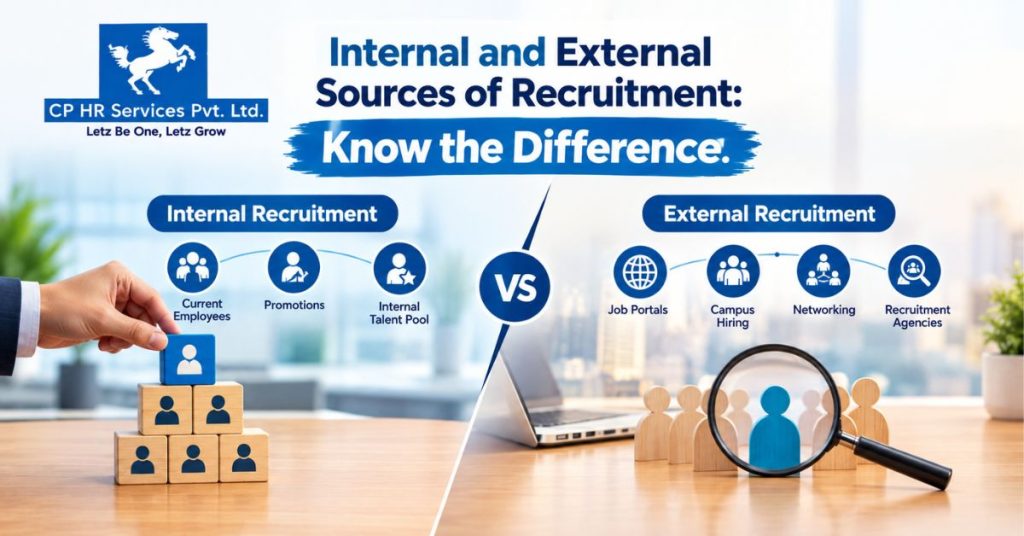
You have an open slot and a quick turnaround. Do you look inside your own team? Or do you just post the job and see who shows up? This choice is central to internal versus external sources of recruitment. Both paths work, and both have trade-offs in cost, speed, and risk. Let’s break it down so you can pick the right path for your next vacancy. The Short Answer Internal sources fill a vacancy with people already working for your company. It is filled with candidates from outside the company by external sources. Internal hiring is typically cheaper and quicker. External hiring brings in new skills and a wider talent pool. Most growing companies use both, varying by role. What Are Sources of Recruitment in HR? A source of recruitment is any location or channel from which you find candidates for a job. HR teams then tag these sources into two buckets based on one question – is the candidate already working for you? That answer will inform your budget, timeline, and even how your current team feels about the opening. So it pays to know both groups before you write the job post. Internal Sources of Recruitment Internal sources of recruitment are the talent you already have on board. They know you, and you know them. They know your products, your managers, and your habits. That’s what it looks like in real hiring. Common Internal Hiring Methods Advantages of Internal Hiring The retention point is supported by research. According to an ATD article in TD Magazine, employees at organisations with high internal mobility stay about 5.5 years, versus slightly under three years at organisations with low internal mobility. According to SHRM, LinkedIn data shows that employees who move around within a company are also more likely to stick around. Disadvantages of Internal Hiring External Sources of Recruitment External sources of recruitment are those that reach out to people outside your company. This group reaches more channels than the internal group and is still growing as hiring goes online. Common External Hiring Channels Advantages of External Hiring Disadvantages of External Hiring Internal vs External Sources of Recruitment: Side-by-Side Comparison Factor Internal sources External sources Candidate pool Current employees only Anyone in the job market Cost Usually lower Usually higher Speed Faster Slower Ramp-up time Short Longer Fresh ideas Fewer More Risk of a bad hire Lower, since you know the person Higher, since you know less Effect on morale Boosts it Can bruise it if staff feel ignored Best for Next-step and leadership roles New skills, fast growth, entry-level volume What the Research Says About Internal and External Hires Here’s why this decision should be revisited. Matthew Bidwell, a Wharton professor, looked at the question in an investment banking context. He found that outside hires received much lower performance ratings in the first two years than employees who were promoted or transferred into similar roles and said it takes about two years for outsiders to catch up. New hires from outside also earned much more than staff members promoted from within for similar jobs. That’s a straightforward tradeoff. You pay more for an outsider and wait longer for the complete results. Cost works the same way. According to LinkedIn’s talent development team, hiring a new employee costs about 2.5 times more than reskilling an existing one. Be careful. That’s one industry the Wharton study looked at, so consider it a cautionary tale, not a rule. The figures are also based on large company data sets, and your own figures may differ. Leverage the research to ask better questions, then look at your own hiring data. A Quick Scenario Take the example of a midsize manufacturer looking for a new production supervisor. A senior machine operator has 3 years with the firm and knows every line and has trained 2 juniors. Bringing that person in from within costs next to nothing, and the trust of the team is already there. Then the company needs a new operator, a position that is easier to fill from outside. Now reverse the roles. The same manufacturer wants a quality systems lead to bring in a certification that no one on the staff has ever worked with. There is no internal candidate. This time around, the smart move is to go outside. This is a simple illustration of the pattern. But the role determines the source. How to Choose Between Internal and External Hiring This is what you need to do for each new opening: When Internal Hiring Wins When External Hiring Wins Vet Every Hire, Whatever the Source “Because there are more unknowns with outside candidates, checking is even more important.” CP HR Services, a Pune-based HR company that has been in business since 2006, lists recruitment, background verification, and hiring assessments as separate hiring solutions on its website. This division makes sense. Hiring a candidate and confirming a candidate are two different jobs. Care must be taken with internal moves too. A long-time employee who moves to a finance or security position still needs a reasonable assessment of the requirements of the new role. Tips to Make Either Route Work Next Steps No path wins all the time. Internal hiring saves your budget and retains good people. External hiring brings in skills you don’t have. Pair the source to the role, track what each costs you, and look over the numbers after each hire. To learn more, visit the CP HR Services blog for topics such as helping new employees get settled on their first day. FAQs on Internal vs External Sources of Recruitment What is the main difference between internal and external sources of recruitment? Internal sources fill a vacancy by using your current employees through transfers, promotions, and internal postings. It is filled from outside the company through external sources like job portals, agencies, campus drives, and social media. Internal hiring is usually cheaper. External hiring gives you more choice. Are employee referrals an internal or external source of recruitment?
What Is External Sources of Recruitment in HRM
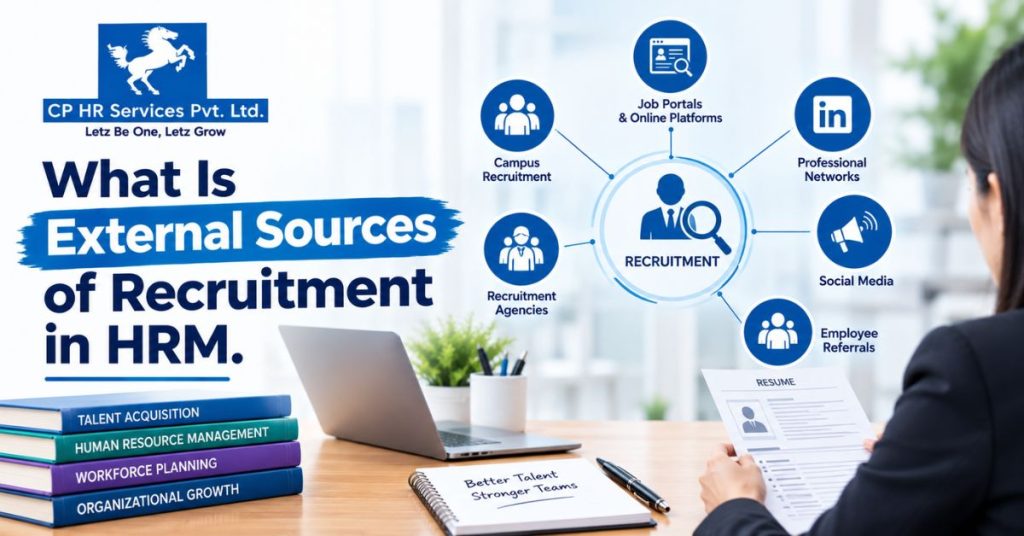
All hiring plans start with one question: where do the candidates come from? Sometimes the answer is inside your company. And often it doesn’t. Recruitment in HRM: External Sources – An Overview of the Main Sources, Pros and Cons, and Matching a Source to a Role. It also offers insights into how Indian employers can use public tools and screen outside hires. Let’s break it down. Just a quick note on sources. I used open university textbooks, Government of India records, recruiting blogs, and public pages of an HR firm. I obtained them on October 9, 2026. The textbooks use different terms. I note the differences below. What Are External Sources of Recruitment in HRM? External recruitment is the filling of a vacancy from outside your organisation. An open textbook on recruitment defines it as ‘searching outside the organisation for candidates’ and ‘enlarging the size of the talent pool’. External sources are the channels through which you get those outside candidates. Here are the most popular: One recruiting blog puts the idea succinctly: External recruiting draws on talent outside your organisation through job postings, agencies, campus hiring, social media and direct outreach to passive candidates. Passive candidates are people who are employed and not actively seeking employment. Internal vs. External Recruitment Employers rarely take one road for good. One chapter in a textbook said that a recruiting plan must specify whether candidates will come from inside, outside, or both. It also says the right choice depends on the labour market, the availability of internal talent, the budget and the company’s goals. Internal recruitment External recruitment Candidate pool Current employees People outside the company Typical sources Internal job postings, promotions, transfers Job portals, agencies, campuses, social media Cost and speed Usually lower and faster Usually higher and slower New skills and ideas Limited to what you already have Wider pool, new viewpoints Risk Smaller pool, possible gaps Unknown candidate, longer settling in Some organisations have already taken the decision. The same textbook notes that some organisations have no real choice, such as the military, which goes internal, or a small business, which goes external. Types of External Sources of Recruitment Now, to the channels themselves. They fit different roles and budgets. Job Portals and Company Career Pages Job boards cast the widest net. One recruiting blog reports that job boards generate about 90 per cent of applicants, and employee referrals generate 38 per cent of hires. “Those numbers are indicative, based on vendor analysis,” he said. The pattern, however, is plain. “Portals bring volume, and you’ve got to screen it yet.” Recruitment Agencies and Executive Search Many employers will outsource the search to an outside firm. Outside firms that do the searching are, in textbook language, external recruiters. Executive recruiters specialise in senior roles, and staffing companies provide temporary jobs. For a top-level position, a textbook suggests that the best way to find the right person might be to use an outside head-hunting firm. Campus Recruitment Campus drives are good for entry-level jobs. The textbook says that while campus recruiting can be effective for entry-level positions, it takes real effort to build relationships with colleges. Schedule visits early, as placement calendars fill quickly. Social Media Recruiting Social platforms position your vacancy in front of people where they’re already hanging out. “Social media is a popular recruiting method,” a textbook states. “Advertising on social networking websites may be the best strategy for an entry-level position. It also allows you to contact passive candidates directly. Job Fairs and Events Job fairs gather a lot of candidates in one room. Some companies have their own job fairs, while others go to industry or job-specific fairs to find specific people, says the textbook. Fairs allow for quick screening, but staff time adds up. Government Employment Services The public option is in India. The Ministry of Labour and Employment converted the 978 employment exchanges into career centres and launched the National Career Service (NCS) portal on 20 July 2015. Employers sign up with a Labour Identification Number and post vacancies on the portal. As of 15 November 2024, more than 3.53 crore vacancies have been posted, and more than 36.23 lakh employers have registered, the ministry informed Parliament. The legal context matters too. The NCS is supported by the Employment Exchanges (Compulsory Notification of Vacancies) Act, 1959, to the extent applicable. Is your establishment covered by the Act? Check with your legal adviser. Employee Referrals Referrals are in a grey area. Some sources classify them as internal recruitment, as a current employee makes the introduction. Others classify them as external recruitment because the candidate is from outside. Referrals are a great way to drum up interest in a posted role, and employers will typically give the referring employee an incentive, a textbook says. Regardless of the label you use, referred candidates still need the same screening as everyone else. How to Choose the Right External Source Match source to position. This fit guide uses points from the above textbooks: Role Source that often fits Why? Senior or executive role Executive search or head-hunting Outside firms can recruit for high-level positions. Entry-level role Campus drives, social media Campus recruiting can be effective for entry-level jobs. Temporary role Staffing firm Temporary positions may use a staffing firm. Hard-to-find skill Agency, direct outreach Reaches passive candidates Large volume Job portals, NCS, job fairs Wide reach at a lower cost per applicant Do some labour market research before you sign up. The textbook warns that recruiting from outside necessitates understanding the labour market and that talent availability varies widely by field. A source that works in one sector can fail in another sector. Advantages of External Recruitment A SAGE textbook summarises these benefits of external hiring: Disadvantages of External Recruitment The same summary lists the costs: That’s the last reason why screening is so important for external hires. How to Measure Which Source Works Don’t guess which channel is the best. Results to follow. One textbook suggests comparing the
Do Companies Check Education Background in India

You have an offer in hand. Then HR asks for your degree certificates and mark sheets. Is this normal, or a warning sign that something is wrong? Do companies in India verify educational background? Yes, in many hiring flows, but the depth varies by sector, role, and employer. This guide will tell you who verifies, when it happens, how it works, and what to do before a verifier calls your college. Let’s get started. Note resources: quick. I used official bodies, news coverage of surveys, legal commentary, and a verification firm’s public page. I accessed these on 9 October 2026. This is general information and not legal advice. The Short Answer: Yes, Often After the Offer Most mid-size and large employers do check education at some point, and it’s usually after the offer, not before the interview. One report on hiring fraud talks about discrepancies during the post-offer background check process that lead to lost time and money, which tells you when many employers run their checks. Here’s the pattern brief: Depth is the true variable. A 2017 trade report, quoted by a business outlet, says 90 per cent of organised-sector employers, except IT, banking and financial services, do only minimal background checks. That is an old figure, so take it as history. It does suggest IT and finance have long been more closely checked than other sectors. And government jobs are the same. “Getting a government job in India is not the end of the road,” says a blog post on CP HR Services. “Before the appointment letter comes verification. Why Companies Check Education Background in India Employers check. Fake credentials are a real, measurable problem. This is the evidence. By law, degrees can be illegal. The University Grants Commission (UGC) has stated that degrees issued by unrecognised bodies are not valid for higher education or employment. The UGC list has 32 entities in states and union territories, a public summary dated February 2026 shows. The count is changing; check UGC’s live page. Research points the same way. A study from 2020 sent out job applications without a degree, with a “grey” degree from a dubious university, and with an authentic degree. Grey degrees boosted callbacks by 42 per cent compared to no degree, but they were less effective than real degrees. The authors interpreted this as employers doubting the authenticity of degrees and discounting questionable ones. Verification removes exactly that doubt. Which Sectors and Roles See the Most Checks? The data reveal sector trends. The most prevalent employment-related disparities are found in IT/ITeS, financial services, healthcare, professional services, and BPO/KPO/GCC roles, as per a news summary dated May 2025. Verification firms have a wider mix. The industries are mentioned on the CP HR Services background verification page: IT and technology, banking and financial services, retail and real estate, education and EdTech, healthcare, manufacturing and logistics, MSMEs and startups, and CXO and leadership hiring. It also says its checks apply to permanent, contractual, and leadership positions. “So the question is less about ‘which sector checks’ and more about ‘how far will each employer go’. A startup could just look at your highest degree. The bank may check all your submitted credentials. What Do Companies Verify About Your Education? These checks usually consist of: There is also a government path. The National Academic Depository (NAD) runs on DigiLocker. Colleges and universities upload records in NAD, students share them with specific consent, and verifiers check authenticity directly, the Press Information Bureau said. The NAD materials also say that employers may verify an award with the student’s prior approval. College and year not listed on NAD? Many verifiers will still be reaching out to the college or university directly. How Companies Check Education Background Step by Step The normal sequence is: Steps 3 to 5 are often done by contractors for many employers. CP HR Services puts it like this: The client sends the candidate’s details, the firm gets digital consent and then runs checks through official channels that it is authorised to use, before the employer receives a report. It says most verifications will take between two and seven business days, depending on the cheques requested. It also says its systems are GDPR and ISO 9001:2015 compliant. Timelines depend on how quickly colleges and universities respond. A busy exam office can add days, so submit clean documents early. What About Consent and Your Data? Now, this process is governed by India’s data protection rules. According to legal commentary, the government notified the Digital Personal Data Protection Rules on 13 November 2025 with a phased rollout. Another summary says: “The key consent, breach and children’s data responsibilities begin 14 May 2027. One legal primer identifies a “legitimate use” ground that may allow employers to process some employee data for employment purposes without consent. It also cautions employers to be careful where that ground may not apply. Approval from the student for education records on NAD is shown above. So what does that mean for you? Read every consent form, make a copy, and ask HR how long your data will be kept. Talk to an expert if you have legal questions. What Happens If Your Education Details Do Not Match? The flag doesn’t always stop the process. Here’s what verifiers say they’re seeing. IT and telecom hiring problems include unaccredited colleges and degrees not matching the course claimed. Another report says that the main problem in education checks is fake certificates and degrees from blacklisted colleges. The report itself does not determine your destiny. The report highlights discrepancies so the employer can decide with full knowledge. Results may differ by employer. If you receive a flag, do the following: Many of the mismatches are minor errors, such as a spelling gap or an incorrect year of passing. Most are resolved with fast, documented responses. How to Get Ready for an Education Check Be prepared before the request comes. The next steps are easy. Complete items 1-4 this week. Wrapping Up Do
How Do Background Checks Verify Education?

Your CV says you have a diploma. The employer demands proof. That gap is where education verification begins, and it’s more structured than most candidates expect. This guide will explain how education is verified via background checks, who is contacted, what records matter, and what happens if information doesn’t match. Let’s break it down. First, a quick note. I focus on India because that’s where the main official systems are. I checked public sources on 9 October 2026. This is a general guide; procedures vary by employer and country. How Do Background Checks Verify Education? Simply put, a verifier takes the details you gave, checks that the college or university can award that credential, checks the award with the awarding body or a government digital record, and matches everything against your claim. Here are the instructions: What Education Details Get Checked? Verifiers do not simply look at a certificate. They consider some points: Education verification is where an HR firm like CP HR Services based in Pune can help. They will check the degree or certificate, enrolment, and graduation, and verify whether the degree was recognised by UGC or AICTE. That list is the same as the five points above. Why the Awarding Body’s Approval Matters The fact that a certificate looks genuine doesn’t mean much if the issuer had no right to issue it. The University Grants Commission (UGC) of India has said that only universities established by a central, state, or provincial act or empowered under the UGC Act can award degrees. It added that degrees from unapproved bodies were not valid for higher education or employment. That is why verifiers look at approval first. Here’s how they do it: If you are going to study somewhere, do this check yourself before you pay fees. It takes minutes, guards years of work. How Digital Records Work: NAD and DigiLocker Paper certificates are easy to forge, so India has built a digital one. The National Academic Depository (NAD) is a Ministry of Education initiative to provide colleges and universities with an online store, available 24/7, to house their academic awards. The purpose is to prevent fake and forged paper certificates. The flow, as stated by the Press Information Bureau, is as under. Colleges and universities upload verified records into NAD through DigiLocker. Students can view them on DigiLocker. Students share them by providing explicit consent. The verifiers then directly verify the authenticity through NAD and DigiLocker. Two practical points follow: Not all graduating years or colleges are on NAD. This is why the verifiers also often contact the issuing university directly. How a Verification Firm Handles Education Checks Many employers farm this work out to a verification firm. CP HR Services describes its workflow in this way. The client gives candidate details, the firm obtains digital consent, and the checks run through official channels. Then the employer gets a report, and the report points out inconsistencies so the employer can make an informed decision. Two other facts from its service page are worth knowing as well: Education is a slice of a larger pie. The same page also lists identity, employment, address, criminal record, reference, and credit checks for sensitive roles. Employers typically run several together, so a delay in one check can hold up the entire report. Common Red Flags Verifiers Look For Most education fraud follows a few patterns. Verifiers look for these: There are many honest mistakes with flags. A typo on a certificate or a change of name after marriage can look suspicious until someone explains it. What Happens When Education Details Do Not Match? A mismatch doesn’t always doom a job offer. The standard sequence looks like this: Universities are helpful here as well. Some tell students to verify the details on their digital certificate and report any inaccuracies. Do that sooner, before a verifier catches you in a mistake. How to Prepare for Education Verification With a little prep, most problems can be avoided. Utilise this checklist: Wrapping Up Education verification has three questions: is the college or university accredited, is the award real, and does the record match your claim? Have your paperwork in order, check your own records, and respond promptly to questions. To see how an employer-side service lists its checks, check the description of CP HR Services at the verification page. Frequently Asked Questions How do employers verify a degree certificate? Employers or verification companies first confirm that the college or university is approved, then verify the award with the issuer or a government digital record such as NAD. They cross-check names, courses, and dates against your claim. They flag discrepancies. What is the National Academic Depository? NAD is an online store for colleges and universities’ academic awards, provided by the Ministry of Education. Students can access their records through DigiLocker, and employers can verify an award with prior approval of the student. Can a background check catch a fake university degree? Yes. Verifiers verify that the awarding body is approved and matches the UGC fake university list. They also verify the award with the issuer. UGC says a degree from an unapproved body is not valid for employment. How long does education verification take? The timing depends on the college or university, the type of record, and how fast the issuer responds. Most of its cheques take two to seven business days depending on what cheques the employer requests, says a verification firm. Do employers need my consent to verify my education? Employers and other NAD users authenticate awards with the student’s prior approval. An initial step of consent before checks commence is also stated by verification companies. Always read and keep a copy of the consent form.
Ericsson Background Verification Process Explained

You passed the interviews, and now you get an email about verification. One wonders what happens after that. Ericsson has detailed most of its background verification process on its public hiring pages and recruitment privacy notice, so the Ericsson background verification process is no mystery. This guide decodes what Ericsson says it checks, when checks apply, how it handles your data, and how to prepare. Let’s get into it. Just a quick note. This article cites Ericsson’s public pages accessed October 9, 2026. This is not an official statement from Ericsson. The specifics vary by role and country, so check with your recruiter to confirm specifics. What Is the Ericsson Background Verification Process? It is the set of pre-employment checks. Ericsson may run to verify what you told them during hiring. Ericsson’s recruitment privacy notice says it may do background checks on candidates applying for jobs considered high risk due to the nature of the role or level of access to sensitive information and resources. The notice also says these checks are only performed where appropriate and permitted under applicable law and are to verify information obtained during the recruitment process and to assess suitability, integrity and reliability. Here’s the quick lowdown: So not every applicant goes through all the checks. Depends on the job. How deep it goes. Where Background Checks Fit in the Hiring Process at Ericsson The usual route is through Ericsson’s careers page. The steps are as follows: You’ll see. The hiring page does have the reference check, but there is no step for a background check. The privacy notice includes background checks and puts them within the framework of the recruitment process. Ericsson doesn’t give exact timing on its public pages, so ask your recruiter when yours will be. What Does Ericsson Verify? The privacy notice explains what data Ericsson can process for background checks. Let’s take it apart by category. Identity, Employment, and Education Checks Ericsson may review your name, date of birth, address history, ID or passport, and contact details for identity, employment history, education, and professional integrity. It may also review your CV, past roles, references, degrees, certifications, directorships and conflicts of interest. One thing stands out. The notice adds that Ericsson may also use information from your professional social media, such as LinkedIn. Make sure your profile matches your CV. Financial, Criminal, and Sanctions Screening Some roles even go further. For financial checks, criminal records and sanctions watchlists, Ericsson may process credit history, bankruptcy, criminal convictions, police extracts, sanctions lists and adverse media. The notice provides two legal bases for these checks. One basis is “legitimate interests”, and another is compliance with legal obligations, where some countries require background checks. Reference Checks References are in a class on their own. Ericsson then asks for references at the end of the process and contacts them. The privacy notice also includes referees. It says Ericsson gathers their contact details and what they say about your work with them. Give your referees a heads up so the call doesn’t come as a surprise. Right-to-Work Documents Ericsson also handles immigration paperwork in addition to background checks. It says that when preparing your employment contract, the notice tells you it may process information needed to verify your right to work, for example, visa or work permit information. Consent, Privacy, and Your Rights A lot of candidates are worried about who sees their data. Ericsson’s notice tries to answer some of these questions. How Long Does Ericsson Background Verification Take? Ericsson does not provide a timeline. How long it takes depends on the role, the country, how many checks are applicable, and the speed of response from previous employers and referees. For context, verification firms publish their own figures. CP HR Services says most of its verifications are finished in two to seven business days, depending on the checks requested. That figure is for its own service, not for Ericsson’s. This is a rough guide only; don’t use it as anything more. How Employers in India Usually Run These Checks Candidates in India often ask how the checks are actually carried out on the ground. CP HR Services, an HR firm based out of Pune, is a typical employer-side service. In this part, we will go over the usual verification process for Indian hires. It does not describe Ericsson’s own methods or vendors. The checks listed on its service page are: The process begins with the employer giving candidate details. The company obtains digital consent, processes the checks through official authorised channels and delivers a report. CP HR Services says its reports highlight discrepancies so that the employer can make the call. Systems are compliant with ISO 9001:2015 and GDPR standards, it states. Notice the overlap with the Ericsson list. Identity, employment, education, criminal record, and references are common elements in both. That’s why the preparation is similar across employers. How to Prepare for Your Ericsson Background Check You can’t control the outcome, but you can control your file. Look at this list: The next steps are simple. Do these before the request comes, not after. Beware of Fake Ericsson Verification Requests The word “verification” is commonly used in hiring scams. Ericsson warns it will never ask for personal documents, fees, or payments during the recruitment process. It also says legitimate contact is only from @ericsson.com, @ericsson.net, or @ericsson.se email addresses. And that’s why it is important. Beware of “verification fee” requests. Before sharing anything, verify the sender domain and then check with your recruiter via the Ericsson official careers site. What Happens If Something Does Not Match? Ericsson’s notice does not outline a dispute resolution process. It does entitle you to have inaccurate personal data corrected. If you get a mismatch with a cheque, do the following: Most mismatches are due to minor errors, like a name spelt two different ways or a date that’s off by a month. Usually they get settled with fast, documented answers. Wrapping Up “Background checks are mainly for high-risk
What Is Background Verification for Gep

You must have seen the term “Background Verification for GEP” in a Passport Seva menu and wondered what it means. Here’s the short version. GEP (Global Entry Program) is a trusted US traveller programme, and this is India’s side of the vetting for Indian applicants. This guide covers what the service is, how to apply, what officials look at, how long it takes, and how it is different from the employee background checks HR teams conduct. Let’s break it down. Short note. I looked at the official pages on October 9, 2026. Please check with CBP and Passport Seva for the latest rules and timelines before you act, as they change. What Is Background Verification for GEP? GEP Background verification: Security vetting of Indian citizens who applied to US Customs and Border Protection (CBP) for Global Entry, by the Indian side. As per the Passport Seva guide, it is done by the Government of India on behalf of the US government, under a bilateral agreement. Here’s the short story: The last point will surprise many applicants, and we return to it below. What Is the Global Entry Program? CBP operates Global Entry as a Trusted Traveller Program. It allows fast-track clearance for pre-approved, low-risk travellers. When CBP opened the programme to Indian citizens, India became the 11th country whose citizens could enrol in the programme. For Indian members, a few programme rules are important: How the GEP Verification Process Works Your application will be processed by two government systems, one American and one Indian. The steps, in order, are as follows: 3 to 5 occur on the Indian side. CBP performs steps 1, 7, and 8. What Does GEP Vetting Check? India has no checklist to publish. According to the Passport Seva guide, the vetting process is carried out by several government departments and provides assurance to a foreign government on security and other confidential matters. Here are some checks that are done: CBP is more candid about potential disqualifiers for an applicant. The reasons are listed in the CBP determination notice: Here’s one possible reading of the Indian side. The portal asks you to register with the Passport Office that corresponds to your verification address. That means your address info is important, so keep it consistent with your other info. “This is an inference, not an official declaration.” How Long Does GEP Vetting Take? Expect to wait a long time. CBP says vetting by the Indian government can take 6 months to 2 years and can delay membership approval by as much as 2 years. “Passport Seva says no hard timeline. Processing varies case by case. Apply long before you need the benefit. Do not book travel that requires approval to arrive by a certain date. Can You Track Your GEP Verification Status? Not directly. Passport Seva says the verification status is not made available to applicants or the public by India because it is collecting the information for the US government under a bilateral agreement. Your best signal is CBP’s final notice on your dashboard. In case you have any queries about the form or your appointment, Passport Seva has a national call centre at 1800-258-1800. Common Mistakes That Slow GEP Applications Smallest errors cause the most trouble. Beware of these: Members still need a valid passport and visa to use the kiosks, a visa rule that is often forgotten. GEP Verification vs. Employee Background Verification There are two different things here that people confuse. GEP vetting is a government security vetting associated with a traveller programme. Employee background verification is a hiring process done by employers for potential employees. The second kind is by CP HR Services, an HR firm from Pune. On its service page, it lists these employer-side checks: The process starts with the employer giving candidate details. The company collects digital consent, performs checks through official authorised channels, and returns a report pointing out inconsistencies. The company says its systems meet ISO 9001:2015 and GDPR standards and that most verifications take 2-7 business days. Its page is about screening for employers. The GEP vetting is done through the government, so a private firm cannot take its place.” Here’s the comparison between the two: GEP verification Employee background verification Purpose Global Entry eligibility Hiring decisions Run by Government of India for CBP Employer or a verification firm Your role Apply through CBP and Passport Seva. Share details and give consent. Who gets the result? CBP, not the applicant The employer Typical timeline 6 months to 2 years, per CBP 2 to 7 business days, per CP HR Services If you have looked up this subject matter because you are looking for a job and not a travel programme, then the second column is the answer. Employers typically request your permission, your papers, and honest answers to questions about break periods in your history. Next Steps: A Quick GEP Checklist Here’s a list to use before you start: Wrapping Up GEP background verification is a government process that you initiate, but you can’t see it. Apply early, register with the right Passport Office, keep your details consistent, and let CBP’s dashboard tell you where you stand. If you are really screening new hires for your search, CP HR Services details its employee verification checks on the verification page. Frequently Asked Questions What does GEP stand for in background verification? GEP is an acronym for Global Entry Program, which is a trusted traveller program of US Customs and Border Protection. GEP service on Passport Seva is associated with India vetting its citizens who applied for membership in the Global Entry program of CBP. Is GEP background verification open to everyone? No, Passport Seva says it is not a public service for all Indian citizens. Only those who applied to CBP’s Global Entry Program are put through it, and India carries it out for the US government. How long does GEP vetting take? There is no fixed time limit. CBP says the Indian government vetting can take
What Visa Background Verification Checks

Applying for a visa is a little like telling a stranger your life story. You are so many things. Your file will be approved once a consulate or immigration office has verified your identity, your past addresses, and any red flags on your record. Visa background checks can sound daunting, but they follow a standard pattern. This guide covers what officers look for, what documents you are likely to need, and where people go wrong when applying. Let’s have a look. First, one quick note. Each country has its own rules, and requirements vary by visa type. It is a general guide only, and you should verify details with the official immigration authority of your destination. What Do Visa Background Verification Checks Include? A visa background check is a series of checks carried out by immigration officials on your application. It’s easy. They want to make sure that you’re who you say you are and that you conform to the rules of entry. Most applications will have some combination of these checks: Not all visas trigger all checks. A short tourist trip typically needs fewer steps than a work or residency visa. Here’s how each check works. Identity Checks and Biometrics Identity is first. In the United States, USCIS collects fingerprints, photos, and electronic signatures to confirm identity and to facilitate criminal and national security checks. Applicants fill out an online DS-160 form at US consulates, and officers take fingerprint scans of nearly all applicants. The State Department also runs applicant names against records of past visa applications, refusals, and issuances. Your best bet is to be consistent. Write your name exactly as it appears on your passport on all forms and documents. Small spelling gaps raise questions that could be avoided later. Criminal Record Checks and Police Clearance Certificates For most applicants, the police clearance certificate is important, so let’s look at how a few countries manage it. Canada”. A police certificate, as defined by IRCC, is a statement that you do not have a criminal record or, if you do, a copy of that record. It’s what officers use to check if anything makes you inadmissible to Canada. The certificate is valid for the immigration programme you are applying under. If a country will not issue one, you must show why you cannot get it, including a letter explaining your efforts. United Kingdom: For some skilled worker roles, applicants from the UK need a criminal record certificate, and there is a similar rule for the health and care worker visa. If you’re under 28 years of age, you need a certificate from any country where you spent a total of 12 months or more since turning 18 years old. If you’re 28 or older, you’ll need one from any country you’ve lived in over the last 10 years. India. Indian citizens residing abroad can apply for a Police Clearance Certificate (PCC) to prove that they have no criminal record in India. Foreign nationals who live in India can also apply for a PCC. In an effort to ease the demand from the people applying for jobs abroad, education, long-term visas, and emigration, the Ministry of External Affairs started PCC applications at all online Post Office Passport Seva Kendras from 28 September 2022. How to Apply for a Police Clearance Certificate in India Here are the instructions on the Passport Seva website: Security Screening and Name Checks Besides your paperwork, authorities do their own checks. The security checks, USCIS says, can include fingerprint background checks, an FBI name check, and other DHS or interagency screenings. The State Department runs fingerprints through law enforcement databases and facial recognition against a watchlist on the consular side. This is why some cases are slow. A potential name match can trigger a request for a security advisory opinion, sending the file to Washington for interagency review. That doesn’t mean you did anything wrong. This means officers have to prove that you are not the person on the record. Health Screening Requirements Some visas have a medical step. For example, in the UK, you must take a tuberculosis test if you plan to stay for six months or more, if you lived in a listed country for six months or more, and if you were living there within the last six months. The test is a chest X-ray. A positive result is a certificate valid for six months from the date of the X-ray. Other countries have their own medical exams for certain types of visas. Book a clinic appointment early on, as it can take longer than you expect to do so, and see the official checklist. Financial and Qualification Checks for Work Visas And then there are work visas. If you’re applying for a UK Skilled Worker visa or a Health and Care Worker visa, you’ll need a certificate of sponsorship reference number, proof of knowledge of English and a valid passport. Many also show bank statements as proof of funds unless the sponsorship certificate states the employer will support them. Some applicants apply through Ecctis for qualifications from outside the UK. Keep all your degree certificates, employment letters and payslips in a folder. Officers and employers can ask for them at different stages. How Employers Verify Candidates Who Need a Visa Government checks tell half of the story. Employers who hire someone who needs a work visa will often do their own background verification, so the details in the file will match real records. CP HR Services is an HR company located in Pune. They offer employee background verification services and have various types of checks. Checks are: It’s a straightforward process. The employer submits candidate details, the firm obtains digital consent, and checks are run through authorised official channels before the client receives a report. Most verifications take between two and seven business days, depending on the checks you request, the company says. These employer checks are separate from government visa screening. They are not a replacement for it.