
10 Best Corporate HR Training Solution Programs

The way organizations train employees has changed drastically. Companies that once relied on annual workshops now recognize that learning needs to happen continuously. With 94% of employees willing to stay longer at companies that invest in their development, choosing the right corporate HR training solution program has become a retention strategy. Here’s what the data tells us: organizations spend around $101.8 billion globally on training programs, yet only 10% produces meaningful outcomes. The gap comes down to choosing solutions that fit how your teams work and learn. This guide walks you through the top corporate HR training solution programs in 2026, what sets them apart, and how to pick the right one. What Makes a Corporate HR Training Solution Program Effective? The best programs share three key characteristics. First, they meet people where they are with content that’s short, relevant, and accessible on their schedule. Second, they track what matters by connecting training to actual performance outcomes, not just completion rates. Third, they integrate with your existing systems so you’re not manually moving data between platforms. Top 10 Corporate HR Training Solution Programs for 2026 Let’s break down the platforms that are getting results in 2026. 1. CPHR Services For organizations in India looking for customized Corporate HR Training Solution Programs, CPHR Services offers expert-led learning solutions focused on soft skills development and workforce capability building. CPHR Services specializes in creating tailored training programs that address specific team challenges rather than delivering generic content. Their approach combines behavioral competencies with technical skills, recognizing that both matter as work becomes more automated. Organizations partnering with CPHR Services benefit from continuous learning programs that keep employees growing throughout their careers, not just during onboarding. The focus on measurable outcomes helps companies prove training ROI and adjust programs based on what actually works. 2. TalentLMS TalentLMS is straightforward and designed for growing businesses that need training running quickly without a dedicated L&D team. It includes course creation tools, automated learning paths, and gamification features. The forever-free tier for five users makes testing easy. 3. Absorb LMS Absorb LMS targets mid-size and enterprise organizations delivering training at scale. It uses AI to personalize learning paths and handles complex training scenarios with learner segmentation by department, location, or role. Robust reporting helps prove ROI to leadership. 4. Docebo Docebo focuses on AI-driven personalization, analyzing learner behavior to suggest content matching skill gaps and career goals. Social learning features allow employees to share knowledge and learn collaboratively. Real-time analytics dashboards provide visibility into engagement and outcomes. 5. 360Learning 360Learning emphasizes collaborative learning by allowing subject matter experts across your organization to contribute training materials. This peer-to-peer model scales content creation without expanding L&D headcount. The platform includes tools for feedback, discussion, and co-creation. 6. iSpring LMS iSpring LMS specializes in role-specific training that impacts performance. The rapid course authoring tool converts PowerPoint presentations into interactive training modules, saving time if you have existing materials. Detailed analytics show not just completion but comprehension based on assessment scores. 7. CYPHER Learning CYPHER Learning leads in AI automation for enterprise training. It automates course creation, skill mapping, and personalized recommendations. The clean, user-friendly interface works well for employees who aren’t tech-savvy. Enterprise-grade security standards matter for regulated industries. 8. Litmos Litmos stands out for its extensive off-the-shelf content library. You can pull from thousands of ready-made courses for compliance or skills training instead of building from scratch. Fast implementation means most organizations go live in weeks. Works well for regulated industries needing reliable compliance tracking. 9. Brightspace by D2L Brightspace handles complex training requirements across multiple teams and geographies. It supports personalized learning paths, automation tools, and deep HR system integration. Course completion tracking across your organization appears in a single view. Best for diverse training needs varying by role, region, or business unit. 10. Rippling Learn Rippling Learn integrates training into a broader HR, IT, and finance platform. Training assignments trigger automatically based on HR events like promotions or role changes. Performance data flows between systems, creating a single source of truth for employee information. How to Choose the Right Corporate HR Training Solution Program Picking the right platform comes down to three questions. What result do you need to prove in 12 months? Companies that set a single, measurable KPI see higher adoption rates and faster payback—an approach often recommended by an experienced HR consulting company in Pune working closely with leadership teams. Who will run the program day to day? Match software complexity to the bandwidth you actually have, rather than choosing a feature-heavy platform that overwhelms internal teams. Which systems need to share data? Confirm that native integrations exist with your HRIS, CRM, or performance management software to avoid manual work and reporting gaps. Key Trends Shaping Corporate HR Training in 2026 AI adoption in training has jumped from 25% to 37% of companies in just one year. These tools personalize learning paths, recommend content, and automate administrative tasks. Microlearning continues replacing long training sessions. Employees want 5-10 minute learning blocks between meetings, not three-hour workshops. Companies using bite-sized content see stronger retention rates. Skills-based learning takes priority over role-based training. Organizations now map competencies and create learning paths based on individual skill gaps rather than training everyone in a department the same way. Mobile learning reached $77.4 billion in 2025. With most employees preferring to learn at their own pace and location, mobile access has become essential. Common Mistakes to Avoid Run a three-week pilot with a small group before rolling out company-wide. Track completion rates and gather feedback to prevent larger problems later. About 50% of organizations report that managers lack proper support to help their teams engage with training. If managers can’t carve out time for their people to learn, adoption suffers. Focus on your actual needs, not the longest feature list. A platform with 50 features you’ll never use isn’t better than one with 10 features you’ll use daily. And remember: great platforms with poor content still deliver poor results.
Why Background Verification Matters More for Remote Employees
The pandemic transformed how India works. Offices emptied, home desks filled, and remote work became the new standard. Today, companies hire talent from Mumbai, Bengaluru, Pune, and beyond without ever meeting face-to-face. This shift opened doors to a broader talent pool but also introduced new hiring risks that many organisations overlook. Remote employees access company systems, handle confidential data, and represent your brand from their personal spaces. Without physical oversight, the need for thorough background verification for remote employees becomes non-negotiable. Let’s explore why screening remote workers deserves extra attention and how companies can protect themselves while building distributed teams. The Hidden Risks of Remote Hiring When employees work from an office, there’s natural oversight. Colleagues interact daily, managers observe work patterns, and physical security measures protect sensitive information. Remote work strips away these safeguards. Remote candidates face unique verification challenges due to the lack of in-person interaction, making it harder to confirm identities and work histories. The distance creates opportunities for fraudsters who exploit digital hiring processes. Here’s what makes remote hiring riskier: Identity Verification Becomes Complex Video interviews and scanned documents can be manipulated more easily than face-to-face meetings. Candidates might use someone else’s credentials during virtual interviews, a practice sometimes called employment impersonation. Without physical document verification, fake identity papers slip through more easily. India ranks first globally with 27.2 million identity theft victims annually, highlighting the scale of this problem. For remote positions, companies must verify that the person joining is actually who they claim to be. Data Security Vulnerabilities Multiply Remote employees access company systems through personal devices and home networks, creating multiple security entry points. A candidate with a history of fraud or data breaches poses serious threats when given system access from day one. Unlike office environments with controlled networks and IT monitoring, home setups vary wildly in security. One compromised employee account can expose customer information, financial records, or proprietary data. Credential Fraud Goes Undetected Verifying international candidates’ employment history and educational qualifications becomes challenging when hiring across states or countries. Educational institutions and past employers may operate remotely, making verification harder. Some candidates exaggerate skills or fabricate experience, knowing remote employers might skip thorough checks. This leads to hiring unqualified people who cannot deliver on promises. Why Background Checks Are Non-Negotiable for Remote Teams The case for thorough screening becomes stronger when employees work remotely. Here’s why background verification for remote employees should be a priority: Protecting Company Assets Remote workers often receive company laptops, software licenses, and confidential information before their first day. Without proper vetting, you might hand over expensive equipment to someone with no intention of working or a history of theft. CP HR Services helps companies verify candidate backgrounds before onboarding, ensuring only trustworthy individuals receive company resources. This simple step prevents costly losses. Maintaining Compliance Standards Industry regulations that require background checks apply equally to remote employees. Sectors like healthcare, finance, and IT must screen all hires regardless of work location. Failing to verify remote workers creates compliance gaps that result in penalties. Companies hiring across states must understand regional regulations. What’s acceptable verification in Karnataka might differ from requirements in Uttar Pradesh. Professional screening services navigate these complexities. Building Trust in Virtual Teams When team members never meet physically, trust becomes the foundation of collaboration. Knowing that every colleague passed the same screening standards creates confidence. Employees feel safer sharing information when they know their teammates were properly vetted. Background verification reinforces company values by ensuring new hires align with organisational standards. This consistency strengthens remote team culture. Avoiding Expensive Hiring Mistakes India may lose over ₹1.2 lakh crore to cyber fraud in 2025, much of it involving employment fraud and data breaches. A bad remote hire costs more than just salary. Training time, recruitment expenses, and potential security breaches add up quickly. Replacing someone who doesn’t work out takes months and diverts resources from business goals. Screening candidates properly the first time saves money and headaches. What Should Remote Employee Verification Cover? Comprehensive background checks for remote workers need to address the unique risks of distributed work. CP HR Services recommends these verification components: Identity Confirmation Verify government-issued documents like Aadhaar cards, PAN cards, and passports. Cross-check details across multiple sources to catch discrepancies. For remote hires, consider video verification calls where candidates present original documents. Education Credentials Contact universities and colleges directly to confirm degrees and certifications. With many educational institutions operating remotely, verification takes longer but remains essential. Check that institutions are recognised and accredited. Employment History Reach out to previous employers for Employee Background Verification to confirm job titles, employment dates, and reasons for leaving. This step helps catch resume exaggerations and validates claimed experience. Request relieving letters and experience certificates as supporting proof. Criminal Record Searches Check court records and police databases for criminal history. This protects workplace safety even in virtual environments. Different jurisdictions have different access levels, so work with verification partners who understand local laws. Reference Checks Speak with professional references who can confirm the candidate’s work quality, reliability, and character. References provide insights that documents cannot capture, especially for remote roles where interpersonal skills matter. Address Verification Confirm the candidate’s current address through utility bills, rental agreements, or government documents. This step ensures you can locate employees if needed and verifies they’re where they claim to be. The Role of Professional Verification Services Managing remote employee screening internally becomes overwhelming quickly. Different states have varying data access rules, international verifications require local partnerships, and the time investment distracts from core business. Professional background verification companies like CP HR Services bring specialised expertise. They maintain relationships with educational institutions, government databases, and past employers. Their technology detects document manipulation and flags inconsistencies human reviewers might miss. CP HR Services handles verification with confidentiality and complies with data protection regulations. Their reports provide clear findings that help hiring managers make informed decisions. For startups and small businesses hiring their first remote workers, outsourcing verification makes practical sense.
Top 10 Background Verification Company in Chennai
Hiring the right talent can make or break your business. Before you bring someone on board, you need to know if their credentials check out. Background verification companies in Chennai help businesses confirm candidate details, reduce hiring risks, and maintain workplace safety. This guide walks you through the top 10 providers in the city, what they offer, and how to choose the right partner for your needs. Why Background Verification Matters for Chennai Businesses Chennai’s job market is booming. Companies across IT, manufacturing, healthcare, and retail are expanding their teams. But with growth comes risk. Fake degrees, fabricated work experience, and hidden criminal records can slip through traditional hiring processes. A thorough background check protects your company in several ways: Companies that skip these steps often face legal troubles, workplace conflicts, or damaged reputations. Partnering with a background verification company in Chennai gives you peace of mind and helps you build a trustworthy team. Top 10 Background Verification Companies in Chennai 1. CP HR Services CP HR Services Journey leads the background verification space in Chennai with a client-first approach and accurate reporting. The company handles everything from education checks to criminal record searches, using both digital tools and on-ground teams to verify information. What sets them apart is their quick turnaround time. Most reports arrive within 3-5 business days, which matters when you’re racing to close a hiring process. They cover all standard checks—education, employment, criminal records, address verification, and reference calls. Their team understands local nuances. Whether you’re hiring for a startup in Guindy or a manufacturing unit in Ambattur, they adapt their verification methods to suit different industries and roles. Small businesses and large corporations alike trust CP HR Services for pre-employment screening. Visit their website to learn more about their packages and pricing. 2. AuthBridge AuthBridge operates across India with a strong presence in Chennai. They use technology to speed up verification while maintaining accuracy. Their platform lets HR teams track verification status in real time. The company offers standard background checks plus specialized services like global database searches and social media screening. Their reports are detailed and easy to understand, which helps hiring managers make faster decisions. 3. First Advantage India First Advantage brings global expertise to the Chennai market. They’re known for their comprehensive checks and compliance with local laws. Their verification process covers everything from court records to driving licenses. The company serves multiple sectors including IT, banking, and healthcare. They have a dedicated support team that guides clients through the verification process and answers queries promptly. 4. Springverify Springverify focuses on digital verification methods. Their automated platform reduces manual work and cuts down verification time. Most checks complete within 48-72 hours. They offer a pay-per-check model, which works well for small businesses and startups that don’t need bulk verification services. Their dashboard is user-friendly and provides real-time updates on each candidate. 5. IDfy (formerly known as Credence Verifications) IDfy combines artificial intelligence with human verification to ensure accuracy. They offer video-based verification for remote employees, which became popular during the pandemic. Their services extend beyond pre-employment checks. They also provide periodic employee screening and vendor verification. The company maintains strict data privacy standards and complies with all regulatory requirements. 6. Mintz Global Screening Mintz specializes in international background checks. If your Chennai office hires candidates with overseas experience, they can verify foreign credentials and employment history. They have tie-ups with verification agencies across 200+ countries. Their reports are thorough and include details that might get missed by local-only providers. 7. Verifacts Services Verifacts takes a personalized approach to background verification. They assign a dedicated account manager to each client, which ensures smooth communication and faster resolution of issues. The company has field agents across Tamil Nadu who conduct physical verifications for address checks and previous employer visits. This on-ground presence adds an extra layer of accuracy to their reports. 8. DataFlow Group DataFlow focuses on credential verification, particularly for healthcare professionals. They verify degrees, licenses, and certifications from educational institutions and regulatory bodies. Their services are popular among hospitals, clinics, and pharmaceutical companies in Chennai. The verification process is thorough but takes slightly longer than standard employment checks due to the specialized nature of medical credentials. 9. Triton Verification Services Triton offers affordable verification packages for small and medium businesses. They handle basic checks like education, employment, and criminal records at competitive prices. While they may not have all the advanced features of larger providers, their core services are reliable. They’re a good starting point for companies new to background verification. 10. Accurate Background Accurate Background has been in the verification business for over 25 years. They bring experience and established processes to every check they conduct. Their Chennai office serves clients across South India. They offer both standard and customized verification packages based on industry requirements. Their customer support team is responsive and helps clients understand report findings. How to Choose the Right Background Verification Partner Picking a verification company requires careful thought. Here’s what to look for: Turnaround Time: Ask how long each type of check takes. If you’re hiring quickly, you need a provider who delivers reports within days, not weeks. Verification Methods: Companies that combine digital checks with physical verification tend to be more accurate. Look for providers with field agents who can visit addresses and previous employers. Industry Experience: Some companies specialize in specific sectors. A provider familiar with your industry will understand what checks matter most for your roles. Technology Platform: A good dashboard lets you track verification status, view reports, and manage multiple candidates at once. Test the platform before committing. Compliance and Data Security: Verification companies handle sensitive personal information. Check if they follow data protection laws and maintain secure systems. Pricing Structure: Compare costs across providers. Some charge per check, others offer packages. Make sure there are no hidden fees for follow-up queries or report amendments. Customer Support: You’ll have questions during the verification process. Choose a company with responsive support staff
Background Verification Process for Experienced: 2026 Guide
Finding the right talent is only half the battle. For companies hiring experienced professionals in 2026, the background verification process has become a critical step in building trustworthy teams. This comprehensive guide walks you through everything you need to know about verifying credentials, from understanding why it matters to navigating the latest compliance requirements. Why Background Verification Matters More Than Ever The workplace has changed dramatically. Remote work arrangements and digital credentials have made it easier for candidates to misrepresent their qualifications. Recent studies show that approximately 30% of job applications contain some form of inaccuracy, whether intentional or unintentional. For experienced professionals, the stakes are even higher. These individuals often move into leadership roles, handle sensitive information, or make decisions that impact entire departments. A single bad senior level hire can cost companies three to five times the annual salary when recruitment costs, lost productivity, and potential legal risks are considered, making thorough screening by a reliable recruitment agency essential Background checks protect your organisation from these risks. They verify that the person you’re hiring is exactly who they claim to be, with the experience and qualifications they’ve listed on their CV. What Gets Verified in the Background Check Process The background verification process for experienced candidates typically covers several key areas. Each component serves a specific purpose in building a complete picture of the candidate. Employment History Verification This step confirms the candidate’s previous job titles, dates of employment, and job responsibilities. Verifiers contact former employers directly to validate the information provided. For experienced professionals with 10-15 years of work history, this process can take considerable time. The verification team checks for gaps in employment, reasons for leaving previous positions, and whether the candidate is eligible for rehire at their former companies. This information helps employers spot potential red flags early. Educational Qualifications Check Degree verification confirms that candidates actually earned the educational credentials they claim. Verifiers contact universities and colleges directly to validate degrees, diplomas, and certifications. For experienced professionals, this includes checking professional certifications, specialised training programmes, and continuing education courses. Many industries require specific licences or certifications, making this step particularly important. Identity and Address Verification This basic check confirms the candidate’s identity using government-issued documents like Aadhaar cards, PAN cards, or passports. Address verification involves checking current and previous residential addresses through utility bills, rental agreements, or property documents. Criminal Record Check A police verification check reveals any criminal history that might disqualify a candidate from certain positions. This typically involves obtaining a police clearance certificate from the candidate’s local police station. For senior positions or roles involving financial responsibility, companies often conduct court record searches to identify any ongoing litigation or past criminal cases. Credit History Review For positions involving financial management or access to company funds, credit checks have become standard practice. These reports reveal the candidate’s financial responsibility and any outstanding debts or bankruptcies that might pose a risk. Reference Checks Speaking with former colleagues, managers, or clients provides qualitative insights that documents cannot capture. Reference checks help assess the candidate’s work ethic, interpersonal skills, and professional reputation. The Step-by-Step Verification Timeline Understanding the timeline helps set realistic expectations. Here’s how the process typically unfolds: Days 1-2: Consent and Documentation The candidate provides written consent and submits all required documents. This includes identity proofs, educational certificates, employment letters, and contact information for references. Days 3-7: Initial Verification Verification teams begin contacting educational institutions and previous employers. They verify basic information like dates, titles, and degrees. Days 8-14: Detailed Checks Police verification requests are submitted. Credit reports are pulled (with consent). References are contacted for detailed feedback. Days 15-21: Report Compilation All findings are compiled into a comprehensive report. Any discrepancies are flagged for review. The employer receives a detailed breakdown of all verification results. This timeline can extend to 30 days or more for international candidates or those with complex employment histories spanning multiple countries. Legal Compliance Requirements in India Companies must navigate several legal requirements when conducting background checks in India. The process must comply with various regulations protecting candidate privacy and rights. The Information Technology (Reasonable Security Practices and Procedures and Sensitive Personal Data or Information) Rules, 2011 mandate specific protocols for handling personal data. Companies must obtain explicit written consent before collecting any personal information for verification purposes. The Right to Privacy, recognised as a fundamental right by the Supreme Court, requires employers to limit data collection to what’s strictly necessary for employment decisions. They cannot ask for excessive personal information unrelated to the job role. Some states have specific regulations regarding police verification procedures. Companies operating across multiple states need to understand these regional variations. Common Challenges and How to Address Them Unresponsive Former Employers Many companies have strict policies against providing detailed employment references. When former employers refuse to cooperate, verification becomes challenging. Professional background verification companies like CP HR Services maintain relationships with HR departments across industries, making it easier to obtain necessary confirmations. They know which channels to use and how to frame requests for maximum cooperation. Document Verification Delays Universities and government offices often take weeks to respond to verification requests. These delays can hold up the entire hiring process. Starting the background verification process early, even before making the final offer, can help reduce delays. Some organisations conduct preliminary checks during the interview stage for shortlisted candidates. International Employment Verification For candidates who’ve worked abroad, verification becomes more complex. Different countries have different privacy laws and verification procedures. Working with verification partners who have global networks solves this problem. CP HR Services offers international verification services, coordinating with agencies in other countries to verify foreign employment and education records. Discrepancies in Candidate Information Sometimes verification reveals discrepancies between what the candidate stated and what records show. These might be innocent mistakes or deliberate misrepresentations. When discrepancies arise, give candidates the opportunity to explain. Sometimes the issues result from differences in job title terminology, confusion about dates, or administrative errors in official
How Predictive Hiring Assessments Helped to Reduce Bad Hires by 40%
Hiring the wrong person costs organisations more than just money. Bad hires drain team morale, waste training resources, and disrupt productivity. Research shows that a single bad hire can cost a company up to 30% of that employee’s first-year earnings. Organisations need better ways to identify candidates who will truly succeed in their roles. Predictive hiring assessments have emerged as a game-changing solution. These data-backed tools analyse candidate potential before hiring decisions are made. Companies using these assessments report up to 40% fewer bad hires compared to traditional interview-only approaches. Let’s break down how predictive hiring assessments work and why they deliver such impressive results. What Are Predictive Hiring Assessments? Predictive hiring assessments are scientifically designed tools that evaluate candidates based on skills, cognitive abilities, personality traits, and job-specific competencies. Unlike traditional interviews that rely heavily on gut feelings, these assessments use measurable data to predict job performance. The tools typically include: When CP HR Services implements these assessments for clients, they focus on aligning evaluation criteria with actual job requirements. This alignment ensures candidates are measured against what matters most for success in specific roles. The Cost of Bad Hires: Why Prevention Matters Before exploring how predictive assessments solve hiring problems, understanding the true cost of bad hires is essential. Financial Impact Recruitment expenses, onboarding costs, training investments, and lost productivity all add up quickly. When someone leaves within the first year, organisations must restart the entire hiring process, often involving a recruitment agency again. This repeated cycle drains budgets and exhausts HR teams. Team Disruption Bad hires don’t just affect the person in that role. Co-workers often pick up the slack, leading to burnout and resentment. Team dynamics suffer, and high performers may start looking elsewhere. Opportunity Cost Every day spent with the wrong person in a position is a day without someone who could excel. Projects stall, deadlines are missed, and business growth slows. Companies using predictive hiring assessments avoid these cascading problems by making better decisions upfront. How Predictive Hiring Assessments Reduce Bad Hires Here is why these tools deliver measurable improvements in hiring outcomes. 1. Objective Data Replaces Subjective Bias Traditional interviews suffer from unconscious bias. Interviewers often favour candidates who remind them of themselves or who present well in conversations. These subjective impressions don’t always correlate with job performance. Predictive assessments provide standardised, objective measurements. Every candidate answers the same questions under the same conditions. This standardisation removes variables that lead to biased decisions. 2. Skills Validation Before Hiring Resumes and interviews allow candidates to claim skills without proving them. Predictive assessments require candidates to demonstrate abilities through practical tests. A customer service role might include a simulated call scenario. A coding position could involve solving actual programming challenges. These hands-on evaluations reveal true capabilities better than any interview question. 3. Personality and Culture Alignment Technical skills matter, but personality fit determines long-term success. An employee with perfect qualifications but misaligned work style will struggle in the organisation’s environment. Personality assessments identify traits like collaboration preference, stress tolerance, and communication style. When CP HR Services match these traits to company culture and team dynamics, retention rates improve substantially. 4. Predictive Analytics Identify Success Patterns Advanced predictive assessments analyse data from current high performers to identify common traits. These success patterns become benchmarks for evaluating new candidates. For example, if top sales performers share specific cognitive abilities and personality characteristics, the assessment can flag candidates with similar profiles. This data-driven approach removes guesswork from hiring decisions. 5. Reduced Time-to-Hire with Better Quality Some organisations worry that adding assessments will slow down hiring. The opposite proves true. Predictive tools quickly filter out unsuitable candidates, allowing recruiters to focus on qualified prospects. Hiring managers spend less time interviewing poor fits and more time engaging with candidates likely to succeed. This efficiency speeds up the overall process while improving quality. Real-World Results: The 40% Reduction in Bad Hires Multiple studies confirm the effectiveness of predictive hiring assessments. Organisations across industries report significant improvements after implementation. A 2023 study by the Society for Human Resource Management found that companies using validated pre-employment assessments experienced 39% lower turnover rates. Another research project tracked 500 organisations and found that those using predictive assessments reduced bad hires by an average of 41%. These numbers reflect real business outcomes. Fewer bad hires mean lower recruitment costs, stronger teams, and faster business growth. CP HR Services has helped numerous organisations implement these assessment strategies. Clients report not just fewer bad hires but also improved employee performance and satisfaction scores. Implementing Predictive Hiring Assessments Successfully Getting results requires more than purchasing an assessment tool. Implementation strategy determines success. Define Success Criteria First Before selecting assessments, organisations must identify what success looks like for each role. What skills, traits, and abilities do top performers share? What causes new hires to fail? This analysis creates a blueprint for choosing the right assessment types and criteria. Choose Validated Assessment Tools Not all assessments provide reliable predictions. Look for tools with strong psychometric properties, validation studies, and compliance with employment testing standards. Working with experienced HR consultants ensures assessments meet legal requirements and actually measure what they claim to measure. Integrate Assessments into the Hiring Workflow Predictive assessments work best when combined with other evaluation methods. A typical process might include: This layered approach provides a complete picture of each candidate. Train Hiring Managers on Results Interpretation Assessment results mean nothing if hiring managers don’t understand them. Training ensures everyone interprets data correctly and makes informed decisions. Managers should learn which scores predict success, how to weigh different factors, and how to discuss results with candidates. Monitor and Refine Over Time Track which assessments best predict performance in your organisation. Measure turnover rates, performance reviews, and hiring manager satisfaction. Use this data to refine your assessment strategy continuously. Common Misconceptions About Predictive Hiring Assessments “Assessments replace interviews entirely” Not true. Assessments complement interviews by providing objective data. Face-to-face interactions remain valuable for evaluating communication skills and cultural nuances.
Selective Hiring Assessments Guide for Smarter Hiring
Finding the right talent can make or break your organisation. When you hire the wrong person, you lose time, money, and team morale. But how do you separate truly qualified candidates from those who simply interview well? The answer lies in selective hiring assessments. These structured evaluation tools help you look beyond resumes and interviews. They measure specific skills, cognitive abilities, and behavioural traits that predict job performance. Companies across India now use hiring assessments to make data-driven decisions and build stronger teams. Let’s break down everything you need to know about selective hiring assessments and how they can transform your recruitment process. What Are Selective Hiring Assessments? Selective hiring assessments are standardised tests that evaluate candidates on job-related competencies. Unlike traditional interviews that rely on gut feeling, these tools provide objective data about each applicant. Pre-employment assessments measure different aspects of a candidate’s potential. Some test technical skills specific to the role. Others evaluate problem-solving ability, personality traits, or how someone might handle workplace situations. When you combine these insights with interviews and reference checks, you make better hiring decisions. Research from Harvard Business School shows that a poor hire costs three to five times the employee’s annual compensation. For a company with 2,000 employees and a 12% turnover rate, that adds up to four million dollars per year in recruitment costs, training expenses, and lost productivity. CP HR Services has helped businesses across various industries implement effective hiring strategies since 2006. Their expertise in recruitment and background verification ensures companies find candidates who not only have the right skills but also fit well within the organisation. Types of Hiring Assessment Tools Different assessment types serve different purposes. Here are the main categories you should know about. Cognitive Ability Tests Cognitive assessments measure mental capacity and problem-solving skills. They evaluate how well candidates can learn new information, think critically, and adapt to changing situations. These tests typically include: Studies show that cognitive ability tests are among the best predictors of job performance. They work particularly well for complex roles that require quick thinking and continuous learning. Behavioural Assessments Behavioral tests examine personality traits and work styles. They help predict how candidates will interact with colleagues, handle stress, and fit into your company culture. Common behavioural assessments measure: A candidate might have perfect technical skills but clash with your team’s collaborative culture. Behavioral assessments help you avoid these costly mismatches. Skills-Based Tests Skills assessments evaluate job-specific competencies. An accountant might complete problems using Generally Accepted Accounting Principles. An IT candidate could troubleshoot common technical issues. A customer service applicant might respond to simulated customer scenarios. These tests directly measure whether someone can perform the essential functions of the role. They reduce the time wasted interviewing unqualified candidates. Situational Judgement Tests Situational judgement tests present realistic workplace scenarios. Candidates choose how they would respond to each situation. These assessments reveal decision-making skills, priorities, and work-related judgement. For example, a customer service scenario might describe an angry customer making unreasonable demands. The test shows whether the candidate would escalate appropriately, try to find a compromise, or strictly enforce company policy. Benefits of Using Selective Hiring Assessments Pre-employment testing delivers measurable results. Companies that implement assessment programmes see clear improvements in hiring outcomes. Reduce Bad Hires Assessment tools screen out unsuitable candidates early in the process. You spend less time interviewing people who lack essential skills or won’t fit your culture. This means fewer hiring mistakes and lower turnover costs. Many organisations using platforms like those offered by CP HR Services report significantly reduced hiring errors and improved candidate quality. Save Time and Money When you can quickly identify top candidates, your entire hiring process speeds up. Some companies reduce their time-to-hire by 50-60%. Your recruitment team focuses energy on the best prospects instead of reviewing hundreds of marginally qualified applications. Pre-employment assessments also cost far less than the expenses of a bad hire. The relatively small investment in testing saves substantial money in reduced turnover, training, and productivity losses. Make Objective Decisions Personal biases can influence interview decisions. Assessment tests provide standardised, objective data on every candidate. This creates a fairer process and helps you focus on job-related qualifications rather than subjective impressions. Consistent evaluation criteria mean you can compare candidates directly. The person who scores highest on relevant competencies gets the position, regardless of demographic factors. Predict Job Performance Well-designed assessments predict future success better than many traditional selection methods. Cognitive ability tests show strong correlation with job performance across different industries and roles. When you know a candidate’s problem-solving ability, learning speed, and behavioural tendencies, you can predict how they’ll handle the actual job responsibilities. Build Stronger Teams Assessment results help you understand how new hires will mesh with existing team members. You can intentionally build diverse teams with complementary skills and work styles. This leads to better collaboration, higher employee satisfaction, and improved retention rates over time. How to Implement Hiring Assessments Effectively Getting the most value from selective hiring assessments requires thoughtful implementation. Follow these steps to create a successful testing programme. Define Job Requirements Clearly Start by analysing exactly what each role requires. List the specific skills, cognitive abilities, and behavioural traits needed for success. A sales position might require strong verbal skills and assertiveness. An engineering role might prioritise logical reasoning and technical problem-solving. This analysis guides your test selection. You only assess competencies that truly matter for the job. Choose the Right Assessment Tools Select tests that match your identified requirements. If the role demands complex problem-solving, include cognitive assessments. For customer-facing positions, add behavioural tests that measure interpersonal skills. Working with experienced HR consultants like CP HR Services can help you identify the most appropriate assessment tools for your specific needs and industry. Keep Assessments Reasonable in Length Long tests lead to candidate dropout. Research shows completion rates around 80% for assessments taking up to 40 minutes. Respect candidates’ time by choosing efficient tests that measure what matters most. If you need to
How to Use Behavioral Assessment for Hiring Process
Finding the right person for a job is tougher than it looks. Resumes show qualifications. Interviews reveal communication skills. But neither truly explains how someone will behave once they’re part of your team. That’s where behavioral assessment for the hiring process and modern hiring assessments come in. These tools go beyond credentials to uncover how candidates think, work under pressure, solve problems, and interact with others. Instead of guessing cultural fit or work style, hiring assessments provide data-backed insights into real workplace behavior. When used correctly, behavioral hiring assessments help you build stronger, more compatible teams, improve performance, and significantly reduce the risk of costly bad hires. Let’s break down what behavioral assessments are, why they matter, and how to use them effectively in your hiring process What Is a Behavioral Assessment? A behavioral assessment is a pre-employment test that evaluates how candidates might behave in the workplace. Unlike skill tests that measure what someone can do, behavioral assessments measure how they’re likely to do it. These assessments typically include multiple-choice questions, rating scales, or scenario-based questions that candidates answer honestly. The responses reveal personality traits, work styles, motivations, and how someone handles stress, teamwork, and decision-making. According to Talent Board’s 2022 Report, 45% of companies use pre-employment assessments during hiring, with 42% of those being personality or behavioral tests. Why Behavioral Assessments Matter in Hiring Traditional hiring methods have blind spots. A candidate might look perfect on paper but struggle in your work environment. Behavioral assessments help fill those gaps. Reduce Bias in Hiring Decisions When you rely only on interviews and resumes, unconscious bias can creep in. Behavioral assessments provide objective, data-driven insights that help hiring teams evaluate candidates fairly. Companies like CP HR Services use structured assessments to help businesses make hiring decisions based on measurable traits rather than gut feelings alone. Lower Employee Turnover Hiring someone who doesn’t fit the role or company culture costs money and time. Research shows the total cost to hire and lose an employee can be three to four times their salary. Behavioral assessments help you identify candidates who are more likely to stay and succeed in their roles. Build Stronger Teams Understanding how people work helps you build teams that complement each other. Someone who’s detail-oriented and process-driven might balance out a big-picture thinker who moves fast. Behavioral data shows you how different personalities will interact. Improve Candidate Experience Many behavioral assessments give candidates insight into their own work styles. Even if they don’t get the job, they walk away with useful self-knowledge. This leaves a positive impression of your company. Types of Behavioral Assessments for Hiring Several types of behavioral assessments exist, each measuring different aspects of workplace behavior. DISC Assessment The DISC model is one of the most popular behavioral assessment tools. It measures four main behavioral traits: Most people show a combination of these traits. The DISC assessment takes about 10-15 minutes to complete and helps predict how someone will communicate and work. Situational Judgment Tests (SJT) SJTs present candidates with realistic workplace scenarios and ask how they would respond. These tests measure problem-solving, ethics, and decision-making in context. They’re particularly useful for customer-facing roles where you need to see how someone handles difficult situations. Big Five Personality Test The Big Five model evaluates five personality dimensions: openness, conscientiousness, extraversion, agreeableness, and emotional stability. This assessment provides a broader view of personality and is backed by extensive psychological research. 16 Personalities Test Based on Carl Jung’s work, the 16 Personalities test categorizes people into 16 distinct personality types. It measures how people process information, make decisions, and live their lives. The test is popular because it provides detailed, relatable descriptions of each type. How to Implement Behavioral Assessment in Your Hiring Process Adding behavioral assessments to your hiring process takes planning. Here’s how to do it effectively. Step 1: Define What You’re Looking For Start by identifying the behavioral traits that matter most for the role. A sales position might need high influence and dominance. An accounting role might require high conscientiousness and attention to detail. Talk to top performers in similar roles. What traits do they share? What behaviors help them succeed? Use this information to create a behavioral profile for your ideal candidate. Step 2: Choose the Right Assessment Tool Not all behavioral assessments are equal. Look for tools that are: Companies like CP HR Services in Pune can help you select and implement the right assessment tools for your specific hiring needs. Since 2006, they’ve been helping businesses make better hiring decisions through recruitment services and background verification. Step 3: Integrate Assessments Into Your Process Decide when candidates will take the assessment. Some companies include it in the initial application. Others send it after the first screening interview. Most experts recommend using assessments after you’ve screened resumes but before the final interview. This way, you’re only testing serious candidates, and you can use the results to inform your interview questions. Here’s a sample hiring process with behavioral assessments: Step 4: Be Transparent With Candidates Tell candidates upfront that you’ll be using behavioral assessments. Explain why you use them and how the results will be evaluated. This transparency builds trust and shows you’re committed to fair hiring practices. Let candidates know: Step 5: Train Your Hiring Team Your hiring managers need to understand how to interpret assessment results. A high dominance score isn’t automatically good or bad. It depends on the role and team dynamics. Provide training on: Step 6: Use Results to Guide, Not Decide Here’s the most important rule: behavioral assessments should inform your hiring decisions, not make them for you. These tools provide valuable data, but they’re just one piece of the puzzle. Combine assessment results with: The assessment might reveal that a candidate has a different work style than you expected. That’s not necessarily a deal-breaker. Use it as a starting point for deeper conversation during interviews. Best Practices for Using Behavioral Assessments Getting the most value from behavioral assessments
What Is Social Media Background Verification?
Ever wondered why that perfect candidate suddenly went quiet after the interview? Or why companies are asking for your social media handles these days? Social Media Background Verification has become the new normal in hiring, and it’s changing how employers evaluate potential team members beyond just their CVs. Think about it, we all have digital footprints. From that random tweet you posted five years ago to your LinkedIn professional updates, everything paints a picture of who you are. Companies aren’t being nosy; they’re being smart. Let’s dive into what social media background verification really means and why it matters more than ever. Understanding Social Media Background Verification Social Media Background Verification is the process where employers systematically review a candidate’s online presence across various social platforms to assess their character, professionalism, and cultural fit within the organisation. Unlike traditional background checks that focus on criminal records or employment history, this digital screening examines: It’s not about invading privacy, it’s about understanding the complete person behind the application. Why Social Media Background Checks Matter in Today’s Hiring Landscape Remember when employers only cared about your CV and references? Those days are long gone. Here’s why social media verification has become crucial: 1. Brand Protection and Reputation Management Companies invest crores in building their brand image. One inappropriate post from an employee can go viral and damage years of reputation-building efforts. For example, imagine hiring someone for a customer-facing role, only to discover they regularly post inflammatory content that could alienate your client base. It’s a risk no company wants to take. 2. Cultural Alignment Assessment Your social media presence reveals your values, interests, and communication style. Employers use this information to determine if you’ll mesh well with their team culture. Someone who constantly criticises teamwork on social platforms might struggle in collaborative environments, regardless of their technical skills. 3. Professional Consistency Verification Does your LinkedIn profile match your CV? Are your claimed achievements consistent across platforms? Social media background verification helps identify discrepancies that traditional checks might miss. What is the background verification process in HR? It’s a systematic check of a candidate’s history to ensure trust, compliance, and right hiring. What Employers Look For During Social Media Screening When conducting social media background verification, recruiters and HR professionals typically examine: Red Flags That Raise Concerns Positive Indicators They Appreciate The Legal Landscape: What’s Allowed and What’s Not Social media verification operates in a grey area legally. Here’s what you need to know: Employer Rights Companies can review publicly available information on social media platforms. If you’ve posted something publicly, it’s fair game for evaluation. Employee Privacy Protection Employers cannot: Best Practices for Compliance Legitimate social media background verification should be: Step-by-Step Social Media Background Verification Process Here’s how professional social media verification typically works: Phase 1: Initial Screening Phase 2: Detailed Analysis Phase 3: Risk Assessment Phase 4: Compliance Review How to Prepare for Social Media Background Verification Since social media screening is becoming standard practice, here’s how to prepare: Audit Your Digital Presence Create a Professional Online Brand What to Avoid The Technology Behind Social Media Verification Modern social media background verification uses sophisticated tools and techniques: Automated Screening Tools Manual Review Processes Industry-Specific Considerations for Social Media Checks Different industries have varying standards for social media background verification: High-Security Sectors Government positions, defence contractors, and financial institutions conduct more rigorous social media screening due to security concerns. Customer-Facing Roles Retail, hospitality, and sales positions receive extra scrutiny since employees directly represent the brand to customers. Creative Industries Marketing, advertising, and media companies often view social media presence as a portfolio, looking for creativity and engagement skills. Healthcare and Education These sectors focus on professionalism and ethical behaviour, given their responsibility towards vulnerable populations. How CP HR Services Transforms Your Hiring Process At CP HR Services, we understand that social media background verification is more than just checking profiles, it’s about making informed hiring decisions that protect your company while respecting candidate privacy. Our comprehensive background verification Bangalore services combine traditional screening with modern digital assessment techniques. With nearly two decades of HR expertise, we’ve developed a systematic approach that ensures accuracy while maintaining compliance with privacy regulations. What sets us apart is our commitment to transparency and turnaround time. Our verification process typically completes within 24-48 hours for standard checks, and our proprietary platform allows real-time tracking of verification progress. This means you get reliable information quickly, without compromising on thoroughness. We don’t just provide verification services, we build lasting relationships with our clients by understanding their specific needs and industry requirements. Whether you’re a startup looking to build your first team or an established company scaling rapidly, our tailored solutions ensure you make hiring decisions with confidence. Future Trends in Social Media Background Verification The landscape of social media screening continues evolving: Emerging Technologies Regulatory Developments Changing Social Patterns Conclusion Social Media Background Verification isn’t going away it’s becoming more sophisticated and widespread. The key is understanding how to navigate this digital landscape professionally while maintaining your authentic self online. Whether you’re an employer looking to make better hiring decisions or a job seeker preparing for the modern recruitment process, remember that social media screening is about finding the right fit for everyone involved. It’s not about perfection; it’s about professionalism, consistency, and cultural alignment. The future belongs to those who can balance personal expression with professional responsibility in their digital lives. As Social Media Background Verification continues shaping hiring practices, staying informed and prepared gives you the advantage in today’s competitive job market. Ready to ensure your hiring process includes comprehensive background verification? Connect with CP HR Services today for expert guidance on implementing effective and compliant social media screening procedures that protect your business while respecting candidate privacy. Frequently Asked Questions Q1: Is social media background verification legal in India? Yes, employers can legally review publicly available social media content. However, they cannot demand access to private accounts or discriminate based on protected characteristics
Why HR Consulting Is Important for Your Business
Picture this: You’re running a growing business, juggling client demands, managing finances, and suddenly your top performer quits without warning. Your HR processes are scattered across Excel sheets, compliance issues are piling up, and you’re spending more time on paperwork than strategy. Sound familiar? HR consulting is important for your business because it transforms these everyday chaos moments into streamlined, strategic advantages. It’s like having a GPS for your human resources guiding you through complex employment landscapes while you focus on what you do best. What Exactly Is HR Consulting? Think of HR consulting as your business’s personal trainer for people management. Just as a fitness trainer spots your weak points and creates targeted solutions, HR consultants identify gaps in your human resource processes and build customised strategies. HR consulting involves external experts who dive deep into your organisation’s people challenges. They analyse everything from recruitment hiccups to employee engagement issues, then craft practical solutions that actually work in the real world. Unlike generic advice from Google searches, these consultants bring industry-specific insights and proven methodologies that have helped hundreds of businesses like yours. The Real Business Impact of Professional HR Consulting Transforming Recruitment from Guesswork to Science Remember the last time you hired someone who looked perfect on paper but turned out to be completely wrong for your team culture? Professional HR consultants use data-driven approaches to identify candidates who don’t just have the right skills they fit your company’s DNA. They understand that hiring the wrong person can cost up to three times their annual salary in replacement costs, training, and lost productivity. Here’s what strategic recruitment consulting delivers: Building Bulletproof Compliance Systems One labour law violation can cost your business lakhs in penalties, not to mention the reputation damage. India’s complex employment regulations change frequently, and staying updated isn’t just recommended it’s survival. HR consultants act as your compliance guardians, ensuring your policies align with: They create compliance calendars, audit existing processes, and build systems that prevent violations before they happen. Why HR Consulting Is Important for Your Business Growth Scalability Without Growing Pains Growing from 10 to 100 employees isn’t just about hiring more people it’s about fundamentally changing how your organisation operates. Without proper HR frameworks, rapid growth often leads to: Strategic HR consulting helps you build scalable people processes that grow with your business. Consultants design organisational structures, create standardised procedures, and implement systems that maintain your company culture even as you expand. Data-Driven Decision Making Modern HR isn’t about gut feelings anymore it’s about insights derived from employee data. Professional consultants bring analytics tools and expertise to help you understand: This data transforms HR from a cost centre into a strategic business function that directly impacts your bottom line. HR Consulting vs. In-House: Understand the key differences to choose the best model for your business growth and workforce management. Specific Areas Where HR Consulting Makes a Difference Employee Engagement and Retention Losing good employees is expensive and demoralising. HR consultants don’t just conduct generic employee satisfaction surveys they dig deeper to understand what actually motivates your specific workforce. They might discover that your tech team values flexible working hours more than salary increases, or that your sales team needs recognition programs rather than additional benefits. Customised engagement strategies can: Performance Management Systems Traditional annual appraisals are dead. Modern performance management requires ongoing feedback, clear goal alignment, and development-focused conversations. HR consultants help design performance systems that: Training and Development Programs Generic training programs waste time and money. Effective L&D requires understanding your specific skill gaps and business objectives. Consultants conduct thorough training needs analysis, then design programs that deliver measurable results. They might recommend technical certifications for your IT team while focusing on leadership development for your managers. How CP HR Services Revolutionises HR for Growing Businesses When businesses in Pune and across Maharashtra need comprehensive HR solutions, they turn to CP HR Services for good reason. As a top HR services consultancy in Pune, India, CP HR offers recruitment, HR training, career counseling, and tailored HR solutions for diverse industries. What sets CP HR Services apart is their holistic approach to human resource challenges. Their vision focuses on placing the Right Resource at the Right Place in the Right Time at the Right Price. CP HR’s comprehensive service portfolio includes: Their expertise spans recruitment, background verification, career counselling, and online courses, making them a one-stop solution for businesses looking to streamline their entire HR function. The real value lies in their understanding of local market dynamics combined with global best practices. They’ve helped hundreds of businesses transform their people processes, from startups scaling rapidly to established companies optimising their workforce strategies. The ROI of Investing in Professional HR Consulting Smart business owners think in terms of return on investment. Here’s how HR consulting pays for itself: Cost Savings: Revenue Impact: Risk Mitigation: Most businesses see measurable improvements within 3-6 months of implementing professional HR consulting recommendations. Common Myths About HR Consulting Debunked Myth 1: “HR consulting is only for large corporations” Reality: Small and medium businesses often benefit more because they lack dedicated HR resources. Myth 2: “It’s too expensive for growing businesses” Reality: The cost of not having proper HR processes far exceeds consulting fees. Myth 3: “External consultants don’t understand our business” Reality: Good consultants spend time understanding your unique challenges and industry dynamics. Myth 4: “We can handle HR internally” Reality: Most business owners underestimate the complexity and time requirements of modern HR. Making the Smart Choice for Your Business Future Every successful business reaches a point where amateur HR approaches start limiting growth. The question isn’t whether you need professional HR support it’s whether you’ll invest in it before problems become crises or after expensive mistakes. HR consulting is important for your business because it transforms people management from a necessary evil into a competitive advantage. It’s the difference between hoping your workforce will drive success and strategically ensuring they do. Ready to transform your HR challenges
HR Consulting vs. In-House: Which is Right Model
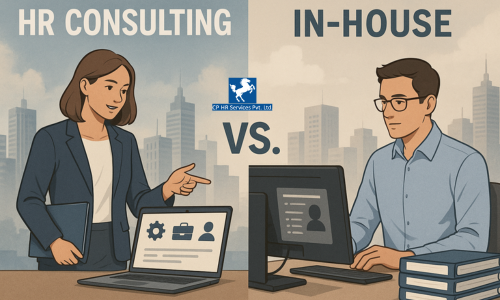
Picture this: It’s Monday morning, and your startup just landed its biggest client yet. Great news, right? Except now you need to hire 20 people in the next two months, set up payroll systems, draft employment contracts, and somehow ensure you’re compliant with labour laws. Your co-founder is frantically googling “how to write job descriptions” while you’re wondering if HR consulting vs. in-house is even a debate worth having at this stage. If this sounds familiar, you’re not alone. Every growing business in India faces this crossroads – should you build an internal HR team or partner with external HR consultants? The decision impacts everything from your budget to company culture, and frankly, there’s no one-size-fits-all answer. Let’s break down both models so you can make an informed choice that actually makes sense for your business. What is In-House HR vs. HR Consulting? In-house HR means having dedicated HR professionals as full-time employees within your organisation. They’re physically present, know your company inside out, and handle everything from recruitment to employee relations on-site. HR consulting, on the other hand, involves partnering with external specialists who provide HR services as needed. Think of them as your HR Consulting on-demand they bring expertise without the full-time commitment. The choice between these models isn’t just about cost (though that matters). It’s about finding the right fit for your business stage, industry, and growth plans. Benefits of In-House HR Teams Deep Company Knowledge and Culture Integration Your in-house HR team lives and breathes your company culture daily. They understand the quirks, the unspoken rules, and what makes your employees tick. When Rajesh from accounts has a conflict with Priya from marketing, your internal HR person knows the history, personalities, and the best approach to resolve it. This intimate knowledge becomes invaluable during: Immediate Availability and Dedicated Focus Need to discuss a sensitive issue? Your in-house HR is just a desk away. There’s no appointment booking, no waiting for callbacks, and certainly no worrying about whether they’ll be available during your crisis. Benefits include: Long-term Strategic Planning In-house teams are invested in your company’s future. They’re planning your workforce needs for the next quarter, next year, and beyond. They understand your business cycles, seasonal hiring patterns, and can anticipate HR needs before they become urgent. Advantages of HR Consulting Services Cost-Effective Expertise Access Here’s the reality check hiring a senior HR professional in Mumbai or Bangalore can cost you ₹8-15 lakhs annually, plus benefits. Add junior HR staff, training costs, and software subscriptions, and you’re looking at a significant investment. HR consulting vs. in-house cost comparison often favours consulting, especially for smaller businesses. You get access to senior-level expertise without the full-time price tag. Specialized Knowledge and Industry Best Practices HR consultants work with multiple companies across various industries. They’ve seen what works, what doesn’t, and what’s trending. When labour laws change (and they do frequently in India), your consultant is already updated and compliant. Key advantages: Scalability and Flexibility Your startup might need intensive recruitment support this month but only basic payroll management next month. HR consultants offer this flexibility without you having to hire and fire based on fluctuating needs. Objective, Unbiased Perspective Sometimes you need an outsider’s view. HR consultants can provide honest feedback about your company practices, identify blind spots, and suggest improvements without office politics getting in the way. Discover the Top 10 HR Consulting Firms in India that excel in recruitment, strategy, and workforce solutions for business growth. When to Choose In-House HR Company Size and Growth Stage Optimal for companies with 50+ employees Once you hit this threshold, the volume of HR activities typically justifies a full-time person. You’ll have enough recruitment, employee relations, and administrative work to keep someone busy. Stable, established businesses If your hiring patterns are predictable and your processes are established, an in-house team can manage day-to-day operations efficiently. Industry-Specific Requirements Some industries have unique compliance requirements, union relationships, or cultural considerations that benefit from dedicated, internal expertise. Examples include: Strong Company Culture Focus If your company culture is your competitive advantage, having someone internally dedicated to nurturing and protecting it becomes crucial. When HR Consulting Makes More Sense Startups and Small Businesses (Under 50 Employees) The HR consulting vs. in-house debate often leans towards consulting for smaller companies. You get professional expertise without the overhead of a full-time salary, benefits, and office space. Project-Based Needs Need to implement a new performance management system? Planning a major restructure? These intensive, short-term projects are perfect for consultants who can dedicate focused time without long-term commitment. Rapid Growth Phases When you’re scaling quickly, external support can help you build processes, hire rapidly, and maintain compliance without getting overwhelmed. Cost Constraints Let’s be honest cash flow matters. If budget is tight but you still need professional HR support, consulting offers a middle ground. Hybrid Approach: Best of Both Worlds Many smart companies don’t choose sides – they blend both models strategically. Common hybrid setups: This approach works particularly well for mid-sized companies (50-200 employees) who want dedicated support but also need access to specialized expertise. How CP HR Services Bridges the Gap When evaluating the HR consulting vs. in-house decision, partnering with an experienced consultancy can provide the best of both worlds. Since 2006, CP HR Services has been helping companies find the right talent and individuals find the right direction in their careers, offering a comprehensive suite of HR solutions that adapt to your business needs. What sets CP HR Services apart is their holistic approach. They support businesses with hiring, employee verification, and HR Consulting Services in Pune, while also providing career counselling and online education choices. This means whether you need immediate recruitment support, background verification for new hires, or strategic HR consultation, you get consistent service from a team that understands the Indian business landscape. Their model works particularly well for companies caught in the HR consulting vs. in-house dilemma. You can start with their consulting services to establish processes and handle